
Join us in celebrating National Translation Month with these queer novels translated into English! Looking for non-English translations of English works? Click here for MG/YA and here for Adult fiction.
Middle Grade
Cross My Heart and Never Lie by Nora Dåsnes, translated from Norwegian by Matt Bagguley
 Tuva is starting seventh grade, and her checklist of goals includes: writing out a diary, getting a trendy look, building the best fort in the woods with her BFFs, and much more. But when she starts school, nothing is how she hoped it would be.
Seventh grade has split her friends into rival factions: TEAM LINNEA and the girls who fall in love and TEAM BAO and the girls who NEVER fall in love. Linnea has a BOYFRIEND, Bao hates everything related to love. Worst of all, Linnea and Bao expect Tuva to choose a side!
In this delighfully hand-lettered coming-of-age graphic diary, Tuva gets caught between feeling like a kid and wanting to know HOW to become a teenager. Then Miriam shows up and suddenly Tuva feels as if she’s met her soulmate. Can you fall in love with a girl, keep it from your friends, and survive? For Tuva, it may be possible, but it’s defintely not easy.
Young Adult
Where We Go From Here by Lucas Rocha, translated from Brazilian Portuguese by Larissa Helena
 Ian has just been diagnosed with HIV.
Victor, to his great relief, has tested negative.
Henrique has been living with HIV for the past three years.
When Victor finds himself getting tested for HIV for the first time, he can’t help but question his entire relationship with Henrique, the guy he has-had-been dating. See, Henrique didn’t disclose his positive HIV status to Victor until after they had sex, and even though Henrique insisted on using every possible precaution, Victor is livid.
That’s when Victor meets Ian, a guy who’s also getting tested for HIV. But Ian’s test comes back positive, and his world is about to change forever. Though Victor is loath to think about Henrique, he offers to put the two of them in touch, hoping that perhaps Henrique can help Ian navigate his new life. In the process, the lives of Ian, Victor, and Henrique will become intertwined in a story of friendship, love, and stigma-a story about hitting what you think is rock bottom, but finding the courage and support to keep moving forward.
Set in Rio de Janeiro, Brazil, this utterly engrossing debut by Brazilian author Lucas Rocha calls back to Alex Sanchez’s Rainbow Boys series, bringing attention to how far we’ve come with HIV, while shining a harsh light on just how far we have yet to go.
Buy it: Bookshop | Amazon | B&N
London on My Mind by Clara Alves, translated from Brazilian Portuguese by Nina Perrotta
 Sixteen-year-old Dayana has always dreamed of visiting London — to walk along the Thames, take pictures outside Buckingham Palace, and maybe even get a glimpse of Arthur, Prince of Wales, whose marriage has been all over tabloids. But the trip of her dreams turns into a royal nightmare when her mother passes away. Now, Day must leave Rio de Janeiro to live with her estranged father and his new family in London.
As it turns out, the U.K. isn’t exactly Day’s cup of tea. She struggles to forgive her father for walking out on her and her mom all those years ago; fights with her stepsister constantly; detests her stepmother; and she can’t even see One Direction in concert because they’ve been broken up for ages. All she wants to do is trade the rainy skies of London for the sun and beaches of Rio.
That’s when she runs into the girl of her dreams — literally: The coincidentally named Diana, a witty, funny, redhead who was in the middle of . . . escaping Buckingham Palace? Something isn’t right here, but it makes Diana all the more alluring. As time passes, and the two girls grow closer, Day can’t help but wonder if there is more than a little truth to the rumors surrounding Prince Arthur — and if Diana might be involved somehow. Is it all in her head, or could Day be caught up in a real-life royal scandal?
Here the Whole Time by Vitor Martins, translated from Brazilian Portuguese by Larissa Helena
 What would you do if you had to spend the next 15 days with your lifelong crush?
Felipe gets it — he’s fat. Not chubby. Not big-boned. Fat. And he doesn’t need anyone to remind him, which is, of course, what everyone does. That’s why he’s been waiting for this moment ever since the school year began: school break. Finally, he’ll be able to spend some time far away from school and the classmates who tease him incessantly. His plans include catching up on his favorite TV shows, finishing his to-be-read pile, and watching YouTube tutorials on skills he’ll never actually put into practice.
But things get a little out of hand when Felipe’s mom informs him that Caio, the neighbor kid from apartment 57, will be spending the next 15 days with them while his parents are on vacation. Felipe is distraught because A) he’s had a crush on Caio since, well, forever, and B) Felipe has a list of body image insecurities and absolutely NO idea how he’s going to entertain his neighbor for two full weeks.
Suddenly, the days ahead of him that once promised rest and relaxation (not to mention some epic Netflix bingeing) end up bringing a whirlwind of feelings, forcing Felipe to dive head-first into every unresolved issue he has had with himself — but maybe, just maybe, he’ll manage to win over Caio, too.
Buy it: Bookshop | Amazon | B&N
Adult Fiction
Fathers and Fugitives by S.J. Naudé, translated from Afrikaans by Michiel Heyns
 Daniel is a worldly and urbane journalist living in London. His relationships appear to be sexually fulfilling but sentimentally meager. A young gay man with no relationships outside of sexual ones, he can seem at once callow and, at times, cold to the point of cruel with his lovers. Emotionally distant from his elderly, senile father, Daniel nonetheless returns to South Africa to care for him during his final months. Following his father’s death, Daniel learns of an unusual clause in the old man’s will: he will only inherit his half of his father’s considerable estate once he has spent time with Theon, a cousin whom he hasn’t seen since they were boys, who lives on the old family farm in the Free State. Once there, Daniel discovers that the young son of the woman Theon lives with is seriously ill. With the conditions bearing on Daniel’s inheritance shifting in real time, Theon and Daniel travel with the boy to Japan for an experimental cure and a voyage that will change their lives forever.
Selamlik by Khaled Alesmael, translated from Arabic by Leri Price
 Furat, a Syrian in his early 20s, visits Sibki Park in Damascus, one of the city’s most popular cruising areas. There he learns about the hammams, secret meeting places for gay men located throughout the old city. Inside these public baths, the air is thick with the scent of bay laurel soap, and naked men hide in the steam. Furat faces sometimes violent disapproval from all levels of society—regime, religion, the man in the street—and yet he manages to find the love he’s been seeking just before his world collapses and he’s forced to flee. Selamlik is the story of Furat’s journey, along with that of other refugees. It’s a journey in which they face physical and economic hardship, draconian migration laws, and the unwelcome grief, shame, and hatred they’ve carried with them from their ever more distant pasts. Despite everything, Furat remains steadfast in his pursuit of passion, pleasure, and love.
Boulder by Eva Baltasar, translated from Catalan by Julia Sanches
 Working as a cook on a merchant ship, a woman comes to know and love Samsa, a woman who gives her the nickname “Boulder.” When Samsa gets a job in Reykjavik and the couple decides to move there together, Samsa decides that she wants to have a child. She is already forty and can’t bear to let the opportunity pass her by. Boulder is less enthused, but doesn’t know how to say no―and so finds herself dragged along on a journey that feels as thankless as it is alien.
With motherhood changing Samsa into a stranger, Boulder must decide where her priorities lie, and whether her yearning for freedom can truly trump her yearning for love.
Napalm in the Heart by Po Guash, translated from Catalan by Mara Faye Lethem
 In a near future devastated by war and unspecified natural disaster, a young man and his mother cling to survival at the edge of a forest. Society is militarized and dangerous, with men with shaved heads patrolling the land as families are uprooted and nature is all but decimated. The young man spends his days helping his mother, who is traumatized from her experience working in the ominous Factory, and exchanging letters with his lover, Boris, who lives in a city on the other side of the forest. It’s barely a life, but it’s life nonetheless.
After a brutal act of desperate violence and the arrival of armed men at their doorstep, the young man leaves his mother and finds Boris, who travels with him through the forest to the city. Escaping slavers and trekking through the empty landscape, the two find moments of intimacy despite their circumstances. But as their survival comes with increasingly violent demands, the young man is forced to confront whether, in his effort to stay alive, he’s become the very thing he’s fought to escape.
Sons, Daughters by Ivana Bodrožić, translated from Croatian by Ellen Elias Bursać
 Here the Croatian poet and writer depicts a wrenching love between a transgender man and a woman as well as a demanding love between a mother and a daughter in a narrative about breaking through and liberation of the mind, family, and society.
This is a story of hidden gay and trans relationships, the effects of a near-fatal accident, and an oppressed childhood, where Ivana Bodrožić tackles the issues addressed in her previous works—issues of otherness, identity and gender, pain and guilt, injustice and violence.
A daughter is paralyzed after a car crash, left without the ability to speak, trapped in a hospital bed, unable to move anything but her eyes. Although she is immobilized, her mind reels, moving through time, her memories a salve and a burden. A son is stuck in a body that he doesn’t feel is his own. He endures misperceptions and abuse on the way to becoming who he truly is. A mother who grew up being told she was never good enough, in a world with no place for the desires and choices of women. She carries with her the burden of generations.
These three stories run parallel and intertwine. Three voices deepen and give perspective to one another’s truth, pain, and struggle to survive.
Change: A Method by Edouard Louis, translated from French by John Lambert
 An autobiographical novel from the international bestselling author Édouard Louis—about success, transformation, and the perils of leaving the past behind.
One question took center stage in my life, it focused all of my thoughts and occupied every moment when I was alone with myself: how could I get this revenge, by what means? I tried everything.
Édouard Louis has received international acclaim for his vivid, unflinching accounts of poverty and homophobia in his autobiographical novels, such as A Woman’s Battles and Transformations and The End of Eddy. Now, in Change: A Method, he turns his keen eye upon himself, investigating his youth like never before: the people he idolized and emulated, the manners he adopted to blend in at elegant tables, the daily and nightly jobs he undertook to make a living, the injuries of the past and the impossibility of escape.
A question pulses, urgent and demanding: “Am I doomed always to hope for another life?” Louis mines emotion, true and deep to the core, as he addresses past friends, lovers, and selves, and attempts to belong, to be loved, to succeed, and—at all costs—to change.
The Night of Baba Yaga by Akiro Otani, translated from Japanese by Sam Bett
 Tokyo, 1979. Yoriko Shindo, a workhorse of a woman who has been an outcast her whole life, is kidnapped and dragged to the lair of the Naiki-kai, a branch of the yakuza. After she savagely fends off a throng of henchmen in an attempt to escape, Shindo is only permitted to live under one condition: that she will become the bodyguard and driver for Shoko Naiki, the obsessively sheltered daughter of the gang’s boss.
Eighteen-year-old Shoko, pretty and silent as a doll, has no friends, wears strangely old-fashioned clothes, and is completely naive in all matters of life. Originally disdaining her ward, Shindo soon finds herself far more invested in Shoko’s well-being than she ever expected. But every man around them is bloodthirsty and trigger-happy. Shindo doubts she and Shoko will survive much longer if nothing changes. Could there ever be a different life for two women like them?
Walking Practice by Dolki Min, translated from Korean by Victoria Caudle
 After crashing their spacecraft in the middle of nowhere, a shapeshifting alien find themself stranded on an unfamiliar planet and disabled by Earth’s gravity. To survive, they will need to practice walking. And what better way than to hunt for food? As they discover, humans are delicious.
Intelligent, clever, and adaptable, the alien shift their gender, appearance, and conduct to suit a prey’s sexual preference, then attack at the pivotal moment of their encounter. They use a variety of hunting tools, including a popular dating app, to target the juiciest prey and carry a backpack filled with torturous instruments and cleaning equipment. But the alien’s existence begins to unravel one night when they fail to kill their latest meal.
Thrust into an ill-fated chase across the city, the alien is confronted with the psychological and physical tolls their experience on Earth has taken. Questioning what they must do to sustain their own survival, they begin to understand why humans also fight to live. But their hunger is insatiable, and the alien once again targets a new prey, not knowing what awaits. . . .
Taiwan Travelogue by Yáng Shuang-zi, translated from Mandarin Chinese by Lin King
 May 1938. The young novelist Aoyama Chizuko has sailed from her home in Nagasaki, Japan, and arrived in Taiwan. She’s been invited there by the Japanese government ruling the island, though she has no interest in their official banquets or imperialist agenda. Instead, Chizuko longs to experience real island life and to taste as much of its authentic cuisine as her famously monstrous appetite can bear.
Soon a Taiwanese woman—who is younger even than she is, and who shares the characters of her name—is hired as her interpreter and makes her dreams come true. The charming, erudite, meticulous Chizuru arranges Chizuko’s travels all over the Land of the South and also proves to be an exceptional cook. Over scenic train rides and braised pork rice, lively banter and winter melon tea, Chizuko grows infatuated with her companion and intent on drawing her closer. But something causes Chizuru to keep her distance. It’s only after a heartbreaking separation that Chizuko begins to grasp what the “something” is.
Wound by Oksana Vasyakina, translated from Russian by Elina Alter
 From one of Russia’s most exciting new voices, Wound follows a young lesbian poet on a journey from Moscow to her hometown in Siberia, where she has promised to bury her mother’s ashes. Woven throughout this fascinating travel narrative are harrowing and at times sublime memories of her childhood and her sexual and artistic awakening. As she carefully documents her grief and interrogates her past, the narrator of Oksana Vasyakina’s autobiographical novel meditates on queerness, death, and love and finds new words for understanding her relationship with her mother, her country, her sexuality, and her identity as an artist.
A sensual, whip-smart account of the complicated dynamics of queer life in present-day Siberia and Moscow, Wound is also in conversation with feminist thinkers and artists, including Susan Sontag, Louise Bourgeois, and Monique Wittig, locating Vasyakina’s work in a rich and exciting international literary tradition.
Bad Habit by Alana S. Portero, translated from Spanish by Mara Faye Lethem
 “I saw a whole generation of boys fall like irredeemable angels.”
Told in the heartrending voice of a girl trapped within the body of a boy, Bad Habit is a story of coming-of-age in working class Madrid–in a godforsaken neighborhood ironically named after a saint. Alana S. Portero’s spunky protagonist struggles to make sense of herself and the world she inhabits, conveying her surroundings with mythic allusions and a poetic vitality absent from everyday life.
Set against the heroin epidemic that ravaged Madrid in the 1980s and the city’s vibrant party scene that dominated its nightlife in the 1990s, Bad Habit follows Portero’s unnamed protagonist as she grows up in a blue-collar suburb that has no place for her. Forging ahead, she discovers community and kinship in downtown Madrid, amid a lively party scene animated by junkies, pop divas, and fallen angels. But with each step she takes forward, she finds herself confronted by a violence she does not yet know how to counter; in this exciting, often terrifying, world each choice can truly be a matter of life and death.
Thirst by Marina Yuszczuk, translated from Spanish by Heather Cleary
 It is the twilight of Europe’s bloody bacchanals, of murder and feasting without end. In the nineteenth century, a vampire arrives from Europe to the coast of Buenos Aires and, for the second time in her life, watches as villages transform into a cosmopolitan city, one that will soon be ravaged by yellow fever. She must adapt, intermingle with humans, and be discreet.
In present-day Buenos Aires, a woman finds herself at an impasse as she grapples with her mother’s terminal illness and her own relationship with motherhood. When she first encounters the vampire in a cemetery, something ignites within the two women—and they cross a threshold from which there’s no turning back.
The Hormone of Darkness by Tilsa Otta, translated from Spanish by Farid Matuk (October 15, 2024)
 We can go on like that forever
building paradise from our urges
out of our fetishes our loves our vices
How lucky
We’ll wait for you then
Don’t be too long
Bookmark the page
We’ll be Here
—From “The New Heaven”
In Tilsa Otta’s The Hormone of Darkness, we find a queer, Latinx person who has lived through iterations of authoritarian rule, and who answers these conditions by creating poetry that doubles down on a life force that precedes and exceeds received notions of the poetic. Here poetry is bawdy, fabulist, and spiritual—in short, it is alive. Otta has created a heaven where readers can go after they die.
Drawing from four volumes spanning Otta’s career, translator-poet Farid Matuk has curated a playlist we can dance and dream to, one that honors Otta’s drive toward liberation through both perreo in the club and transdimensional wandering among the stars.
Antiquity by Hanna Johansson, translated from Swedish by Kira Josefsson
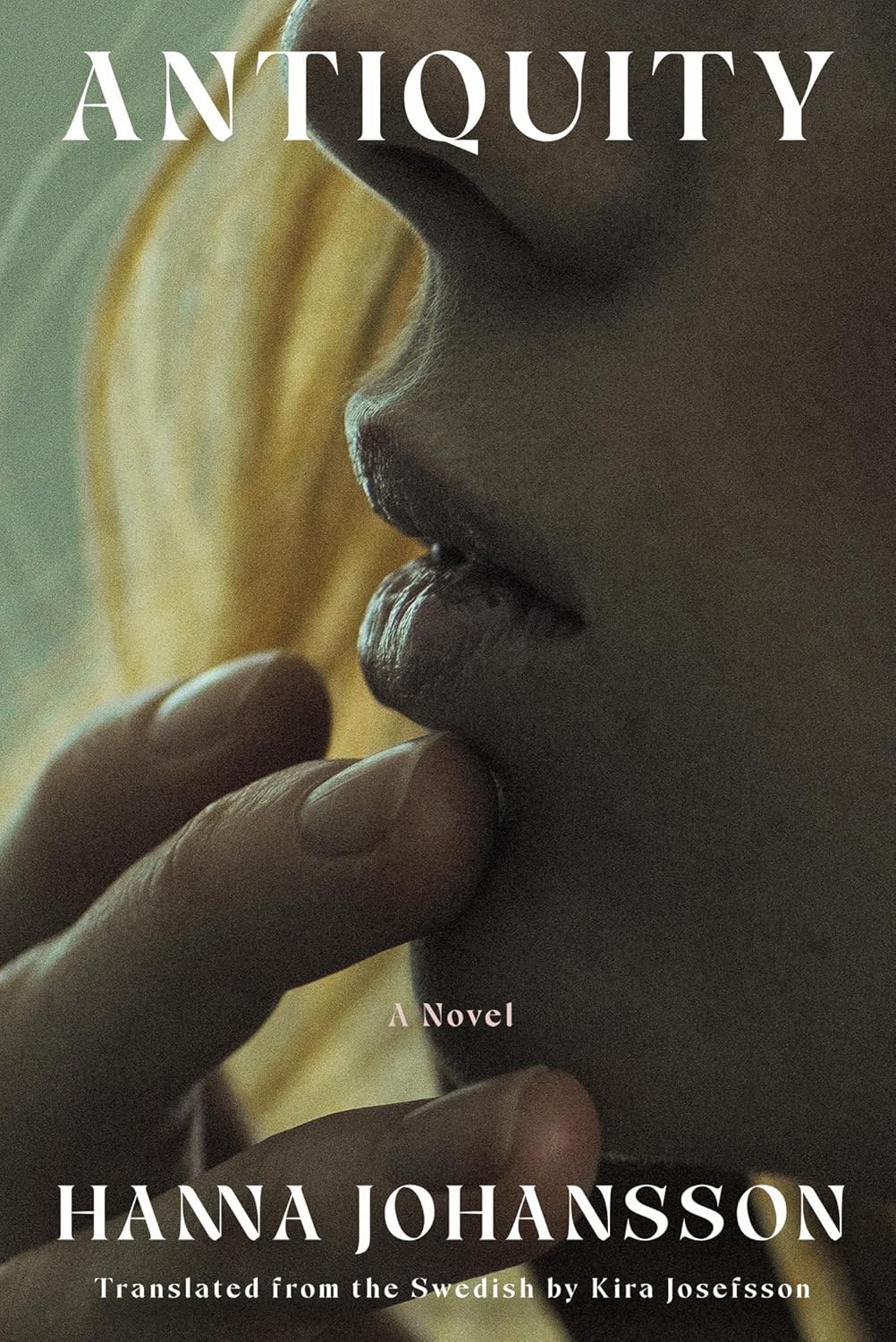 On a Greek island rich with ancient beauty, a lonely woman in her thirties upends the relationship between a mother and her teenage daughter. Lust and admiration for Helena, a chic older artist, brings Antiquity’s unnamed narrator to Ermoupoli, where Helena’s daughter, Olga, seems at first like an obstacle and a nuisance. But the unpredictable forces of ego and desire take over, leading our narrator down a more dangerous path, and causing the roles of lover and beloved, child and adult, stranger and intimate to become distorted. As the months go by, the fragile web connecting the three women nears rupture, and the ominous consequences of their entanglement loom just beyond a summer that must end.
