
Today on the site I’m delighted to present three authors in conversation! Eve Gleichman and Laura Blackett are the coauthors of Trust & Safety (more on the book below), and they’re here to chat with Yael van der Wouden, author of the Booker Prize-shortlisted The Safekeep, about their new releases, cowriting, crafting sex scenes, and more!
Eve: Hi Yael! Hi Laura! How does it feel to be inside a Google Doc together?
Yael: Both familiar and brand new! I used to write with gdocs ALL the time, and then get friends in to edit–but the live chat thing is interesting. Is this how you two usually work, is this old news to you? I am very much looking around big eyed.
Eve: We do work in Google Docs! Usually not at the same time, thankfully. Did you write your novel in a g-doc? And did your friends get to edit?
Yael: My very first attempt at a baby novel, YES. And then I’d get some friends in and let them both edit and leave behind comments and oh my god the Christmas morning (I assume, raised very Jewish here) feeling of getting comment notifications as people get further and further into the story. And getting to see exactly where your reader is, which page, which paragraph–like, that’s not a power I think a writer SHOULD have but it sure was a power I enjoyed for a hot second back then.
Laura: I remember that feeling from when we first sent drafts to our editor! Also, when Eve and I work together, the best feeling is getting a notification that a new chapter has dropped! My favorite content.
Yael: So I’m super curious–and I know this question must have been asked a million times before, but if you’d indulge me–I’d love to hear about your first experiment writing together and how that went if you knew immediately, ‘yes, this is someone I can WRITE with.’
 Laura: We were friends for a long time before we started to write together. We lived in the same apartment building, and shared meals together and told each other a lot of stories about our lives and our schools and workplaces. So I think we had a sense of our compatibility as friends, and we knew that it was fun to hang out and talk about things together. I wish I could remember the moment when we decided to give writing a try, but I don’t. I know it felt risky and fun. Also, I wasn’t coming from a literary background, so the idea of co-writing a novel with Eve was just as unexpected as writing one alone.
Eve: I’m just thinking about what Laura’s saying here and what you said above about giving your friends access to your work, Yael—about how people are always really interested in the co-writing process/experience, but most writers are doing the same thing that we did! There’s so much collaboration happening even if there’s only one name on the book.
Yael: Oh my gosh, yes. I’ve had people comment on my 3-page acknowledgement section. And okay, yes, I literally thank every single person I’ve ever met from my students to my landlord, but also, it was genuinely a project where so many people were involved, at least for me. When I finish a first draft, I send it to three initial writers. I process their feedback, and then it goes to another three people, different people, and I do that about six to nine times, depending on how rough the draft is. That’s–that’s a lot of people! Who I should probably pay for doing that! God bless them!
Eve: Does it ever feel like too many cooks in the kitchen? What happens when there’s a disagreement between your readers?
Laura: And how do you pick your first readers?
Yael: Oh that’s a good question. First readers are people who will know what I’m working on and who I trust with my heart and my life because that’s what a first draft feels like–like it’s my heart and my life on the line. They’re people who will give me the most solid baseline feedback. This character doesn’t work. This chapter needs expanding or cutting. Then, after those, it’s people with different backgrounds to mine, different languages, to see if the story is felt beyond my own narrow scope of the world . . . Then it’s people whose taste I value, people whose opinion I want on one SUPER specific topic, and on it goes!
Once it starts feeling like too many cooks in the kitchen, that’s usually when the meal is done I think… and yes, there’s always disagreement, but that’s good. If my readers disagree then that means I’ve written something that can be interpreted in different ways, which usually means there’s an emotion attached–most people felt a very certain way about the ending, for example. My mom is an artist, and some of her art is abstract, and she often gets people who get angry at it, you know, ‘my kid could’ve drawn that!!’ type of thing, and she always says: well at least I got a REACTION out of them. She dislikes it very much when the response is a mild, ‘that’s a nice painting’. She’d rather people dislike it than call it ‘nice’. I’ve tried to carry that over into my work as well, the conviction that an audience’s disagreement isn’t a bad thing, but an interesting thing.
Eve: Is your mom one of your readers?
Yael: Hahaha nooo she gets to read it once it’s done. Is either of yours?
 Laura: My mom did read an early draft of our first book, and she loved it and was very sweetly supportive in the best way she knew how, which was to start a new Word Doc where she made a bulleted list of typos, copy-editor style. It was less critical than it sounds, I think she truly wanted to help out.
Eve: I forgot about this, and love so much that she did that.
Yael: Mom!! That’s so recognizable. My dad’s two comments were, ‘It was very good’ and ‘There’s a mistake on page 167’. It’s sweet, they want us to succeed.
Laura: You say that giving people drafts of our novels feels like handing over your heart and your life– how do you think about (or don’t think about) incorporating things from your life and relationships into your work? How do people in your world react to your work? Do they see themselves in it?
Yael: God, it’s a bit inevitable, isn’t it? Even in writing about the 60s and about two women who are so, so different from me, you can’t help it–a painting your grandparents owned creeps in, or that rant you give everyone about siblings, or bad thoughts that won’t leave you. You can give them to a character in the hope of exorcizing them. Isabel, for example, is so, so cynical about love and what’s the point of love, if it only makes you more miserable when it leaves. That’s me at 3am after too many wines and too many coffees and then I watch a sad movie and see a text from an old friend and there you go, it’s bawling time. So I stuffed that into Isabel’s monologue with this idea of, off you go Isabel, take it away from me. A lot of friends who read my book say they hear my voice in it, that it sounds like me, which is both nice and also terrifies me. How is that for you? Because I can imagine people try to pick out your individual voices, or try to guess what was written by whom, which probably doesn’t quite work like that, right? Or does it?
Eve: That is fascinating about Isabel being an outlet for painful feelings. I wonder if we did that with Rosie a bit, too. She’s kind of harsh and judgmental, and she doesn’t know what she wants. I’ve certainly felt that way before and I think there’s a little bit of me in all the characters—even Rosie’s cis hetero husband, Jordan—I’m not sure if Laura feels the same way. People always want to know who wrote which part, but the truth is we both had our hands in every scene, every sentence—the metaphors, even punctuation.
Laura: I do see myself in some ways in all the characters. And yeah, people really want to know who wrote which parts. I hear from people that parts of the book remind them of me or experiences we’ve had. Eve, do people say that sort of thing to you, that they can feel you in it?
Eve: Yes! And sometimes they incorrectly guess that I conceived of an idea or scene.
Laura: I think one of the trippy parts about co-authoring and something that can be a struggle is to understand or appreciate my individual contributions to something that comes out to be so much more than the sum of its parts. There’s character, plot, and the actual sentences in the end. By the end of writing a book I don’t know what a book is anymore!
Eve: It’s like staring at a painting too long or something.
Yael: Speaking of character plot and the actual sentences–one of the things I thought was SO clever about the novel is how you set it up like a classical romance for a hot second, but it’s really not. We root for the main pairing but then, as time goes on and everyone turns out to be flawed in exhausting ways, we kind of . . . don’t, anymore? And then when the third act rolls in, the fact that we don’t get what we thought we wanted is almost a relief and just a fucking rollicking ride. I was hoping you’d tell me a bit about how romance, as a genre or a diverted goal or a theme was part of the conversation when you started dreaming up the novel!
Eve: You know, I don’t think we were ever really thinking in terms of genre except that at the beginning of writing the book, we thought we were writing a thriller (which was also the case for our first book). It turned out to not be a thriller, really, at least not in the usual sense of the word. But I loved the idea of starting the novel with a wedding—and in fact, when we first started writing the book, we each separately wrote a first chapter, and both of us started off the book with Rosie and Jordan’s wedding. There was something really sinister and exciting about beginning a book with this very recognizable commitment between two people; you sort of know it can only go downhill from there.
Laura: It is interesting to remember that our first novel started with someone who was totally alone, and our second with a “happy” couple. We knew that we were going to take something apart with our second book, and starting with a wedding seemed like the best place to begin.
Yael: Oh, I can so see the book as a thriller, and I can also see how it ended up being what it is. There IS something deeply unsettling about the happy new couple moving out to the countryside and then all the sexy weirdos creep in. I recently watched Rocky Horror with my girlfriend–my personal Original Sexual Awakening movie–because she’d never seen it before, and I was watching it going, yep. Whacky queerness in the countryside. It’s a thing I imprinted on.
Laura: One thing we were very clear on from the start is that we wanted our protagonists to move from straight-land to gay-land. We wanted everyone they met in the country to be queer, and for them to be in a different world than what they were used to.
Yael: I kept thinking about it as a queer coming of age novel mashed together with a disenchantment with home ownership in your thirties novel!! I do think there’s a very real connection between queerness and belonging in space, the fantasy of finding your ‘true’ identity in finding your ‘true’ home, and I LOVED how it all–without giving the ending away–fell apart in a far more chaotic, not straight-forward way in Trust and Safety. Like, the fantasy of the home is a farce, but also the fantasy of the perfect relationship is a farce–both in the straight and in the queer world, it seems.
Eve: Yael, can we talk about your extremely (fire emoji) sex scenes?
Yael: Hahaha absolutely we can. Where would you like to start?
Laura: I’m curious if you like writing sex scenes, and how you think of their role in the novel? And what you think makes a good sex scene!
 Yael: They’re the most fun to write! A lot of my plotting revolves around, okay, what needs to happen between these two people for them to go from disliking to desiring each other, from desiring to acting, from acting to longing. And each step of the way heightens the tension. So by the time I get to break that tension, which I also had to sit in for over a hundred pages, it’s very much a reward. And because so much of the character development–at least in The Safekeep–in the first two parts hinges on how the tension changes Isabel’s sense of self, I hope that the sex scenes feel integral to the plot, and not gratuitous. But even if they are gratuitous, fuck it, the girls deserve to have some fun. This was my mantra while writing. Let them have some fun!! That was the working title for that chapter, chapter 10, by the way. “Let the lesbians have some fun.”
Eve: I love that. When Isabel and Eva finally get together (is this a spoiler? I don’t care!) I was reminded of the first sex scene in Desert Hearts. You created this embittered, reserved character who despite her best attempts can’t seem to stop longing for Eva. So when they do get together it’s a huge relief to see Isabel let go and give in to her desire. It was incredibly hot!
Yael: I noticed that with all the tension you’d built, a lot of the sex in Trust & Safety was told in retrospect, and a bit obscured. Which I thought worked very well with the whole ‘fantasy vs reality’ theme you had going–was that the plan all along, or was something else driving the decision making there?
Laura: Writing the sex scenes in Trust & Safety felt risky and exposing! There wasn’t much sex in our first novel so I think we were trying something new. First drafts were more explicit and graphic, and then in revision I think we couldn’t help but obscure it a bit. I know that I asked myself often what the purpose of the sex scene was– was it for fun or entertainment or was it really working for the story. At times I didn’t really care and just wanted them to hook up already! One thing I do remember is a disagreement we had about feelings of urgency during sex– whether something more urgent or languorous was hotter or more appropriate for the moment.
Yael: So what did you end up settling on—urgency or languorous sex? I can so see either having the desired effect, depending on the scene and depending on the journey the characters took to get there… Trying to think of a hot slow scene from a novel or a movie.
Laura: It’s hard to remember, but I think we probably leaned into the urgency. But then again if you think of the sex starting earlier, there’s a lot of tension that we built between Rosie & Dylan that I’m privately considering part of their eventual sex scenes.
Eve: By the time Rosie and Dylan hook up, we’ve seen a lot of her sex with Jordan, and we wanted to create a contrast. The sex she has with Jordan is all about his pleasure, and the sex she has with Dylan is about hers.
Yael: Oh I was super invested in Rosie and Dylan when we got to that scene and I just about screamed when it faded to black. But also, somehow, it made it hot too–it’s that voyeurship we’re forced into then, as readers, we are reminded that we’re watching something private. I think that was also the contrast between Rosie & Dylan vs Rosie & Jordan – the one felt like we were a camera in the room, just observing without many feelings, and the other we really felt like readers who were invested in the outcome. It was very effective. I very much felt the her pleasure vs his pleasure theme, it was so well done, which is why the ending fucked me UP (in a good way).
Eve: I think something similar was happening in The Safekeep. We see Isabel’s male suitor growing more and more insistent that she be with him, even though it’s so clear she has no desire for him. He doesn’t care—it’s all about his desire; hers never occurs to him! Having this undesirable man in the mix makes the romantic scenes between the women so incredibly satisfying. She’s taking what she wants, despite him, and what she wants is secret, and we’re in on it.
Yael: You know I’ve been thinking about this a lot, also in starting to draft the next novel, how difficult it can be to come to understand want when you’re been socialised as a woman in a world that centres men’s desires. I’m working on this character now who comes into desire in the most roundabout way: she sees her husband desire another woman, and comes to desire that woman, too, through his gaze. I think about that often, especially in writing queer desire, or bi-desire, the loopdeeloops we go through in trying to define what it is that we want. Did you always know for Rosie that she would have the identity crisis she has, also when the novel was still a maybe-thriller?
Eve: I think we didn’t really know what kind of character Rosie was in the beginning. We were really allied with her at first—but her lack of clarity becomes sort of disastrous, for her and for her husband. I don’t think we realized that would be the case at first. We grew to like her less and less.
Laura: That’s how I remember it too. I know that we wanted to give her the memory of a crush on a woman, which she could then use to question her identity and her choices. She has this hindsight hypothetical longing that she gets to use to call her whole life into question.
Yael: Does that mean that her denouement wasn’t planned? Did that happen as you were writing?
Eve: That’s right— we didn’t know really what was going to happen with Rosie until we were maybe halfway through writing the book, at which point it became inevitable. Did you know ahead of time how things would end with Isabel and Eva?
Yael: Aaahh, the inevitable Chekhov’s bear!! I loved that, by the way. The bear scene, followed by that terrible ‘u ok?’ text, will live in my brain forever, probably. I did know how it was going to end, yes. I outlined the whole novel before writing, most scenes were already pretty much formed. Now in the end, of course, I veer off the planned path many times. The details of the ending kept open for a long time, the specifics of where: park bench? Out in the street? They run into each other by accident?
Laura: It must have been so satisfying to follow through with the execution of the plan! That level of planning sounds very soothing to me.
Eve: It’s also so evident! As a reader I felt really taken care of by you, like I was in very sure hands. The ending totally gutted me. I had to take a couple hours away from my desk just to absorb the ending—it was so moving. I was so impressed by how you could execute this really sophisticated twist (no spoilers) with such a steady hand. I never felt manipulated or like —how do I say this— It felt the opposite of reckless! I was safe with you.
Yael: Ah you’re very kind!! I also love reading novels that feel reckless, though, where you don’t know where you’re heading but you’re doing it at high speed. I read Trust & Safety in two days and barely breathed until I got to the end. Though I recognise what you mean, I also enjoy that feeling–where you feel safe with a writer, where they know where they’re going and can’t wait to take you there. That’s what I wanted to do more than anything, make the reader feel secure in the story. It makes me so happy to talk to readers who felt that way! Now onto the terrifying process of trying to do that all over again.
***
Trust & Safety by Laura Blackett and Eve Gleichman
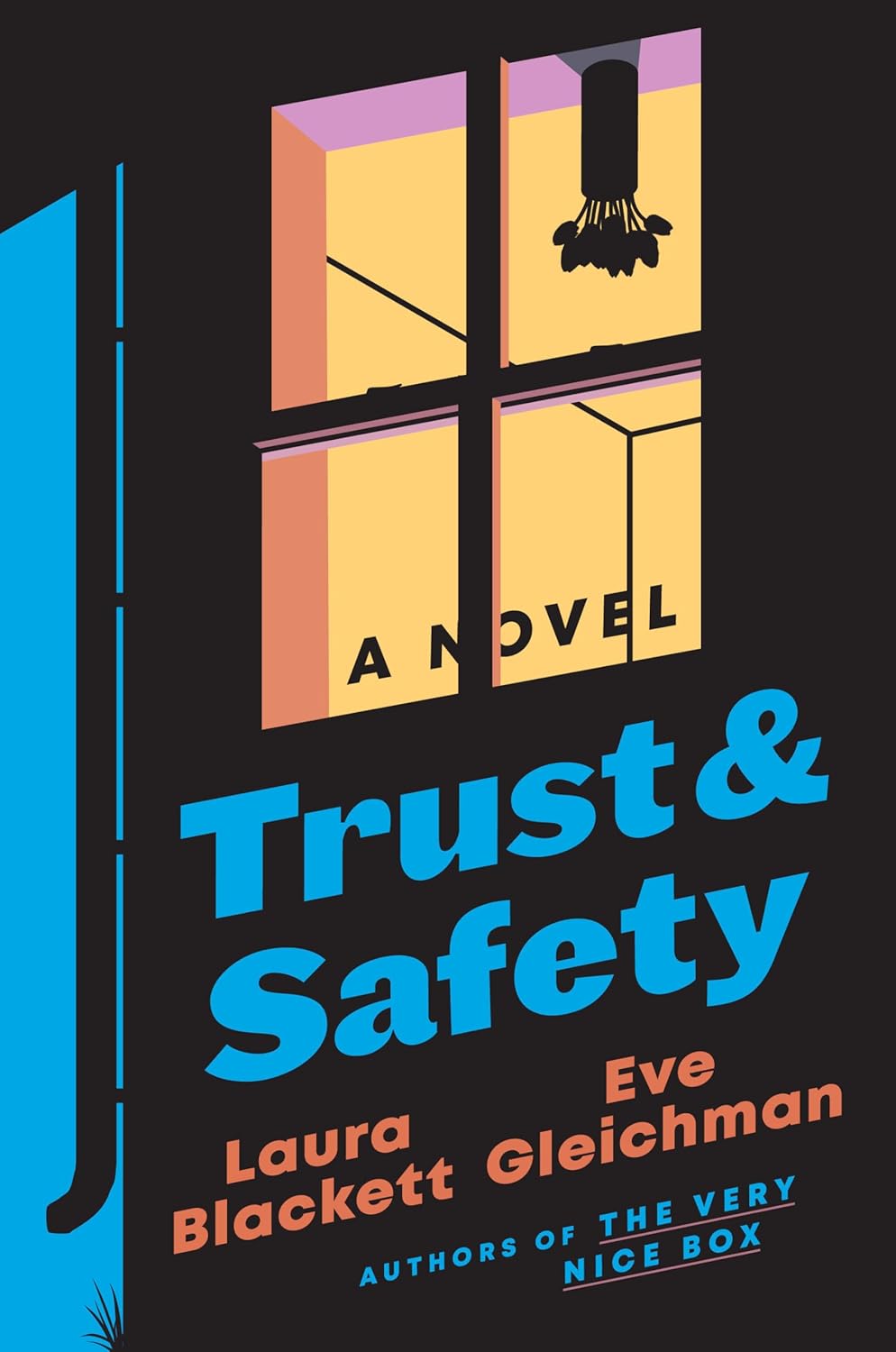 Newlywed Rosie has grown disenchanted with NYC. Inspired by Instagram ads, she starts thirsting for a rural life upstate—one full of beauty and authenticity. She just needs to convince her tech-bro husband, Jordan, of her vision for the future. Willing to do anything for Rosie’s happiness, Jordan signs on, and they offer—well above asking price—on a beautiful, historic fixer-upper in the Hudson Valley.
But when Jordan suddenly loses his job, the couple is forced to rent out the property’s dilapidated outbuilding. There’s no heat, it’s overrun with mold, and nothing works.
Enter Dylan and Lark: an incredibly attractive and handy queer couple who offer to rent the outbuilding and help Rosie and Jordan with repairs. They also happen to be living the life Rosie had envisioned for herself: hand-built furniture, herbal tinctures, guinea hens, and hand-dyed linens. Rosie grows increasingly infatuated with their new tenants, especially with model-esque, charismatic Dylan—to Jordan’s increasing distress.
The Safekeep by Yael van der Wouden
A house is a precious thing…
It is 1961 and the rural Dutch province of Overijssel is quiet. Bomb craters have been filled, buildings reconstructed, and the war is truly over. Living alone in her late mother’s country home, Isabel knows her life is as it should be—led by routine and discipline. But all is upended when her brother Louis brings his graceless new girlfriend Eva, leaving her at Isabel’s doorstep as a guest, to stay for the season.
Eva is Isabel’s antithesis: she sleeps late, walks loudly through the house, and touches things she shouldn’t. In response, Isabel develops a fury-fueled obsession, and when things start disappearing around the house—a spoon, a knife, a bowl—Isabel’s suspicions begin to spiral. In the sweltering peak of summer, Isabel’s paranoia gives way to infatuation, leading to a discovery that unravels all Isabel has ever known. The war might not be well and truly over after all, and neither Eva—nor the house in which they live—are what they seem.
