Today on the site, I’m thrilled to help celebrate the release of Briar Girls by Rebecca Kim Wells, a Sapphic YA reimagining of The Sleeping Beauty yours truly called “a tantalizingly dark and majestic fairy tale filled with love, betrayal, and the ways the two inevitably intersect.” The book releases today, and Rebecca’s here to talk about it with another of our favorite queer YA author Rebeccas, Rebecca Podos (From Dust, a Flame), who also happens to be her agent! But before we get to that, here’s a little more about Briar Girls:
 Lena has a secret: the touch of her skin can kill. Cursed by a witch before she was born, Lena has always lived in fear and isolation. But after a devastating mistake, she and her father are forced to flee to a village near the Silence, a mysterious forest with a reputation for luring people into the trees, never to be seen again…
Until the night an enigmatic girl stumbles out of the Silence and into Lena’s sheltered world. Miranda comes from the Gather, a city in the forest brimming with magic. She is on a quest to wake a sleeping princess believed to hold the key to liberating the Gather from its tyrannical ruler—and she offers Lena a bargain. If Lena assists her on her journey, Miranda will help her break the curse.
Mesmerized by Miranda and her promise of a new life, Lena jumps at the chance. But the deeper into the Silence she goes, the more she suspects she’s been lied to—about her family’s history, her curse, and her future. As the shadows close in, Lena must choose who to trust and decide whether it’s more important to have freedom…or power.
Buy it: Bookshop | Amazon | B&N | IndieBound

And now, I’m thrilled to welcome Rebecca Kim Wells and Rebecca Podos!
RKW: We’ve been working together for several years—since 2015! Back then the publishing landscape was very different, especially around diverse and queer stories. What was your agenting outlook at the time? And what drew you to pick Briar Girls out of your inbox?
RP: It was definitely a different landscape! On the one hand, the decade before 2015 was game-changing for queer representation in kidlit. We saw debut books published by authors who went on to change the conversation about was possible for queer YA, a genre that had previously been considered pretty niche. This industry can be truly frustrating in that it often demands “successful” (aka profitable) books within a certain subgenre or representing a certain group before justifying the purchase of future books which might have been the breakout successes. Still, publishing was slow to expand queer kidlit beyond L and G stories, and beyond white and able main characters. We’re still working on that! And as often happens when we talk about representation, the very first books on the shelf were stories of queer pain and trauma, usually as a direct consequence of a character discovering their own identity or coming out. Which does not mean that authors shouldn’t explore trauma and identity in their fiction, or that every queer story should be fluffy and joyful; we need books at both ends of the spectrum. We need to build a bigger bookshelf, rather than dictating which handful of books are allowed at any given moment.
Anyway, this is where the genre was in 2015: slowly moving beyond contemporary stories within a limited spectrum of queer identities. I had been signing authors of my own since 2012, looking for queer stories from the start. Some, I was able to sell! (And some of the authors I signed in the early days have gone on to write many fantastic queer stories after a non-queer themed debut novel). When I started reading your submission—the story that would become Briar Girls —on my subway ride to work, it was this smart, dark, lush, meta fairytale with a bisexual MC that made me miss my stop. I very distinctly remember having to get off at North Station and circle back. I was late to the office, and I still blame you. But that was how I knew I was about to fall in love with the book, and so I did.
It turns out that 2015 wasn’t quite ready for the story. As I told you much later, after your next amazing queer fantasy had sold, we did get pushback, including rejections along the lines of “we’re not sure the market exists for a fantasy with queer themes,” never mind that the brilliant Malinda Lo had been publishing for years. But I have rarely been more thrilled with my job than the moment we found out that Briar Girls was finally going to make its way onto shelves.
So, that’s my agent-y perspective. What had your experience been with queer books in 2015 as a writer and a reader, and what compelled you to tell your own?
RKW: As a teen reader, most of my experience with queer books had been with contemporary stories focused on coming out, like Geography Club or Rainbow Boys. Back then it wasn’t as easy even to search for queer books as it is now, so a lot of my reading came just from browsing at my local library or bookstore. I did manage to find a few queer fantasies—I still have vivid memories of Kissing the Witch (I just looked up a review from 1999 that said the lesbian endings “promise controversy,” yikes!) and reading Ash for the first time—but they certainly weren’t being published or promoted nearly as much as they are today.
I started writing Briar Girls in 2013. I’ve always been into fairy tale reimaginings, and I loved writing a big mashup of my own. That was the first kernel of the book. Then—this feels so weird to think about now—but in the first iteration, the main characters were actually straight. And at some point along the way, I just had the thought that well, it’s obvious that they should be queer. I don’t know why (certainly the market wasn’t particularly encouraging, especially in 2013), but I made the change and never second-guessed that decision. It was so clear to me that was what the book should be, and I didn’t even think about whether that would make it more difficult to publish. And that belief turned out to be so validated by your enthusiasm for the book. It buoyed me through the submission process, even though Briar Girls didn’t sell at the time.
I’m very glad that you didn’t tell me about those rejections in 2015, because I might have gotten nervous about writing queer characters (which would have been terrible!). Instead I got to lick my wounds and move on to the next project, which turned into Shatter the Sky. We sent that on submission in December 2017 and I think we got the offer from Simon & Schuster around the end of January 2018? It was a very different submission experience, both because it sold (yay!) and because it sold so quickly. Obviously part of the reason it sold is that I had grown as a writer, but I also think that the market around queer books for teens had really started to change in those few years.
While this wasn’t my experience, you mentioned that a few of your other authors wrote non-queer debuts and then went on to write queer books. This is also true of your work as an author—a non-queer debut followed by some incredible queer books. What was your experience like as an author making that transition? How did you decide to write your first queer book?
RP: Ah, the days before sites like LGBTQ Reads and Lambda Literary and the Rainbow Book List made finding queer books one million times easier. And yes, the path to publication for Shatter the Sky was so much smoother! I do think the market had evolved, even in the year or two between projects.
In part, my choice to write my first queer book was inspired by you, and my clients writing extraordinary queer stories at that time. As LGBTQ+ YA became more prominent on shelves, and seemed more possible to publish, I was seeing more of it in my query inbox, and reading more of it myself. Eventually I just decided, why not? So I began Like Water in 2015. And some of the choices I made in drafting that book, I made for my younger self. Like the fact that my main character’s discovery and acceptance of her own bisexuality was pretty painless. Her realization expanded her understanding of herself, and the world around her. She doesn’t spend a lot of time in the story coming out to the people around her; I just wasn’t that interested in her coming out as a huge plot point, despite the fact that the question of how and when to come out preoccupied a lot of my youth. Because, again, why not?
By the way, I had no idea that Briar Girls ever existed in a non-queer form! One of the many things I love about your stories is how queerness is baked into the fabric of your fantasy worlds. What do you love about writing and reading queer genre fiction, and how do you approach building these worlds that, while full of conflict and statements on class and colonization and gender roles, still feel so thoroughly inclusive?
RKW: Yes! The first person to stumble mysteriously out of the Gather was a boy named Colin. Then around July 2014 (per Scrivener metadata) it became obvious to me that the mysterious stranger was meant to be Miranda, and the rest is history!
Oh wow, I love everything about writing and reading queer genre fiction! But in the context of this question, I think what I love most about it is the sense of possibility—that the only constraint on what you can do as an author is the bound of your own imagination. If you don’t like a dynamic from the real world, change it! Interrogate it! Throw it out entirely! In the real world, I find homophobia cruel and horrifying—and also very boring. To me it’s the least interesting societal problem because it has the easiest, most obvious solution—just don’t be a homophobe! Mind your own business! Love your fellow humans! Let people live! So I don’t replicate it in my work. I’m proud of the queerness in my books, and I hope to continue writing queerness in all its complexity into my imagined worlds for many books to come.
I totally relate to the way you describe writing Like Water (and am so honored to be a tangential source of inspiration!)—though I certainly thought about coming out as a teen, it’s not something that I’m very interested in exploring in my own fiction at this time. In many ways, I’m writing toward a more inclusive world that I hope to see, rather than the one I grew up with and that exists today.
In addition to introducing queerness into your work, you’ve also genre-hopped from contemporary toward fantasy and now into historical fiction. But your prose is always so precise—sometimes delicate, sometimes cutting, always perfect—and your characters are always preoccupied by the weight of family—family histories, family bonds, family lore. To me, those are a few marks of a Rebecca Podos book. What do you feel are the common threads between your different books? What themes do you keep returning to as an author?
RP: This is such a lovely appraisal, you’ve made my night! And you pretty much nailed it with family being a common thread. In general, I think all of my books explore themes of inheritance—the things passed down to you or put on your shoulders, for good or for ill, and how you navigate that while trying to figure out who you are, and who you want to become. In Mystery of Hollow Places, it was a girl reckoning with the history of mental illness in her family, and how that shaped her as a person, as well as her relationships. In Like Water, it was a genetic illness the main character is scared to inherit from her father, while she struggles to be grateful for all of the wonderful things he’s instilled in her. In Wise and the Wicked, it’s an actual curse, passed down through generations, but it’s also about what we lose when we don’t speak the same language as our ancestors, when their stories slip away from us. And in From Dust, A Flame, which is up next, a girl discovers and engages with her Jewish identity for the first time, and what that means to her… plus golems and shedim and iburrim, and all of these aspects of Jewish myth and magic that I just really wanted to play with. Also, you know, everybody’s pretty gay.
When I think of a Rebecca Kim Wells book, I think of lush and precise worldbuilding, fascinating magical systems, smartly subverted tropes—like the chosen one trope of Shatter the Sky and Storm the Earth or the cursed princess trope of Briar Girls, but reexamined and completely flipped on their heads—and as you say, queerness without cost. What sort of stories do you feel most drawn to telling, and what experience do you hope readers will come away with from Briar Girls?
RKW: First, From Dust, A Flame sounds So! Good! I can’t wait to read it. And I’m sitting here feeling like I have been swaddled in a warm blanket of your compliments, thank you! You too have hit the nail on the head about so much of what I try to accomplish in my work.
I still remember how enthralled I was by the fantasy books I read as a child and teen. A lot of what I do as an author absolutely involves trying to recapture the feel of that classic fantasy while simultaneously interrogating, updating, flipping, and subverting common threads and tropes. I love complications and shades of gray! I want readers to feel both a happy familiarity and an unexpected, exciting destabilization every time they pick up one of my books. I delight in making the familiar strange.
And then the yearning—not always the romantic kind! My characters tend to be profoundly affected by family legacy (another thing we have in common!), they’ve all got wounds, and they all yearn, deeply. I love yearning. I want my books to make your chest hurt as you read them.
As far as Briar Girls goes…I hope readers finish this book feeling like they have been stabbed in the heart—but that they loved it. Lena’s journey still stabs me in the heart, and I’ve been living with it for eight years! Now I’m thrilled to share it with all of you.
***
 Hannah’s whole life has been spent in motion. Her mother has kept her and her brother, Gabe, on the road for as long as she can remember, leaving a trail of rental homes and faded relationships behind them. No roots, no family but one another, and no explanations.
All of that changes on Hannah’s seventeenth birthday when she wakes up transformed, a pair of golden eyes with knife-slit pupils blinking back at her from the mirror—the first of many such impossible mutations. Promising that she knows someone who can help, her mother leaves Hannah and Gabe behind to find a cure. But as the days turn to weeks and their mother doesn’t return, they realize it’s up to them to find the truth.
What they discover is a family they never knew, and a history more tragic and fantastical than Hannah could have dreamed—one that stretches back to her grandmother’s childhood in Prague under the Nazi occupation, and beyond, into the realm of Jewish mysticism and legend. As the past comes crashing into the present, Hannah must hurry to unearth their family’s secrets—and confront her own hidden legacy in order to break the curse and save the people she loves most, as well as herself.
Buy it: Bookshop | Amazon | B&N | IndieBound
 Rebecca Kim Wells writes books full of magic and fury (and often dragons). Her debut novel Shatter the Sky was a New England Book Award Finalist, an ALA Rainbow Book List selection, an Indies Introduce selection, and a Kids’ Indie Next Pick. She is also the author of Storm the Earth and Briar Girls.
 Rebecca Podos’ debut novel, The Mystery of Hollow Places, was a Junior Library Guild Selection and a B&N Best YA Book of 2016. Her second book, Like Water, won the 2018 Lambda Literary Award for LGBTQ Children’s and Young Adult. The Wise and the Wicked, her third novel, was recently released. Her forthcoming books include Fools in Love (Running Press Kids, 2021) a co-edited YA anthology with author Ashley Herring Blake, and From Dust, a Flame (Balzer + Bray, 2022). A graduate of the Writing, Literature and Publishing Program at Emerson College, she’s an agent at the Rees Literary Agency in Boston by day.

 Bonus: For queer adult Jewish fantasy, check out
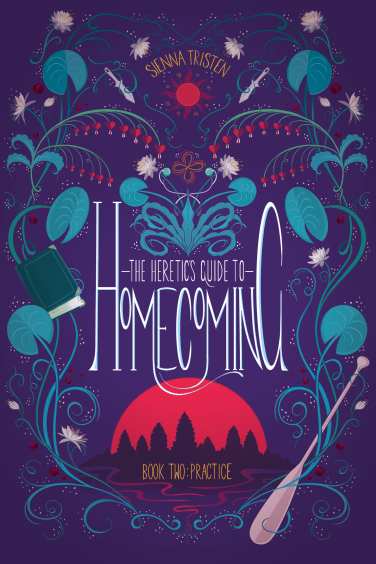
 Sienna Tristen is an author, poet, and literary organizer living in Treaty 3 territory who explores queer platonic partnership, the nonhuman world, and mythmaking in their work. The first installment of their award-winning fantasy duology The Heretic’s Guide to Homecoming came out from indie arts collective The Shale Project in 2018; you can find their poetry in Augur Magazine and Plenitude, and their chapbook hortus animarum: a new herbal for the queer heart is forthcoming from Frog Hollow Press. When the sun is up, they work with The Word On The Street Toronto to showcase the coolest Canadian & Indigenous literature.

 From Atlanta, GA by way of Albany, NY, Aaron has been writing books for the past 10 years. An omnivore when it comes to story, he takes inspiration from such diverse works as Brandon Sanderson’s Cosmere, Eiichiro Oda’s One Piece, daytime soap operas, and the films of Rainer Werner Fassbinder.

 About the authors: Emily Bergslien and Kat Weaver live in Saint Paul, Minnesota with their two small birds. Emily is a Twin Cities bookseller whose reviews have been published in The Riveter magazine. Find her on Twitter @eudaemaniacal. Kat’s short fiction has appeared in Apex Magazine, Lackington’s, Timeworn Literary Journal, and elsewhere. She is a senior fiction editor at Strange Horizons. Her art can be found at

 Two-time Stoker nominee Hailey Piper is the author of The Worm and His Kings, Queen of Teeth, Unfortunate Elements of My Anatomy, and Benny Rose the Cannibal King. She is an active member of Horror Writers Association, with over sixty short stories appearing in publications such as Year’s Best Hardcore Horror, Flash Fiction Online, Dark Matter Magazine, and elsewhere. Hailing from the haunted woods of New York, she now lives with her wife in Maryland, where their paranormal investigations are top secret. Find Hailey at


 Emanuela Ragno always gets what she wants. With her daring mind and socialite schemes, she refuses to be the demure young lady everyone wants her to be. In her most ambitious move yet, she’s about to marry Alessandro Morandi, her childhood best friend and the heir to the wealthiest house in Occhia. Emanuela doesn’t care that she and her groom are both gay, because she doesn’t want a love match. She wants power, and through Ale, she’ll have it all.