
I am so thrilled to have Katherine Locke on the site today, not only as one of my best friends and not only as one of my favorite authors, but as one of the editors of It’s a Whole Spiel, an anthology in which I happen to be a contributor and which releases on the 17th from Knopf! Here’s where I’ll mention that you can see us both at Books of Wonder in NYC on September 17th and Children’s Book World in Haverford on September 19th! And now, on to get to better know Katherine Locke! (Which, by the way, you can also do as a Patron at the $10+ level, as they’ve also done an interview there!)
Happy It’s a Whole Spiel month!
Thank you!! I’m so excited it’s finally here 😀
Of course, I have a little more insight into this one than usual being that I’m a contributor to this all-#ownvoices Jewish anthology you coedited with Laura Silverman, but for those a little less in the know, can you share a little bit about the process of editing it, and about the queer stories in it?
 Yes! Spiel is Laura Silverman’s brain child. She called me in February 2017 and wanted me to co-edit this anthology with her. I was fresh off finishing my story for Unbroken (edited by Marieke Nijkamp) which had been a tough story for me to write (personally, but also from a craft perspective, I hadn’t written short stories since college and hadn’t read much either, to be honest.) But I said yes right away. We worked really collaboratively on putting together the author list, the proposal, and then the editing of the anthology.
It’s been a really interesting experience. There are four explicitly queer stories in it, all by out queer authors–Alex London wrote about a gay boy at summer camp who falls in love with a fellow camp counselor, while also trying to make sense of a crisis aboard the space station, one of his favorite nerdy topics. David Levithan wrote a really moving story about a Jewish boy’s coming of age, falling in love, and how that weaves through being Jewish too. It has lines that brought tears to my eyes and lines that made me sigh. It’s lovely. Hannah Moskowitz’s short story is about a Jewish girl who is dating a more observant Jewish girl, and grappling with her eating disorder on Yom Kippur. Hannah writes with this beautiful sparse language that really guts you, and this story really showcases that. I love that it’s the story of two girls dating and religious observance all tangled up together (with a good serving of self-acceptance and taking the first steps toward recovery mindset as well.) And my story is also queer!
Your own story has some A+ queer content, including a non-binary sibling who undergoes a religious coming-of-age ceremony. It’s a great example of how queerness and religion intersect, and I’d love for you to talk a little about that!
Yes! Davey, the younger sibling to my narrator Gabe, is nonbinary and uses they/them pronouns. I used B’nai Mitzvah for the name of their coming of age ceremony (for non-Jewish readers, Bar and Bat Mitzvah are gendered (as is Hebrew) after consulting with a rabbi and parents of nonbinary kids. I really loved writing Davey and writing Gabe’s interactions with Davey. Gabe’s fiercely protective of his sibling (a theme that comes up a LOT in my work). Gabe identifies as cishet, but there’s another character, Yael, who is the moderator of the fandom website Gabe haunts, who is also nonbinary and uses they/them but online only. That’s all I can say without spoilers!
Of course, this isn’t your first queer work (or even your first Jewish queer work); your most recently published novel, The Spy With the Red Balloon, is a dual-POV set during WWII and told from the perspectives of two Jewish siblings, one of whom is a bi girl and one of whom is a demi boy in a relationship with another boy. How do you go about writing historical with identities that didn’t have the terminology we have now, and in what ways does their queerness impact the story you’ve told?
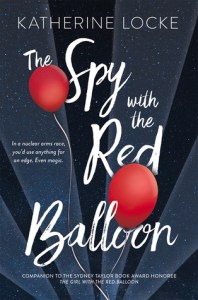 I struggle a lot with terminology in historical fiction. A lot of it, including phrases which marginalized people used to self-identify, would be considered slurs and harmful now. And sometimes, people just didn’t have the language we have now. I try to describe how they feel instead, being as precise as possible. I was more vague with Wolf (my demisexual MC in Spy) at first and my editor asked me to be MORE explicit. I balked at first, mostly because I think it’s hard to describe demisexuality on the page (I am demisexual and I wrote Wolf’s ID largely from my experience). But I’m glad I did because that’s been something readers really connected with. But Wolf uses the word ‘queer’ because that’s the word that came up frequently in my research that I could be comfortable with, versus other words I wasn’t comfortable putting on the page. Ilse doesn’t have the word “bisexual” but says she likes some girls the way she likes some boys.
Spy was the first time I’d written queer main characters. I really loved writing those queer relationships that felt bold and brave and hopeful in that book because a lot of that book is grim and dark. When I think about the book, I think about those quiet, gentle moments between those characters–Ilse and Polly’s first kiss, Wolf asking Max if he volunteered to be a pilot because Wolf was on the mission, Ilse teasing Wolf and Max, the last scene that I can’t talk about because spoilers. Those relationships got me through the dark parts of writing the book. And they were often the first scenes to come to me. Writing SPY was a really hard process and I wrote it in a pretty chaotic fashion. But Ilse and Polly’s first kiss has been there from the first draft, written exactly as it is now. Those are the lights in the dark. (Tl;dr: writing the queer relationships in SPY gave me the same joy writing fanfic does.)
Like our most recently featured author, you’ve got a short story in the upcoming Out Now, edited by Saundra Mitchell. What can you tell us about it?
Ahhh! I can tell you…that technically it lives in the same universe as my short story in It’s A Whole Spiel! There’s an overlapping coffee shop, because queer coffee shop AUs are the best? The Out Now story is called ‘Seditious Teapots’ because the main character, Rory, collects teapots. They don’t drink tea. They just like teapots. (Their mom does not get it.)
I’m not sure everyone realizes this, but back when YA Pride had a book club, you were its spectacular moderator! Any advice for someone seeking to do a queer book club, and any recommendations that sparked particularly interesting conversation?
Yes! I did that for many years, actually. I would use this lovely website, LGBTQReads as a great resource, if I was running a book club now. And I would talk and communicate with the group members! Some people really don’t want to read any stories in which queer characters come up against tragedy or hate, and that’s totally fair! Some people aren’t into coming out stories. That’s also okay. It’s good to know what your group’s hard limits are. Book recommendations: all of Ashley Herring Blake‘s books sparked great conversation, as did A Line In The Dark by Malinda Lo. I think that one makes a particularly good book club book because it gets that true crime x lgbtqreads crossover. Plus that cover literally sends shivers down my spine.
Your books require a lot of research, and your writing schedule requires a lot of discipline. What are your favorite resources for looking up historical details, and your favorite resources and tricks for staying on track?
I wish I had all the discipline my writing schedule requires! I do a lot of reading for my books. I think the book I’m researching now is going to end up being about 22 books in total. And then there’s the movies, tv shows, articles online, and interviews. I borrow books from the library when I think I can read it, get the general gist and won’t need to touch it again. I buy them when I think I’ll need to reference them again and again. I have a pretty good memory so for the most part, I highlight and bookmark. I only write down the timeline of the events because I do not have the brain for dates/years/times/etc (a problem for my previous two YA novels which were time travel books…)
I have a rule that I read 3 sources before I begin, and the rest I read as I go along. Otherwise, I’ll drown in the research and never surface to write the book. So I usually try to read an overview of the time or event, a personal memoir or biography, and then something broader about that time period in the world OR the time period right before the time period I’m writing about (history builds on what came before it. You can’t write historical fiction and only read about that ONE time period.)
I flag things in manuscripts as I first-draft so that I don’t slow myself down. Part of my problem is my brain gets distracted very easily (ADHD, and also, our brains are being rewired by our technology to have shortened attention spans). So if I open up a tab to look up a street name, I’ll end up with ten tabs open, buying a rug, researching swimsuits, and in a twitter argument. It’s best if I just put [STREET NAME] in my document, and fill it in later in revisions. Everything can be fixed in revisions. EVERYTHING.
What’s the first LGBTQIAP+ representation you recall in media, for better or for worse?
I think Jack? From Will & Grace. I can’t think of one earlier. I certainly didn’t read one in books until college, I think. Or one that I recognized. I suppose in retrospect there’s a lot of queer coding that I did not catch.
Naturally, you’re one of my favorite people to talk upcoming books with, so I have to ask: what are you really excited about this fall and in 2020?
OKAY. I’m excited for everyone to read The Starless Sea by Erin Morgenstern (which has a gay protagonist!) because it is simply stupendous. I’m also excited to read Gideon The Ninth which I’ve heard great things about. I have not read, but am absolutely dying to read, King and the Dragonflies by Kacen Callender. Kace is one of my favorite kidlit writers (they also have an adult novel called Queen of the Conquered coming out this fall I think that I want to dive into!) and King looks lush and magical and heartfelt. I am also DYING-ACTUALLY DYING to get my hands on Julian Winters’ next book How To Be Remy Cameron! I loved his debut, Running With Lions, so much and I just want to shove his books into everyone’s hands. And I’m excited to read By Any Means Necessary because bees! (BEES!) Also: Crier’s War. That’s on my list. (I’m just scrolling through pre-orders right now.) Jackpot by Nic Stone because the voice in Dear Martin blew me away and I just want to get sucked in like that again. OH and The Bone Houses by Emily Lloyd Jones because I try to read one creepy book each year even though I don’t do creepy well, and this is my pick this year. But I’m in it to win it because I’ve been promised an undead goat. [Blogger’s Note for readers: Those last three are not queer books, AFAIK, though both authors do have other queer work! I forgot to specify the queer part in my question.]
Also I hear there’s a really amazing Edgar Allen Poe anthology that’s coming out? His Hideous Heart! That’s the one. So I guess I’m going to get creeped out TWICE this fall. *shivers* *buys more blankets and hot chocolate to make up for it*
What’s up next for you?
*nervous laugh* UHHHHH. It’s A Whole Spiel is out on September 17th, and Out Now is out in May 2020. I am breaking out in my picture book debut in spring 2021 (!!!). And right now, I’m hard at work on another novel! It’s adult, historical fantasy (similar vein as the Balloonmakers books but with a weirder magic system), and I love it very, very much. It’s so weird. It’s so historical. That’s my favorite.
***
Katherine Locke lives and writes in Philadelphia, Pennsylvania with their feline overlords and their addiction to chai lattes. They are the author of The Girl with the Red Balloon, a 2018 Sydney Taylor Honor Book and 2018 Carolyn W. Field Honor Book, as well as The Spy with the Red Balloon. They are the co-editor and contributor to It’s A Whole Spiel: Love, Latkes and Other Jewish Stories, and a contributor to Unbroken: 13 Stories Starring Disabled Teens. They not-so-secretly believe most stories are fairytales in disguise. They can be found online at KatherineLockeBooks.com and @bibliogato on Twitter and Instagram.

 Thank you!
  My path to publication didn’t follow the traditional route. At the time I was writing
  Julian Winters is the best-selling author of contemporary young adult fiction. His debut, Running With Lions (Duet, 2018), won accolades for its positive depictions of diverse, relatable characters. A former management trainer, Julian currently lives outside of Atlanta where he can be found reading, being a self-proclaimed comic book geek, or watching the only two sports he can follow—volleyball and soccer. How to Be Remy Cameron is his second novel.
 Destroy All Monsters is the story of Ash, a regular teenager in the real world, who is trying to save her best friend Solomon from a mental health crisis. But it’s also the story of Solomon, a gay teenage photographer who lives in a city full of monsters and magic, who is trying to save his best friend Ash – the Refugee Princess – from a conspiracy trying to destroy all magic. As their quests progress, these two worlds begin to collide. There’s some of me in all my characters, but Solomon definitely has a big piece of my heart – a gay Jewish boy trying to make art and make sense of the world around him while struggling with mental illness.
 In a post-climate-change future, where rising sea levels and wars for resources have transformed the globe, floating cities are constructed in the Arctic, where polar melt has opened up the interior for resource exploitation. Qaanaaq is one of those cities, essentially a giant oil rig where a million people live, and one day a woman arrives in town with a polar bear and an orca, on a mission… maybe of bloody revenge. And wackiness ensues! As for the award nominations, that was pretty surprising to me, because – like a lot of artists from marginalized communities – I spent a long time being told that my stories were not universal stories, that they would only resonate within my own community, and if I wanted to get a broad audience I’d need to step outside the ghetto of “gay stuff.” My work has always been extremely queer, and so no matter how many accolades it gets, I never ceased to be shocked that folks respond positively to stories about oversexed irresponsible gay boys, lesbian grandmas, gender nonbinary folks, and so on.
 I’ve always adored YA, going back to getting totally messed up by The Chocolate War when I was twelve. Just like Disney movies, I never understood why they have this reputation for being juvenile or saccharine
 Sam J. Miller is the Nebula-Award-winning author of The Art of Starving (an NPR best of the year) and Blackfish City (a best book of the year for Vulture, The Washington Post, Barnes & Noble, and more – and a “Must Read” in Entertainment Weekly and O: The Oprah Winfrey Magazine). A recipient of the Shirley Jackson Award and a graduate of the Clarion Writers’ Workshop, Sam’s work has been nominated for the World Fantasy, Theodore Sturgeon, John W. Campbell and Locus Awards, and reprinted in dozens of anthologies. A community organizer by day, he lives in New York City.</p>
 One morning, Jessa-Lynn Morton walks into the family taxidermy shop to find that her father has committed suicide, right there on one of the metal tables. Shocked and grieving, Jessa steps up to manage the failing business, while the rest of the Morton family crumbles. Her mother starts sneaking into the shop to make aggressively lewd art with the taxidermied animals. Her brother Milo withdraws, struggling to function. And Brynn, Milo’s wife—and the only person Jessa’s ever been in love with—walks out without a word. As Jessa seeks out less-than-legal ways of generating income, her mother’s art escalates—picture a figure of her dead husband and a stuffed buffalo in an uncomfortably sexual pose—and the Mortons reach a tipping point. For the first time, Jessa has no choice but to learn who these people truly are, and ultimately how she fits alongside them.
 I definitely want to write about the queer lives of women. By that I mean I am interested in something that I’ve called “the lesbian domestic.” I wanna see the day-to-day interactions of queer women in households. I know that theme filters into all of my work because it is something I also want to see as a reader. I am also deeply interested in bodies – tactile sensations, physical forms. That crops up over and over again in my work. Also Florida! I’d say all of these themes coalesce in much of my writing, but particularly in the title story from that first collection. I felt it exemplified all of the things I was trying so desperately to write about when it comes to queerness in a household: relationships between queer women, household dynamics and their breakdown, and the actual landscape of a Florida backyard.
 Kristen Arnett is a queer fiction and essay writer. She was awarded Ninth Letter‘s 2015 Literary Award in Fiction, was runner-up for the 2016 Robert Watson Literary Prize at The Greensboro Review, and was a finalist for Indiana Review’s 2016 Fiction Prize. She’s a columnist for Literary Hub and her work has appeared or is upcoming at North American Review, The Normal School, Gulf Coast, TriQuarterly, Guernica, Electric Literature, McSweeneys, PBS Newshour, Literary Hub, Volume 1 Brooklyn, OSU’s The Journal, Catapult, Bennington Review, Portland Review, Tin House Flash Fridays/The Guardian, Salon, The Rumpus, and elsewhere. Her debut story collection, Felt in the Jaw, was published by Split Lip Press and was awarded the 2017 Coil Book Award. Her novel, Mostly Dead Things, will be published by Tin House Books in June 2019.
 It definitely had some strong inspiration. I tend to channel a lot of my anger into my writing, and at the time I was working on
  Wow, thank you so much for saying that! What a huge compliment. Personally, I’m just so damn excited to see more f/f books coming out – not only as a writer but as a reader! While there’s still a ways to go, it gives me hope to think about how far we’ve come in just a few years. But it’s important to acknowledge the writers who inspired and paved the way for all of us. Authors like Nancy Garden, Nina LaCour (Everything Leads To You has a special place in my heart and is one of the reasons I started focusing primarily on writing f/f), Jacqueline Woodson, Malinda Lo and of course, YOU, Dahlia! (Blogger’s Note: *blush*)
 I’m pretty open about my life online (maybe too open? *shrug*). But I believe there is strength in being vulnerable. It’s the fastest way to realise that you’re not alone, that there are others going through similar challenges, and maybe together you can make it through. I think social media has been both a sanctuary and a hellhole for queer life and art. On the upside, it has allowed people to find a sense of community, friends and even family – the kind they might never have found in the real world. On the downside, hate and bigotry have also found a home online, and sometimes it feels like it can drown out all the good. But I try to focus on the upside – or at least use the hate as fuel to keep fighting and writing my anger into my work.
 Jen Wilde is the YA author of QUEENS OF GEEK, THE BRIGHTSIDERS and GOING OFF SCRIPT. She writes unapologetically queer stories about geeks, rockstars, and fangirls who smash the patriarchy in their own unique ways. Her books have been praised in Teen Vogue, Buzzfeed, Autostraddle, Vulture and Bustle. Originally from Australia, Jen now lives in NYC where she spends her time writing, drinking too much coffee and binging reality TV. Follow her online @jenmariewilde.
 Its a tender love story about two girls standing in the wreckage of their parent’s circumstances who find a way to learn how to face the same circumstances “harder better faster stronger”. If you’ve seen the movie Interstellar, its like… if the movie was about Murph growing up, but from the perspective of another girl who thought she was super hot. I wrote this book because I wanted to make a soft and precious love story for the huge HUGE turn out that the WLW community had for
  There are still posts there from when I almost gave up writing
  K. Ancrum grew up in Chicago Illinois. She attended Dominican University to study Fashion Merchandizing, but was lured into getting an English degree after spending too many nights experimenting with hard literary criticism and hanging out with unsavory types, like poetry students. Currently, she lives in Andersonville and writes books at work when no one is looking.
 Yes!
Yes!  In
In  Tehlor Kay Mejia is an author of Young Adult and Middle Grade fantasy at home in the wild woods and alpine meadows of Southern Oregon. When she’s not writing, you can find her plucking at her guitar, stealing rosemary sprigs from overgrown gardens, or trying to make the perfect vegan tamale. She is active in the Latinx lit community, and passionate about representation for marginalized teens in media. You can find her on Twitter and Instagram @tehlorkay.
 On the adult side,
  YES. YES, WE CAN. As a fat author, I have struggled—oh, have I struggled—to see myself and people like me properly represented on my covers. I’ve either had my characters fattish but not too fat or completely thin washed. I mentioned this to the publisher at Fireside, and, at the same time, I fretted about Irene (being a trans woman) getting her labels erased. Pablo’s answer was brilliant; he hired a trans artist of color who understood the representation struggle, who looked at the material and produced something really special. I’m in love with it and hope other publishers take note.
 I wasn’t super specific by design. Our teen years are often (not always, but often) exploratory years, and I don’t just mean sexually. When I was coming around to my labels, I fumbled my way through the discovery process. It’s like trying on jeans—when you get the wrong fit, you’re uncomfortable all day, but find the perfect pair? Wow, awesome. That said, the thing that landed me solidly in keeping with her “questioning, probably bisexual, but not sure yet” ID was the relationship with Devi. I love that pairing, a lot, and I realized halfway through that if Leaf hadn’t happened, Sara would have been more than content just being with Devi for the foreseeable. In fact, I think if Devi hadn’t been straight, they could have been a thing. Alas, Devi isn’t into girls, and Sara knew that and respected that. Accepting that sometimes your crush just isn’t into you doesn’t have to be traumatizing.
 So
So  First of all, thank you because I know some people really don’t like her but I love her, mess and all! I didn’t set out to write The Bi Best Friend; when I first started writing Rose, the book was dual POV and she had her own thing going on. So really she got shifted into that role as I found the heart of the story and stripped back to just Audrey’s POV. But writing Rose was one of those moments that I know plenty of authors have had, where you write a queer character because you’re just SUCH a good ally! and then you stop and realise that ohhhh wait no okay it’s all clear now. So I guess what spoke to me about her was…myself?! I wrote her bisexuality not realising that it was also my bisexuality. And she’s similar to Jules in that she’s very certain of her sexuality and also very afraid that any relationship she gets into is going to go terribly. I guess..am I just writing my own fears again?! Possibly! It was definitely enjoyable to write a girl who’s so sharp and spiky but not a stereotype.
 Right now I have one book tattoo, for
  Rebecca Barrow writes stories about girls and all the wonders they can be. A lipstick obsessive with the ability to quote the entirety of Mean Girls, she lives in England, where it rains a considerable amount more than in the fictional worlds of her characters. She collects tattoos, cats, and more books than she could ever possibly read.
 Being invited to be a part of those anthologies was a blessing and I’m so grateful to have been asked. They really helped me out of a slump when I felt like I couldn’t write anything or I was too bogged down with my novel. All of the editors, Jessica Spotswood, Saundra Mitchell, and Lamar Giles were all incredibly helpful and I was very happy that they thought of me.
 I didn’t really have any idea what I was getting into and I still have a lot to learn. I think I was naïve, but that was sometimes a good thing because I just wrote what was in my heart. I am hopeful and encouraged by all the new books and voices we are seeing, especially from own voices authors who can speak to queer experiences. Could there be room for more? Absolutely. I think we’ve seen LGBTQA books get more support, but that doesn’t mean okay well that’s enough. You’ve had your moment.
 I constantly worry that people may think the one perspective I have in my work is the only perspective because they may not have read other narratives about the characters I write about. I also worry that the characters I do write about who represent real people don’t feel that I am doing it the right way. There is a lot of pressure to represent an under represented group well and to make sure you are doing things perfectly when there is no way to be perfect. My hope is that more own voices books make their way into the world so that people are not always given three dimensional depictions can have some depth, as well as having different perspectives from characters of similar background.
 What can you share about whatever you’re working on now? And do we have any chance at getting a queer-girl basketball player someday? Asking for a friend. Of yours. Who is me 😉
 Sara Farizan, the daughter of Iranian immigrants, was born in Massachusetts. She is an MFA graduate of Lesley University and holds a BA in film and media studies from American University. Sara grew up feeling different in her private high school, not only because of her ethnicity, but also because of her liking girls romantically, her lack of excitement in science and math, and her love of writing plays and short stories. So she came out of the closet in college, realized math and science weren’t so bad (but were not for her), and decided she wanted to be a writer. Sara has been a Hollywood intern, a waitress, a comic book/record store employee, an art magazine blogger, a marketing temp, and an after-school teacher, but above all else she has always been a writer. Sara lives near Boston, loves Kurosawa films, eighties R&B, and graphic novels, and thinks all kids are awesome. She is the acclaimed author of If You Could Be Mine, Tell Me Again How a Crush Should Feel, and Here to Stay.