Authors in Conversation: Kit Rosewater and Nicole Melleby

Welcome back to another Authors in Conversation post on LGBTQReads! If you’ve been following LGBTQA MG, you know it’s been blowing up in the most gorgeous way these past couple of years, and here are two of the authors responsible for that: Kit Rosewater (L), author of The Derby Daredevils, a brand-new illustrated series that kicks off with Kenzie Kickstarts a Team today(!), and Nicole Melleby (R), author of last year’s Hurricane Season, next month’s In the Role of Brie Hutchens…, and at least two more queer MGs after that! (Not to mention co-editor with Katherine Locke of the upcoming all-queer MG anthology This is Our Rainbow!)

Kit and Nicole are here to talk about their new books, what’s up next, and more, so pull up a seat and listen in!

Nicole: Hey Kit! I’m excited to get to do this interview with you! I’m a pretty easy sell when it comes to queer kid lit, but The Derby Daredevils is such a special addition to LGBTQ+ middle grade shelves. It made me want to go dust off my skates, which I haven’t used in, like, a decade. (It’s like riding a bike, though, right?) For those who weren’t lucky enough to get their hands on it before its March 24th release, why don’t you tell us a little bit about it?

Kit: Thank you so much Nicole! I literally dusted off my childhood skates as I researched and wrote The Derby Daredevils! (My feet didn’t grow much after fifth grade.) Book 1 of the illustrated series, Kenzie Kickstarts a Team, follows best friends Kenzie and Shelly as they set out to expand their Dynamic Duo into a whole team of roller derby skaters so they can play together on the Austin junior league. But for every potential new player they recruit, more and more tension gets wound into their own friendship… until Kenzie’s not sure she wants the Dynamic Duo to change at all. As the cast of characters slowly builds, the story shifts, and a big turning point comes when Shelly tries to get Kenzie’s secret crush to join the crew.

You should also tell us about your upcoming middle grade, In the Role of Brie Hutchens! I love how you’ve infused this in-depth history of soap operas and coming out scenes with Brie’s personal story. The way Brie sees the world is so darn relatable, and I have to admit that I slipped right back into my days of first girl crushes as I read along.

Nicole: In the Role of Brie Hutchens is what I keep referring to as Love, Simon meets Lady Bird. Brie is a soap opera obsessed Catholic school girl (much like myself) who has a complicated relationship with her mom, which is only further complicated by her mom’s strong faith and Brie’s first crush on another girl. Nothing seems to really go Brie’s way, especially when her mom walks in on Brie googling inappropriate photos of Brie’s favorite soap opera actress, and to divert her mom’s attention, Brie lies and says she’s been chosen to play the big role in her 8th grades religious May Crowning ceremony…which she obviously hasn’t been. So, to make that actually happen, Brie decides to ask the smartest girl in her class (who happens to be Brie’s crush) for help.

I’m excited we both have queer middle grade novels out this year, especially ones that deal with that awkwardness of a first crush (and those poor decisions you sometimes make because of them!) Kenzie Kickstarts a Team is your debut, and I know you’ll be following up with a sequel later in the year. Would you tell us a bit about your journey to publishing queer middle grade? Did you face any roadblocks or fears when you started?

Kit: I love that both our books explore first queer crushes too! Honestly, this was a subject that until a few years ago, I didn’t realize I was allowed to write about. I was a pretty escapist kid, always trying to disappear into worlds I made up in my head, and my earliest manuscripts were mostly fantasy. I experienced A LOT of typical roadblocks in my publishing journey, from moving between agents to having various projects not make it out of revisions. But the biggest roadblock for publishing queer middle grade was ultimately… me. For so long I had looked back on my first girl crushes in 5th and 6th grade with absolute shame–the same kind I get when I think about accidentally wrecking my mom’s car as a 16-yr-old. It took a long time to realize I could “escape” into positive queer middle grade stories. Now I never want to stop writing about kids who are queer and not cloaked with the type of shame I felt.

There is so much room for all kinds of queer stories in the middle grade canon, and I love every type of story out there–the coming out stories, the unrequited feelings stories, the found families stories, the happy ending stories–all of them! While reading Brie Hutchens, I was so impressed at the way you handled some hefty topics like reconciling being queer within a heavily religious setting. You said that like Brie, you were a Catholic school girl. Would you mind sharing your experience with writing some details from your own childhood into Brie’s story?

Nicole: It’s actually funny–I said earlier that In the Role of Brie Hutchens could be comped to the movie Lady Bird. I actually walked out of the theater after seeing Lady Bird and said, “I want to write about a coming of age queer middle grade story based on my experience in Catholic school.” Only, when I sat down to write that story, I realized that the experiences of middle grade readers now are much different than when I was that age. In big part thanks to the internet (I sound about a thousand years old right now), today’s middle grade readers have access to and an understanding of queer identities and vocabulary that I had no idea existed until I was in my twenties. I had to find a way to tell the story I wanted to tell, but for today’s audience. Brie is exactly like I was: dramatic, confused, a little self-centered, questioning the idea of faith and religion. But Brie knows that she has feelings for girls and doesn’t really struggle with understanding what that means–just what to do about it.

Speaking about main characters–Kenzie (or should I say Kenzilla?) was likeable and relatable right from the start. She’s determined to start her own team, and even with her mistakes along the way, I was rooting for her to succeed while maintaining her changing friendship with Shelly. Can you tell us more about Kenzie, and who she is as a character? Are there any similarities between Kenzie and your younger self?

Kit: Thank you so much! As much as I try not to get personally attached to reader’s opinions… it’s such a relief to know that Kenzie is relatable, because this girl is basically me. I tend to enfold myself into almost every character I write, and because The Derby Daredevils series has rotating protagonists, I wanted a huge chunk of my personality in each team member. But Kenzie feels especially close to home. At her best, Kenzie’s a leader, and she cares deeply about dynamics and how everyone works together. Whenever I’m thriving in a group setting, whether it’s a writers meeting or a school project, it’s because I’m taking on that same role. At her worst, well… Kenzie can be a bit exclusionary. And so was I. I’m embarrassed about how often I bristled when a new person came into my friend group. Maybe I was worried they would replace me in some way. Or maybe, like Kenzie, I was just scared of change. As an adult I try to be really conscientious of including others, but I can still be a bit of a butt about it from time to time. I was one of those kids who always pined for one best friend, and that kind of pining relies on exclusion to some extent.

Brie’s friendship with Parker really tugged on my heartstrings in the best way over the course of their relationship in the book. I love the moments of disconnect they have because they’re such different girls, but the ultimate reassurance that their friendship is one built on mutual support and care. Did you have a close friend like Parker growing up? Were there allies in your life as you explored various parts of your identity?

Nicole: I was actually the kid who was friends with everyone, so I had different groups of friends and different best friends throughout the years. What I wanted to do with Parker was a couple of things. Like I said above, I wanted to tell a coming of age Catholic school queer story for contemporary readers, and Parker played a big role in that. She’s understanding and supportive, because kids are full of empathy and understanding in ways that I didn’t always have growing up. She doesn’t question Brie’s sexuality; they have the knowledge and vocabulary to have a conversation about it. When I was Brie’s age, I remember turning to a friend of mine and saying, “Do you ever just…really like the way another girl’s face looks??” I had no idea I was talking about attraction! I also wanted Parker to be completely boy crazy–because some eighth grade girls are, and there’s nothing wrong with that!–so that I could have Brie encounter those awkward moments and feelings and conversations I was used to. Those ones where a friend says, “Which guy are you crushing on?” and you have to decide, “Am I going to lie?”

As an adult, when I knew I needed to fully come out of the closet, I did have important allies, though, which is why I put a lot of people in Brie’s corner. Teachers, friends, even some family members…it was important for me to build Brie’s support system, because my support system was the only thing that got me through my whole coming out process. I had friends who bought me ice cream and beer the night I came out to my parents, and I had a mentor who listened and helped me get to a point where I was ready to come out at all. Without all that, I don’t know what I would have done. So while not everything goes well for Brie, I wanted some things to go well, too.

What I really liked about Kenzie’s story is that she wasn’t new to the idea of queer identities either–Kenzie even has a transgender parent. It’s another one of those contemporary queer stories–our audience has queer friends and families and are discovering their queer identities themselves openly and in a way queer middle grade books are starting to reflect. Could you tell us more about your decision to write Kenzie’s dad’s identity, along with her own budding sexuality?

Kit: Absolutely! I wrote the queer themes in Kenzie Kickstarts a Team both as a queer/bisexual author and also as an ally to the transgender community. Someone very close in my life came out to friends and family as transgender in 2017. They were in the midst of seeking help for anxiety and depression, and the process of coming out was long and fraught with a lot of emotional speed bumps and roadblocks. As their primary support and contact, I spent so many days crying on the phone with this person, sending notes, contacting other people in our network to buffer negative reactions or intercept inappropriate questions… I couldn’t get any writing done during that time. I finally reached out to my agent and said I just wasn’t interested in continuing to work on the darker middle grade project we’d had in revisions for months. I needed to write a different story, one where being transgender was normalized and celebrated, and where being queer in general was normalized and celebrated. I had gotten into the Austin roller derby scene a few months earlier, and it was like all the pieces fell into place. Once I started writing through Kenzie’s lens, I knew I wanted her to explore her sexuality in a positive and open environment. The only queer stories I’d been exposed to as a kid were tragic ones! I wanted young readers–especially young queer readers–to know there is nothing inherently negative about the queer identity. If people react negatively, that’s 100% ON THEM.

Brie ends up dealing with a variety of reactions–both immediate and eventual reactions–as she explores her own sexuality. I absolutely loved the complexity in her dynamics within each of those relationships. There wasn’t a cliché bigot villain or hero ally, which allows Brie the agency and freedom to navigate the coming out process in her own beautiful, messy way. What would you say is the number one takeaway you hope young readers get from reading Brie’s story?

Nicole: My goal in having Brie come out again, and again, and again… throughout the novel, to a variety of responses, was to show that “coming out” isn’t one moment. It’s a lifetime of moments. And it sucks, it does. It’s frustrating for Brie as much as it is freeing. But I wanted to balance the bad reactions with the good ones. I wanted to show that, despite the struggle and the pain, there is good, there is hope. The soap opera scene that Brie consistently goes back to, the one where the character Bianca comes out to her mom, Erica Kane, is this sweet, heartbreaking scene where Bianca begs her mom to see her. “Can’t you see who I am? I want you to see who I am.” That’s exactly what Brie wants throughout her whole process, too. She wants to be seen, she wants her mom to see her. My number one takeaway I’ve always wanted my young readers to get from this story (and every story I write) is that *I* see them, regardless of the rest.

I think that’s so important in queer middle grade especially–for us to give our readers hope. I think you do that especially beautifully with Kenzie’s story, with the queerness being so celebrated and normalized. I know you have a sequel coming out, too. Could you give us a sneak preview of what we can expect from this continuing story? Are you working on anything else at the moment?

Kit: Book 2 of the Daredevils series is called Shelly Struggles to Shine, and follows Kenzie’s best friend Shelly as the Daredevils team gears up for their first roller derby tournament! Shelly’s story is an artist’s story as she tries to figure out how being creative fits into a sport setting… which it absolutely does in derby! But finding that “in” is tricky. Shelly doesn’t identify as queer, but I wanted to keep the loving and open queer community ongoing in this book. Kenzie’s crush continues to flourish. Shelly’s friend and mentor in art class is non-binary. And many characters from Book 1 make some surprising guest appearances!

Apart from the Daredevils series, I have an upper middle grade WIP with characters closer to Brie’s age. There is a fair bit of queerness in there… with some of my favorite cheesy tropes! One pivotal scene chases my two lead characters, who are camp enemies with secret hots for each other (f/f) up a tree and leaves them stranded. I love the camp setting and the bickering, and am having so much fun with the whole project. My biggest hope is that eventually it will make its way onto shelves and be comped to In the Role of Brie Hutchens!

Nicole, thank you so much for joining me in chatting about our upcoming releases. I’ve been a huge fan of yours since Hurricane Season, and couldn’t be more thrilled to sit down and gab about queer middle grade and the long and drawn out process of coming out! Thank you Dahlia at LGBTQ Reads for hosting us!

***

Kit Rosewater writes books for children. She lives in Albuquerque, New Mexico with her spouse and a border collie who takes up most of the bed. Before she was an author, Kit taught middle school theatre and high school English, then worked as a children’s bookseller. She has a master’s degree in Children’s Literature and a knack for finding her characters in clouds, ceiling plaster, and Cheetos. Books 1 & 2 of her debut series THE DERBY DAREDEVILS rolls out in 2020 through Abrams.

*

Nicole Melleby is a born-and-bred Jersey girl with a passion for storytelling. She studied creative writing at Fairleigh Dickinson University and currently teaches creative writing and literature courses with a handful of local universities. When she’s not writing, she can be found browsing the shelves at her local comic shop or watching soap operas with a cup of tea.

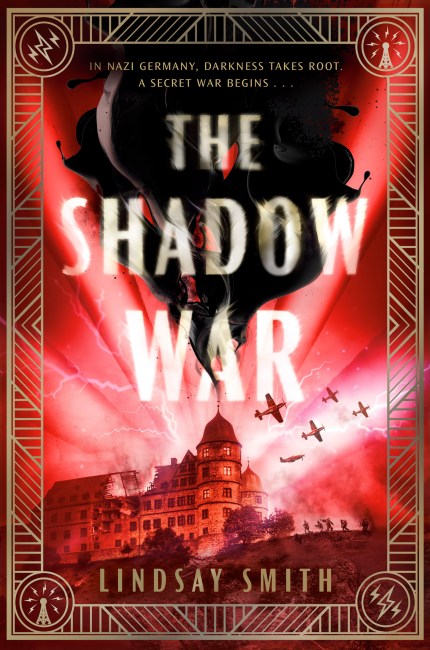
Exclusive Cover and Excerpt Reveal: The Shadow War by Lindsay Smith

You may remember Lindsay Smith from one of my favorite bi YA thrillers, A Darkly Beating Heart or her excellent queer historical story in A Tyranny of Petticoats. Well, now she’s back with something entirely different but still wildly queer, and we get to reveal the cover! The Shadow War is a new YA fantasy releasing on October 13th from Philomel/Penguin, and it’s pitched as Inglorious Basterds meets Stranger Things, which !!! Here’s the official blurb: 

World War II is raging, and five teens are looking to make a mark. Daniel and Rebeka seek revenge against the Nazis who slaughtered their family; Simone is determined to fight back against the oppressors who ruined her life and corrupted her girlfriend; Phillip aims to prove that he’s better than his worst mistakes; and Liam is searching for a way to control the portal to the shadow world he’s uncovered, and the monsters that live within it–before the Nazi regime can do the same. When the five meet, and begrudgingly team up, in the forests of Germany, none of them knows what their future might hold.

As they race against time, war, and enemies from both this world and another, Liam, Daniel, Rebeka, Phillip, and Simone know that all they can count on is their own determination and will to survive. With their world turned upside down, and the shadow realm looming ominously large–and threateningly close–the course of history and the very fate of humanity rest in their hands. Still, the most important question remains: Will they be able to save it?

And here’s the electrifying cover, designed by Kristie Radwilowicz!

Buy it: Amazon | B&N | IndieBound | Book Depository

But wait, there’s more! Here’s an excerpt!

A world on fire…

Fires raged, purple and blue and savage, flowing like liquid through the trees. The sky glowed with unnatural light against a swallowing gulp of darkness. And in the distance, a column of flaming stones soared skyward—a pillar. Shadows circled it like giant bats, impossibly long wings scraping against one another in their jagged dance.

Daniel shrank back, pulse racing. What had happened to his world, his life? The wings beat louder, threatening to drown out his thoughts. “What have you done to me?”

“To you? Not a damn thing. In fact, I think we might be able to help each other.”

Daniel turned toward him. Liam smiled so easily, as if his earlier black rage had never happened. He’d said the rules were different here, without explaining, yet, where here was.

Liam appeared to be in total control. He was confident—calm, even—despite the strangeness surrounding them. He was just an ordinary college student, a little disheveled, though nothing that couldn’t be fixed by a hot bath. His tweed jacket, his satchel, his tidy leather loafers—nothing about him hinted he could unleash hell from his palm.

But Daniel was used to monsters that wore the plainest faces.

In the distance, something howled, slavering and cruel.

“What is this place?” Daniel asked again, though he wasn’t entirely sure he wanted to know the answer.

“This,” Liam said, “is how we’re going to win the war.”

***

Lindsay Smith is the author of Sekret and other novels for young adults. She writes for Serial Box’s Marvel’s Black Widow: Bad BloodOrphan Black: The Next Chapter, and The Witch Who Came In From the Cold. She has also written for comics, RPGs, and more. She lives in Washington, DC, where she works in international cybersecurity.

Fave Five: Queer Irish Fiction

Witches of Ash and Ruin by E. Latimer (YA Bisexual Fantasy)

Spellbook of the Lost and Found by Moïra Fowley-Doyle (YA Bi/Lesbian Fantasy)

At Swim, Two Boys by Jamie O’Neill (Gay Historical Fiction)

Stir-Fry by Emma Donoghue (Contemporary Lesbian Fiction)

The Heart’s Invisible Furies by John Boyne (Gay Historical Fiction)

Bonus: Coming up in 2020, The Falling in Love Montage by Ciara Smyth (Romantic Lesbian Contemporary YA) and The Henna Wars by Adiba Jaigirdar (Lesbian Contemporary YA Romance)!

Exclusive Cover and Excerpt Reveal: The Camino Club by Kevin Craig

I’m so thrilled to have Kevin Craig on the site today to reveal the cover of his sophomore novel (and first with Duet Books), The Camino Club, which releases on October 6th! Here’s the story:

After getting in trouble with the law, a group of wayward teens from diverse backgrounds are given an ultimatum: serve time in juvenile detention for their crimes, or walk the Camino de Santiago pilgrimage route across Spain over the summer holidays with a pair of court-appointed counselor guides. Although unlikely friends, they all try to make the best of their situation. The pilgrims grow closer on their journey, but when and if they reach the Cathedral in Santiago, will they each find what they’re looking for and come out of the walk ready to conquer the shattered worlds they left behind?

And here’s the beautiful cover designed by C.B. Messer!

Buy it: Amazon | B&N | Interlude | IndieBound

But wait, there’s more! Here’s an excerpt!

We’ve been lost for over an hour. The way Claire is so chill about it, I’m beginning to think she doesn’t much care. She might have had something to do with us taking the wrong turns in the first place.

We were only a city block or so ahead of Meagan. Every once in a while I would slow our pace down so she was always able to catch glimpses of us. And Manny and Greg walked just slightly ahead of us. They sped up, and as soon as we lost sight of them, bam. Everything fell apart.

The rain didn’t help. We’re soaked through. At least it’s stopped. Hopefully it stays this way. I need to either dry off or find my way back to the path before I go mad. I can’t be wet and lost.

But here we are, drenched, on this quiet street with no peregrinos anywhere in sight. We have lost our way. And I kept letting Claire lead me in the wrong direction, because I had assumed she was trying to find her way back to the yellow arrows.

Clearly, not a good idea. Not an arrow in sight. I should have just kept walking with Manny and Greg. Even Gil disappeared back at the albergue after he realized Claire finally had a new walking partner.

I think last night may have been a one off, though. She seemed nice enough at the time, but I think today’s Claire may have gone rogue. I’m almost positive. Maybe she’s possessed by Cacabelos Jesus.

“I give up,” I say, stopping in front of a small grocery. “I’m asking for directions.”

“No, don’t. It’s more fun this way. Can’t we just wander around and figure things out for ourselves. Where’s your sense of adventure?”

“You know what I think,” I say before heading inside. “I think you want to be lost. I think you did this to us on purpose. I don’t want to be drawn into any of your plans to screw this up. You’re sabotaging me.”

I turn and walk into the small grocery. I let the door close on Claire, shutting down her ability to respond. I hope they can point me in the right direction. I don’t care if she follows me or not. I’d rather she didn’t.

I have my phone out, getting directions from the lady behind the counter, when Claire finally enters the store. We’re struggling through the language barrier, but the woman understands Camino and is able to show me on Google Maps where it is I have to go to get back on the path. Claire stands behind me, skulking noisily. After I have the directions, I buy a couple apples that happen to sit in a basket on the counter.

I turn to Claire and give her a dirty look as I put one of the apples into a side pocket in my backpack. I bite into the other and say, “Come on. Let’s go.” I hold up my phone to show her I know where I’m going.

“Nah,” she says. She pops a handful of Skittles. It was cute at first, but those little candies are beginning to annoy me. “I think I’ll sit this one out.”

“What does that even mean?”

Claire heads for the door without saying another word. I thank the woman behind the counter again before I leave. She says Buen Camino and I wave as I leave her store.

“What is your problem?” I ask Claire as I catch up to her. She just shrugs and keeps walking, in the opposite direction we need to go in order to get back to the yellow arrows. “Come on, Claire. You’re going the wrong way. You can’t just get lost in Spain. Are you nuts, girl? What is wrong with you? I thought we bonded last night. I thought—”

“Oh, what?” She pivots, cutting me off mid-sentence. “You think because we spent half an hour together we’re best friends now? What about the day before that? Or on the plane? You know, when you didn’t say two words to me?”

“I just want to get back to the Camino, Claire. I don’t want to fight with you.”

“What are you even in for, anyway?” she says. She walks over to where I stand waiting for her.

“You don’t want to know.”

***

Kevin Craig is a playwright, poet, and short story writer who lives in Toronto with their husband, Michael. An author of six published novels, Kevin’s books include Pride Must Be a Place (MuseItUp Publishing, 2018) and Burn Baby Burn Baby (independently published, 2014). Kevin was a founding member of the Ontario Writers’ Conference Board of Directors, and sat on the Writers’ Community of Durham Region’s (WCDR) Board of Directors as Membership Coordinator. Website: https://ktcraig.com/

Tomboys and Witches: Writing Nonbinary Magic, a Guest Post by The Girl of Hawthorn and Glass author Adan Jerreat-Poole

Today on the site, I’m thrilled to welcome Adan Jerreat-Poole, author of the queer fantasy novel The Girl of Hawthorn and Glass, which releases from Dundurn on May 16. Here’s a little more about the book:

Eli isn’t just a teenage girl — she’s a made-thing the witches created to hunt down ghosts in the human world. Trained to kill with her seven magical blades, Eli is a flawless machine, a deadly assassin. But when an assignment goes wrong, Eli starts to question everything she was taught about both worlds, the Coven, and her tyrannical witch-mother.

Worried that she’ll be unmade for her mistake, Eli gets caught up with a group of human and witch renegades, and is given the most difficult and dangerous task in the worlds: capture the Heart of the Coven. With the help of two humans, one motorcycle, and a girl who smells like the sea, Eli is going to get answers — and earn her freedom.

Preorder: Amazon | B&N | Indiebound

And here’s the post from Adan on writing nonbinary magic!

***

I grew up reading Tamora Pierce’s The Song of the Lioness quartet. I was in love with magic, sword-fighting, and the tomboyish Alanna who had to pretend to be a boy in order to become a knight. In some ways I felt like Alanna—but instead of a girl pretending to be a boy, I was a nonbinary person pretending to be a girl. Like Alanna, I felt the constraints of gender roles and sexism corsetting my life and future. The Song of the Lioness helped me imagine breaking out of those roles.

But I wanted more than that. Where were the magical adventures about people like me?

I am the only queer person in my family. I didn’t come out as bisexual/pansexual until I was 26. I didn’t come out as nonbinary until I was 27. Here is an excerpt from the email I sent to my closest family members three days before my 28th birthday:

Some of you may remember me as a little kid with a bowl cut who wore Harry Potter glasses and animal onesies (some things never change). I looked like a little boy, and I didn’t particularly feel like any gender. I’ve often felt uncomfortable trying to make myself more feminine to fit in with gendered expectations and norms. In the last year or so, I’ve met more and more people who identity as nonbinary and I think that might be a better fit for me. I’ve started using the pronouns “they/their.” It feels right.

I have a couple of really close queer friends who helped me come out and feel comfortable with who I am. But they lived in different cities, and as an introvert it was hard for me to meet new people and break into the local LGBT2SQIA+ scene. Because I didn’t have many trans or queer people in my life, I turned to books. It turned out that sometime between 1998 and 2018 a lot of amazing queer YA literature had been published, and I fell in love with reading all over again. My bookshelf now is filled with titles like Blanca & Roja and Girl Mans Up. These books were the queer family I was missing.

Here’s the last thing you have to know about me: I’m angry. Really, really angry. I’m angry at the violence that I’ve experienced and that I see other people experiencing. I’m angry that I had to pretend to be a girl for a long time. I’m angry that we live in a culture that hurts women, trans, queer people, and people of colour. Some of that anger makes its way into the book, curling under each letter and winding through lines of dialogue.

The Girl of Hawthorn and Glass is about an angry queer girl trying to find her place in the worlds. The world she grew up in is weird, magical, and dangerous. She’s going to discover that our world is, too. She’s going to meet a really cool nonbinary person who has secrets and tattoos. (They are the main character of the sequel, The Boi of Feather and Steel). She’s going to learn how to come to terms with pain and past mistakes. She’s going to learn how to use anger to fight for justice.This book is about tomboys and witches, assassins and ghosts and bloodthirsty children. These characters handle every fear and challenge with the strength and honestly that I wanted for myself when I was a young person dreaming of becoming a knight.

If you look carefully, you can see the ink on the page pulsing to the beat of my magical nonbinary heart.

***

Adan Jerreat-Poole is a reader and writer who loves all things fantasy and feminist. They are a PhD candidate at McMaster University studying disability and queerness in popular culture. Adan lives in Kingston with their cat Dragon. The Girl of Hawthorn and Glass is their debut novel.

The Summer of Impossibilities by Rachael Allen: Excerpt Reveal and Giveaway!

Today on the site, I’m thrilled to have Rachael Allen, whose upcoming young adult contemporary, The Summer of Impossibilities, releases May 12 from Abrams! We’ve got an exclusive excerpt from the story, so check out the blurb and dig in! (And pssst: keep scrolling for your chance to win an advanced copy!)

Cover artist: Emily Mahon

Skyler, Ellie, Scarlett and Amelia Grace are forced to spend the summer at the lake house where their moms became best friends.

One can’t wait.

One would rather gnaw off her own arm than hang out with a bunch of strangers just so their moms can drink too much wine and sing Journey two o’clock in the morning.

Two are sisters.

Three are currently feuding with their mothers.

One almost sets her crush on fire with a flaming marshmallow.

Two steal the boat for a midnight joyride that goes horribly, awkwardly wrong.

One of them is hiding how bad her joint pain has gotten.

All of them are hiding something.

One falls in love with a boy she thought she despised.

Two fall in love with each other.

None of them are the same at the end of the summer.

Buy it: Amazon | B&N | IndieBound

And here’s the excerpt!

Amelia Grace

I WAS HOPING SHE WOULD BE THE FIRST PERSON I saw. Only, now that I’m here, I have no idea what to do. I know what she was thinking about doing with that knife—it’s why I stopped dead in the doorway, so she’d have a chance to put it down and paste a smile on her face before my mom could see around my body. But maybe I would have stopped dead no matter what. There’s something about seeing her in person after so many emails that makes me forget how to breathe.

“Scarlett, hi.” Mom gives her a hug. “You’ve gotten so tall.”

She’s definitely taller than I imagined she would be, but I’m only five foot four, so everyone is tall. She’s even more beautiful than in her pictures, all long red hair and curves and freckles. But somehow different. Edgier or sexier.

I stay on the other side of the room. If I get too close to her, will she know? I feel like my mom would know.

“Is Adeline around?” Mom asks, brows furrowed with concern.

“She’s upstairs.” Scarlett bites her lip, and I have to look out the window. “I think she’s not doing so well. Can you check on her?”

“Of course.” Mom squeezes her shoulder and leaves immediately. There’s something about the way she walks out of the room—her steps are so purposeful. I almost don’t recognize her for a second.

Skyler bounds in just as Mom is leaving. She grins at me, but her eyes are red.

“Amelia Grace!” she squeals, giving me a big, bouncy hug. “I haven’t seen you in forever! You look just like your pictures on Insta!”

And then it feels like it would be weird for Scarlett and me not to hug after I’ve just hugged her sister, and she must be feeling the same way because she takes a couple steps toward me too. Her shirt is wet in patches, and so is her hair.

“Are you okay?” I ask. It’s a general are you okay, but buried underneath is a very specific are you okay? Because back when things were really bad, with the girls at school and the cutting, she used to email me every day. But that was three years ago, before our emails trickled to every few weeks and then every few months. A part of me wants to pick back up right where we left off, but—

“I’m fine,” she says.

She hugs me, and it isn’t a big or bouncy one like Skyler’s, and it’s over too quickly, and it doesn’t answer any of my questions. I guess I thought we meant more to each other than that.

There’s the sound of another car pulling up outside, and Skyler runs out of the room to meet them, her chestnut ponytail swinging behind her. Scarlett takes exactly one step closer. She lowers her voice and says in a whisper that’s just for me, “I’m really glad you’re here.”

My heart squeezes in my chest, and I almost choke on my own spit. “Me too.”

The kitchen gets really quiet. I can hear Skyler outside, greeting the new arrivals with some unintelligible bubbliness. A trickle of water from the faucet goes drip- drip- dripping down the sink.

“I should, um, go upstairs and change.” She gestures to her shirt.

“Right. See you.” See you? Of course, I’ll see her. We are living in the same dang house for the summer.

Her footsteps echo up the stairs, and I feel like I’m on the cusp of realizing some great truth. Then my phone dings in my pocket. Carrie? I type in my password. Nah, just a bunch of social media updates. Including one from Carrie. It’s a photo of a book she’s reading—she posts those a lot—with a tiny caption.

weekend plans

So, she does have her phone. Well, maybe she doesn’t know what to say or maybe she’s feeling really bad about things or maybe she wishes it never happened and she never wants to see me again but she’s too sweet to tell me.

What if you just promised you wouldn’t kiss any more girls or go on dates or anything?

Maybe it wouldn’t be such a big deal to promise that after all. If Carrie doesn’t want to talk to me, I mean, I don’t know anyone else in Ranburne who might be interested. And Scarlett, well. She’s in a relationship. I know this. She has emailed me about this. I have pretended to be happy for her on multiple occasions.

I could email Pastor Chris—he’s our youth minister, the one I was going to be serving with. See about being a junior youth minister when I come back in the fall, maybe sooner. I could promise him, like Abby said. I only have one more year of high school anyway. And it wouldn’t be changing who I am so much as it would just be . . . waiting.

Sometimes I imagine what life will be like on the other side and all the shapes my life could take, but mostly I’m scared to even think about it. Because if I do, all the possible futures start to shift like a kaleidoscope, each one falling into place, forming a single dream. I want to marry a sweet girl who I’m in love with. And I want us to have kids; I don’t even know how many. Two? Three? Seven plus a menagerie of pets? I don’t even know how the baby- having part would work exactly, but who cares as long as they’re ours? And she and I will walk down the street holding hands and we’ll sit together in church on Sundays, each holding up one half of the same hymnal.

That’s about where the future starts to fall apart. Because I already know I’ll never be able to have all those things at the same time.

I realize I’m still staring at the stairs, so I go outside, because I don’t want to seem like I’m creeping around Scarlett’s kitchen waiting for her. Skyler is dancing circles around a woman I recognize as my aunt Seema, and her daughter, Ellie. I remember playing with her brother, Zakir, when I was little. I haven’t seen them since Mom married Jay and moved to Tennessee. We stopped seeing all the aunts after that.

I walk up to the group of them, everyone talking at once. I say hi to Ellie, who is impossibly gorgeous and who gives me a hesitant side- hug like she isn’t sure what else to do.

Seema beams at me. “Amelia Grace, love, you look beautiful.”

I smile and allow myself to be scrunched into a hug. I remember that about her from when I was little—she gives the best hugs.

A tan SUV pulls up next to us. There’s not exactly a driveway, more just a dirt road that makes a circle in front of the house. A tall, Latinx woman with golden brown skin and glossy hair gets out. She has a piercing through one eyebrow and a flower tucked behind one ear. Definitely Val.

“I’m here, and I have everything we need!” she hollers. She pulls out a cardboard box from the passenger seat. “My ‘fasten seatbelt’ alarm has been going off since the liquor store. You know it’s a good day when you have enough alcohol in your seat that your car thinks it’s a person.”

She sets down the box so she can give Seema a hug. It’s like watching family members get reunited at the airport.

“How are you, Seema?”

“Good.” Seema smiles slyly. “I’m good. Because I have everything we need.”

“Wh—? Excuse me? I have wine, whiskey, bourbon, and tequila. I’m not sure there’s anything else a person could need.”

Seema swings a wrinkled brown paper bag. If she has weed in there, just, I don’t know, shoot me dead. I am so not prepared for this.

“Every kind of Cadbury you can imagine from when I visited my mother in Canada.”

Val clutches her heart. “You brought Cadbury? Did you bring—”

“Coconut cashew? Yes, five bars of it, one of which I instructed Ellie to write your name on in Sharpie.”

“God bless you.”

I used to think Cadbury was just those eggs you get at Easter, but it turns out Canada has a whole new level of chocolate going on. I remember I would totally freak out every time a care package from Aunt Seema came in the mail.

“Is that whole bag really filled with chocolate?” I ask.

Seema smiles. “About three kilograms.”

“I love it when you talk metric to me,” says Val, and Seema cackles.

And then it’s like they both remember why they’re here at exactly the same time.

“I am going to kill Jimmy Gable,” says Aunt Val.

“You’ll have to arm wrestle me for it, jaan, because I’m going to kill him first.”

I stare up at the blue house with the white wraparound porch, where my mom is no doubt holding my aunt Adeline like she’s trying to put her back together. Scarlett stands in the second window from the left, looking down at the lawn. The way the light hits her makes her look like a ghost. She’s never even talked about liking a girl, so I know she’ll probably never feel the same way, but the things I’m feeling, they’re so big, it doesn’t even matter. I look at her, and I feel lucky just to feel this way.

The great truth finally takes shape inside my head: If I was ever thinking about doing what they want, of going back to the way I was before and locking away the part of me that likes girls and hiding the key until college—seeing her makes me realize that is no longer an option.

* * *

And here’s more from Rachael!

In addition to giving away ARC’s of THE SUMMER OF IMPOSSIBILITIES, I thought it would be fun to do a giveaway where each of the girls in the book gives away her favorite YA book, and next up is an Amelia Grace giveaway and exclusive excerpt with LGBTQ Reads!

About Amelia Grace

Amelia Grace (Nickname: Ames)

Loves: interior design, kindness, being a junior youth minister, friends that feel like family

Favorite YA book: HOW TO BE REMY CAMERON by Julian Winters

Why: Remy is earnest and kind, and he’s confused about how to define himself because he’s a lot of different things – adopted, black, gay, a brother, a best friend. For Amelia Grace, being inside Remy’s head feels like talking to an old friend. It feels like everything. Especially because it’s really rare to find a book that talks about being LGBTQ+ and about religion. Also, Julian Winters is the absolute best at turning high school stereotypes upside down and he’s funny as hell. Like, catch-you-off-guard sly and witty. Please go read this book immediately.

Giveaway includes (open internationally!):

1 signed ARC of The Summer of Impossibilities

1 signed copy of HOW TO BE REMY CAMERON by Julian Winters

Click here to enter the giveaway!

Giveaway note: As a rule, LGBTQ Reads doesn’t host giveaways because they are kind of a lot to deal with. Please note that this giveaway is 100% my (Rachael’s) responsibility, and if you have any questions or concerns, please take them up with me and not LGBTQ Reads. Thanks for being awesome!

* * *

Lauren Wright Photography

Rachael Allen is a scientist by day and kidlit author by night. She is the winner of the 2019 Georgia Young Adult Author of the Year award, and her books include 17 First KissesThe Revenge Playbook, and A Taxonomy of Love, which was a Junior Library Guild selection and a 2018 Books All Young Georgians Should Read. Her next novel, The Summer of Impossibilities, is out May 12, 2020 (Abrams/Amulet). Rachael lives in Atlanta, GA with her husband, two children, and two dire wolves.

Rachael’s books have been published internationally in German, Spanish, French, and Polish. She is represented by Susan Hawk of Upstart Crow Literary.

Visit Rachael on Twitter: @rachael_allen and Instagram: @rachael.stewartallen

Fave Five: Second Chance F/F Romance

Keeping Her Secret by Sarah Nicolas (YA)

Once Ghosted, Twice Shy by Alyssa Cole

Once in a Lifetime by Harper Bliss

You’re My Kind by Clare Lydon

Second Chance by Chelsea M. Cameron

Bonus: Coming up in 2021, Cool for the Summer by Dahlia Adler (YA)

Exclusive Excerpt and Character Portrait Reveal for Late to the Party by Kelly Quindlen!

Today on the site, we’ve got some extra fun in the form of character portrait and excerpt reveals from one of my absolute favorite upcoming releases, Late to the Party by Kelly Quindlen! The book releases on April 21 from Roaring Brook Press/Macmillan, but you can get to know its stars now! (And, a fun note: you can also come see me and Kelly talking about said book at Books of Wonder this summer in NYC on Thursday, June 18th at 6:00 p.m., so save the date!)

Here’s a little more info on Late to the Party:

Seventeen is nothing like Codi Teller imagined.

She’s never crashed a party, never stayed out too late. She’s never even been kissed. And it’s not just because she’s gay. It’s because she and her two best friends, Maritza and JaKory, spend more time in her basement watching Netflix than engaging with the outside world.

So when Maritza and JaKory suggest crashing a party, Codi is highly skeptical. Those parties aren’t for kids like them. They’re for cool kids. Straight kids.

But then Codi stumbles upon one of those cool kids, Ricky, kissing another boy in the dark, and an unexpected friendship is formed. In return for never talking about that kiss, Ricky takes Codi under his wing and draws her into a wild summer filled with late nights, new experiences, and one really cute girl named Lydia.

The only problem? Codi never tells Maritza or JaKory about any of it.

Buy it: B&N | Amazon | IndieBound

And here are the portraits and excerpts! All portraits in this post have been done by Rima Salloum, a good friend of the author’s. 

Codi Teller – the protagonist and narrator, a quiet artist who is questioning her wallflower status

You know how adults are always talking about teenagers? When I was in fourth grade, my family drove past a house that had been rolled with toilet paper, and my dad shook his head and chuckled Teenagers under his breath. My mom griped about Teenagers every June, when dark figures hung over the monkey bars of the clubhouse playground long after closing hours, but she never actually seemed mad; she seemed wistful. And then there’s all those shows and movies, the ones where thirty-year-old actors pretend to be high schoolers, and they go on dates and drive their fast cars and dance at crazy house parties where their fellow Teenagers swing from chandeliers and barf into synthetic tree stands. You grow up with these ideas about Teenagers, about their wild, vibrant, dramatic lives of breaking rules and making out and Being Alive, and you know that it’s your destiny to become one of them someday, but suddenly you’re seventeen and you’re watching people cannonball into a swimming pool in the pouring rain, and you realize you still haven’t become a real Teenager, and maybe you never will.

Maritza Vargas – Codi’s best friend, a headstrong dancer who is determined to expand her social world

Maritza leaned forward, an urgent energy about her. “Listen to me,” she said. “Last night we picked up your little brother from a date, something none of us have ever experienced, and we watched him almost kiss a girl for the first time, something I’ve been wanting to do for ages. Didn’t that feel as shitty for you as it did for me? I’m tired of feeling like I’m missing out. We keep hanging out just the three of us, doing the same shit we always do, watching bad movies we’ve already seen . . .” She clasped her hands in front of her and steeled herself. “We need to try something different, meet people who are different. It’s like Einstein said: The definition of insanity is doing the same thing over and over again and hoping for a different result.”

JaKory Green – Codi’s other best friend, a hopeless idealist trying to push beyond his anxiety

“Did you feel horrible yesterday, too?” JaKory asked.

I looked up from the colors I was mixing. “The worst I’ve felt in a long time.”

JaKory was silent. Then he screwed up his mouth and said, “I went home and wrote a poem about it.”

I smiled wryly. “’Course you did.”

“There was one line I really liked. ‘My youth is infinite but my fears are intimate.’”

I mixed my orange and yellow paints. Such bursts of color, such vibrant promises, like the infinite youth JaKory spoke of. And yet those intimate fears loomed larger.

“I’m scared, too,” I admitted. “Scared of . . . I don’t even know what.”

“I’m so pissed at myself,” JaKory whispered. “I always knew I was different . . . black, nerdy, queer… but that’s not why I’m missing out. It’s because I’m standing in my own way.”

Ricky Flint – the closeted football player who takes Codi under his wing and introduces her to a new social group

After a while, we ended up along the river. Ricky parked with his truck facing the water, and we kicked our feet up on the dash, slurping the last of the ice cream from the bottoms of our cups.

“So what do you and Maritza and JaKory do when you hang out?” Ricky asked. “Is it anything like this?”

I told him. I kept checking his expression the whole time, worrying that I was boring him, but he had this open look on his face that made me feel like he cared what I had to say. When I’d said enough, I asked him, “What about your friends? What’s your favorite thing about them?”

He looked out over the river. A whole minute must have passed, but he didn’t seem pressed to come up with the answer right away. Finally, he started nodding to himself and said, “That I feel like I could have met them in kindergarten.”

“What do you mean?”

“I didn’t meet most of my friends until high school, but every single one of them is someone I could have met on the kindergarten playground—it’s natural and easy, nothing held against each other. Remember how easy it was to make friends at that age?”

Lydia Kaufman – Codi’s crush who is trying to be brave during her last summer before college

She bit her lip, a secret grin on her face. “What’s your favorite color?”

I laughed unexpectedly. “That’s what you want to follow up with?”

“Yes.”

I smiled, my hands in my lap now, all thought of the painting abandoned. “It changes all the time. Right now it’s violet.”

“I love that.”

“What’s yours?”

“Green,” she said right away.

I nodded, unsurprised. “Like your eyes.”

She laughed. “Not for that reason.”

“Why?”

“The first house my family lived in was green. Like a pastel shade, you know? And anytime a friend’s mom would drop me off, we’d turn on my street and I’d say, ‘My house is the green one.’ I didn’t know how to count the mailbox numbers but I knew my house was green, and I loved it.”

My heart expanded inside me. In that moment I felt like it was okay to be exactly who I was, because she was being exactly who she was, and that must have meant something. I absorbed it all: her eyes, her secrets, her space in the world.

The only thing I managed to say was, “I like knowing that.”

“I like knowing that you know it.”

***

Kelly Quindlen is the author of the young adult novels Late to the Party and Her Name in the Sky. A graduate of Vanderbilt University and a former teacher, Kelly has had the joy of speaking to PFLAG groups and high school GSAs. She currently serves on the leadership board of a non-profit for Catholic parents with LGBT children. She lives in Atlanta. Follow her on Twitter @kellyquindlen.

Hope and Happy Endings in YA Fiction: a Guest Post by I’ll See You Again Author CJ Bedell

Today we’re excited to welcome Chris Bedell to the site to discuss his YA contemporary novel, I’ll See You Again, out now from Deep Hearts! Here’s a little more about the book:

It’s the start of his senior year, and Cyrus should be worried about college applications, procrastinating on homework, and staying up past his bedtime. And he does, until his mother’s cancer returns.

To make matters worse, Nico Valentine—the person Cyrus hates most—insists on being his friend. Carefree, flirtatious, and spontaneous, Nico is everything Cyrus’s childhood never allowed him to be. When their English teacher offers Cyrus extra credit to tutor Nico, Cyrus knows he shouldn’t accept. He could use the distraction, though.

A fling soon ensues, and Cyrus realizes they have more in common than he thought. What is more, Nico is the first person who seems to get him and who is there no matter what. But, if Cyrus wants his romance with Nico to turn into something real, he’ll have to do something he’s never done before—be vulnerable with another person.

Buy it: Amazon | B&N

***

And here’s the guest post!

***

(Warning: The following blog post contains spoilers from the YA Contemporary novel I’LL SEE YOU AGAIN)

Hope is a controversial issue in YA literature (and even pop culture in general). On the one hand, people argue YA literature is fiction. So, there’s no harm in having a happy ending. On the other hand, some will argue a YA book might seem unrealistic if an ending is too happy. And the issue of happy endings is something I debated while writing my YA Contemporary novel I’LL SEE YOU AGAIN.

My main character, Cyrus, goes through a lot in the book. His mother has a cancer relapse, and ultimately dies. Cyrus also has his relationship with Nico, which becomes tumultuous towards the end of the book.

Chapter 23 (the book’s second to last chapter) takes place on graduation. Cyrus skips graduation, and reconciles with Nico for that one night. Cyrus wakes up the next morning to find Nico didn’t stay the night. Nico ended things with him on a Post-it note. Some people might argue the book could’ve concluded with that. Cyrus and Nico reconnected very briefly, yet their second breakup reinforces how some relationships don’t always last.

I couldn’t let the book end with the morning after graduation when Cyrus discovers the Post-it note, though. Doing so would’ve been cruel. The arc of Cyrus and Nico’s begins with the book’s first chapter. So, readers deserve a payoff. Cyrus also deserves happiness beyond his writing ambitions, friends, and family. Nico is the one person who understands Cyrus the most despite their opposite personalities. Nico and Cyrus both like to write, had fathers who abandoned them, and had mothers who died of cancer.

Chapter 24 (the book’s last chapter) therefore pushes the novel’s plot forward about nine months. It’s the following March after graduation. Nico and Cyrus are both back in town for Spring Break, and they eventually reconcile.

To me, offering hope is important in YA literature. Something cathartic exists from seeing Cyrus get a happy ending after struggling so much. A general overlap exists with real life—some readers might be grappling with serious problems. And they deserve to know life gets better no matter how trite the sentiment sounds. People are more than their romantic relationship, but being Nico makes Cyrus happy. It’s only human, after all. Most people wanna feel loved and accepted.

Also, I offer realism in a less jarring way. If I wanted to make the book unbelievably happy, then I would’ve had Chapter 24 also mention Cyrus getting a career break with his writing. But I didn’t. Not because that’ll never happen for Cyrus—it will. But because readers don’t need the entirety of Cyrus’s life story to know he’ll be happy. Cyrus is just like most people. Taking life one day at a time. And that’s enough. If Cyrus survived his mother’s death and reconciled with Nico, then he can handle anything.

***

Chris Bedell’s previous publishing credits include Thought Catalog, Entropy Magazine, Chicago Literati, and Foliate Oak Literary Magazine, among others. His debut YA Fantasy novel IN THE NAME OF MAGIC was published by NineStar Press in 2018. Chris’s 2019 novels include his NA Thriller BURNING BRIDGES (BLKDOG Publishing), YA Paranormal Romance DEATHLY DESIRES (DEEP HEARTS YA), and YA Thriller COUSIN DEAREST (BLKDOG Publishing). His other 2020 novels include his YA Thriller I KNOW WHERE THE BODIES ARE BURIED (BLKDOG Publishing), YA Thriller BETWEEN THE LOVE AND MURDER (Between The Lines Publishing), and YA Sci-fi DYING BEFORE LIVING (Deep Hearts YA). Chris also graduated with a BA in Creative Writing from Fairleigh Dickinson University in 2016.

Better Know an Author: Sarah Gailey

Happy March! I am so thrilled to have Sarah Gailey on the site today, because in case you have noticed, they’ve been utterly killing it and have not one but two new books out already in 2020. Gailey’s writing some of the best, queerest, most interesting, and straight-up weirdest stuff out there right now, and if you’re not already familiar, there’s never been a better time to fix that! 

It’s been five seconds into 2020 and you are already having A Year, with publications back to back in February and March. How do you handle having two new books out in two different categories, and what important commonalities are there between Upright Women Wanted and When We Were Magic?

This year has already been completely bananas. It’s been tricky to juggle having two new books out so close together! Fortunately, both books have a similar heart; they’re about finding people who love you for who you are, and who want to support you in growing into the person you’ll become. Those parallels have made it easy to transition from promoting Upright Women Wanted to promoting When We Were Magic (even if that turn happens to be taking place on a dime).

Upright Women Wanted another foray into the queer wild west for you, following your American Hippo duo. What is it about that setting that calls to you, and how did you find doing it as a near-future this time around vs. as an alternate history?

I really love a Wild West setting because the characters we identify most with in that setting tend to be outlaws and outcasts who are fighting to survive in a world that wasn’t built for them. As a queer, nonbinary, and disabled person, that’s a feeling that hits pretty close to home for me. In writing Upright Women Wanted, I felt that it was important to connect that feeling to the fear so many of us have today — that the future doesn’t have a place for us in it. I wanted to answer the question: In a near-future wild-west, how do we find ways to survive? And how might queer people find joy in that survival?

After several years of being rather prolific in adult, When We Were Magic is your first YA. What inspired you to jump categories, and how did you find writing for teens for your first time?

I’ve always loved reading YA, but for a long time, I was intimidated to make an attempt at writing it. The field is populated with so many brilliant, incredible authors. The thing that really pushed me into trying my hand at wriiting for teens was, as is so often the case, my literary agent. He asked me if I really, truly believed that I had nothing to say to all the teen readers who might be able to see themselves in my work. I realized that my trepidation was nothing compared to the opportunity I had to reach out to young women, young queer people, and teen readers who are trying to figure out where they fit in a world that feels simultaneously too big and too small.

Writing for teens was a complete delight. I tapped into emotions that I rarely have the courage to explore in my adult work, and I wrote with a hopeful future in mind. I absolutely loved it and can’t wait to do it again!

One thing I think is so cool about your body of work is how you seem to thrive in all different formats – short story, novella, novel… How do you make the call about the right format for each of your pieces, and are there any you wish you could expand?

For the most part, my stories tell me what length they want to be. As I explore the concept of a story, I start to see the places that want to expand — maybe the worldbuilding needs more space, or the relationships need more time to truly flourish. While some stories want to be concise and direct, other stories want to stretch out and take up a lot of room. Really, all I do is listen.

I would really love to expand my recent Vice short story, DRONES TO PLOUGHSHARES. It’s the story of an agricultural resistance community offering reform opportunities and friendship to government surveillance drones, and I would love to take the time and wordcount to explore how the world they inhabit came to be.

You are no stranger to awards, from the Hugo for Best Fan Writer to the Locus for Best Novella. How do you celebrate yourself, and what is it about your work that you most hear clicks with your readers?

I’m still trying to learn how to celebrate myself! Usually, my instinct is to just work harder, which of course isn’t sustainable. These days, I like to cook something lovely for my friends and sit down with a glass of wine, so we can toast together — I find that the best celebrations are truly celebrations of community, and that’s where I find the most joy.

My readers seem to click a lot with the uncertainty I try to explore in my work. I love writing about people who don’t have all the answers, who aren’t sure about themselves or the world around them, and who can really only find certainty in community and vulnerability. My readers really seem to find themselves in those spaces.

There’s so much bravery in your work, and it’s clear that you put a lot of yourself on the page. Is it something you find easier to do with your fiction or your nonfiction, and why?

I have a much easier time with this in my fiction. In nonfiction, I can’t find anywhere to hide — I have to talk about myself directly, and the people in my life, some of whom are very aware of the moments when they’re the ones I’m talking about. In my fiction, I can tuck pieces of myself and my life into various characters, and although some people might recognize me, not everyone will. I find a lot of comfort in that, and as a result, I’m actually much more vulnerable in my fiction writing than I am in my nonfiction.

Your books are great and all but we need to take a minute to talk about your cooking. Where on earth did you get all that extra talent and what’s the best thing you’ve ever made?

Oh my goodness, I love cooking so much!! It’s truly become an enormous outlet for me over the past year or so, especially now that I’m cooking for a family instead of just for myself. Part of that outlet is in low-stakes risk-taking — I can try out totally bizarre things in my cooking, and if they go wrong, it’s not a big deal because there’s always a pizza in the freezer. But when things go right, I always feel like a golden god. The best thing I’ve ever cooked is, I think, a lasagna. I spent a month or so workshopping it, trying to find everything I could do differently about every aspect of a lasagna, and when I made the final version, it came out completely transcendent. I wrote up a breakdown of everything I did, including a final recipe for a ten-minute version of lasagna that’s perfect for weeknight dinners — but the fancy version of lasagna was definitely the best thing I’ve ever made.

What’s your first recollection of LGBTQIAP+ representation in the media, for better or for worse?

Oof, this is a tough one. If I’m going with implicit representation, it’s definitely XENA, WARRIOR PRINCESS, which is a show I was completely obsessed with as a kid (although at the time I couldn’t have told you why… I just really identified with Xena and Gabrielle, and wanted to be them, and wanted to kiss them, and wanted to be their best friend?? Who can say what it all meant). My first encounter with explicit queer representation on the screen was probably Willow and Tara in BUFFY THE VAMPIRE SLAYER — a story arc that had a huge impact on how much I was unwilling to embrace my own queer identity for so long.

I assume that your answer to “Are you a coward or are you a librarian?” is the latter, so please, help us find some books! For people who love your work, what queer titles should they go to next?

It feels obvious to say so, but please read everything that Mark Oshiro ever writes. Anger Is a Gift is a magnificent book, and their upcoming projects will blow you away. I also can’t recommend Lauren Shippen highly enough — The Infinite Noise is a beautiful book about queer love and mental illness, and I loved it with my whole heart. Finally, Maggie Tokuda-Hall’s upcoming YA novel, The Mermaid, the Witch, and the Sea, is a stunning exploration of queer love, gender, magic, and the cost of violence. Preorder it! Go!!

What’s up next for you?

I’ll be spending the rest of 2020 promoting When We Were Magic and Upright Women Wanted, my recent antifascist queer western novella! After that, I get to start gearing up for early 2021, when my next adult novel will come out from Tor Books. The Echo Wife is a science fiction novel about divorce, identity, duality, and cloning. It follows the story of a scientist whose husband steals her technology in order to clone himself a better version of her. The consequences are dire and far-reaching, and force her to examine everything about herself in a whole new light.

***

sarah00128129
(c) Allan Amato 2019

Hugo Award Winner and Bestselling author Sarah Gailey is an internationally published writer of fiction and nonfiction. Their nonfiction has been published by Mashable and the Boston Globe, and they won a Hugo award for Best Fan Writer. Their most recent fiction credits include Vice and The Atlantic. Their debut novella, River of Teeth, was a 2018 Hugo and Nebula award finalist. Their bestselling adult novel debut, Magic For Liars, was published in 2019; their latest novella, Upright Women Wanted, was published in February 2020. Their Young Adult novel debut, When We Were Magic, came out in March 2020. You can find links to their work at http://www.sarahgailey.com; find them on social media @gaileyfrey.

Queering up your shelf, one rec at a time!