
Today we’re welcoming to the site author Nem Rowan, author of Witcheskin and Rough Sleepers, genre mashups of horror, urban fantasy, and romance with trans and queer representation set in the UK that make for perfect reads for this time of year! The books are being rereleased following the closing of Less Than Three Press, so the author is here to give them a boost and talk about how bisexuality unexpectedly found its way into his stories!
***
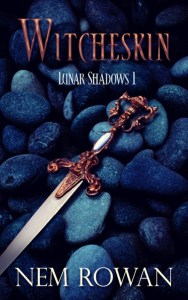 My two books, Witcheskin and Rough Sleepers, recently received a re-release through JMS Books after the closing down of Less Than Three Press, and both have transgender representation in them. What I didn’t plan for when I wrote these books was the representation of bisexuality! Rough Sleepers was one of the finalists in the Bi Writers Association’s 2018 Annual Book Awards for the Romance genre, and this made me consider how and why I seem to write in bisexual characters, sometimes without even meaning to.
I am a transgender man, and this makes a large impact on the kind of characters I write and the way I write about them. Being trans means I sometimes approach certain fictional situations in a different way to how a cis-gendered writer might, taking into consideration the character’s self-esteem, physical presentation and anatomy. When you write trans characters as a trans author, a little part of yourself always makes it into the story, whether it’s in something the character says or does—such as coping strategies for living in a world that can be quite hostile at times—to the reasons for the clothes they wear. But, whether a writer is trans or not, a part of yourself is always there in the writing, and I suppose I didn’t consider that my sexuality would have such a far-reaching, yet subtle, influence on what I wrote as well.
Just a little warning that there are spoilers ahead for those who haven’t read my books!
In Witcheskin, the character Wenda and her husband Evan were in a poly relationship with the main villain of the story, Geraint. At the time of writing, I never considered that this would actually mean—as they were in an equal triad—that both Evan and Geraint were bisexual. It’s never explicitly written in the book, but I had always considered Maredudd, the love interest and secondary main character, to be bisexual, in that his character is heavily inspired by water, and the fluidity of water. It was not a far stretch for me to imagine Maredudd dating a man, a woman, or anyone really, and perhaps that is why he is so ready and willing to accept Owen. Maredudd has no boundaries and lives a free, sometimes wandering, life. Why wouldn’t his sexuality be like that too?
 Moving on to Rough Sleepers, the categorisation of the main character’s sexuality became complicated when it came to defining its place in publishing. Leon is bigender, and (s)he switches between male and female frequently throughout the book. Leon’s sexuality is hard for him/her to define, and even harder for me to define, even though it’s clear that Leon is chronically attracted to masculinity. Ceri, on the other hand, had his sexuality pre-planned for me, since he appears as Geraint in the first book, and after dating Wenda for a time, then goes on to be in a relationship with Leon. Even Mecky, one of the other main characters, leans heavily into bisexuality, as she is attracted to both masculinity and femininity, and seems to take particular interest in gender transformation. I never planned any of these things when I wrote the book; I just wrote it.
My third, currently unreleased, novel The Things We Hide At Home, which hopefully will be getting the release it deserves through JMS Books, is the first book I’ve ever written with a strictly gay male/male romance, and I’m not entirely sure why it ended up that way. The main character, Tenny, is a trans male who is also gay, and is quite different to Owen in how he navigates the world. Perhaps when I wrote this novel, I was going through a particularly gay phase myself. Bisexuality, at least for me and the bisexual people I know, seems to fluctuate in waves, and is never a static block of 50% masculine, 50% feminine.
I think when authors allow their characters to evolve completely organically, by simply guiding them along the vague path chosen by the plot line, they sometimes end up choosing their own sexualities. When I create characters, their sexuality is the last thing I think about. At times, their default sexuality just happens to be bisexual, even if I don’t realise it, and it opens them up to choosing their loves in sometimes totally unexpected ways. Only later, when they have established a solid personality and romance do I then decide what to do about their sexuality, and even then it may just be a small note jotted on a pad somewhere.
Likewise, I’m not saying it’s wrong to pre-plan your character’s sexuality. That’s an impossible thing to refrain from if the story is deeply entwined with that aspect of the character, for example, in a coming out story, or a book based on someone’s life experiences. But, that’s just not my writing style! I think it’s wonderful that writers will actively choose to make their characters LGBTQ+ because it’s important to get that work out there, to the people whose lives we are representing, to the people who need it the most. It could be that my books, and other authors’ books, are found by accident while searching, by someone who needed to see themselves in a main character, being brave and finding their place in the world, because that makes all the difference when you feel isolated and alone.
I feel that bisexuality is sometimes under-represented, and I’d love to see it written about more and more in the LGBTQ+ fiction world. It doesn’t necessarily mean having a gay couple at the forefront—it could have a male and a female in what appears to be a heterosexual relationship, but if one or both of them is bisexual, it’s still queer. We can’t, as a community, do bisexual people a disservice by dictating who they fall in love with, whether it’s gay or straight or anything else, because then we risk becoming the oppressors we’ve fought against all these years.
Bisexuality isn’t greed or indecision; it’s just another sexuality colour in the rainbow.
***
Nem Rowan lives in Sweden with his wife and their girlfriend. He loves reading non-fiction and is fascinated by True Crime and unsolved mysteries, especially missing persons cases and serial killers. Nem is also well-read in mythology and folk tales, particularly British and European folklore. He is a huge fan of Horror movies and Retrowave music.
Nem started writing when he was 11 years old and since then, he’s never looked back. Romance has always been his favourite genre after inheriting a box of Mills & Boon novels from his grandma, but being a Horror fan, there is always some way for him to work in a bit of that to make sure things don’t get too mushy.
https://nemrowan.com
https://instagram.com/nemrowan
https://twitter.com/MrNemRowan

 Coming out is easier when you’ve got someone by your side. At least that’s how the hyper-private Quinn Kincaid sees it. When her publicist suggests a good old-fashioned sham of a Hollywood relationship, Quinn reluctantly agrees. And that’s how the star of Jordan’s Appeal, TV’s highest rated legal drama, ends up with a fake girlfriend—the very real, very sexy, and very gay soap star, Lacey Matthews.


 Nicole Melleby is a born-and-bred Jersey girl with a passion for storytelling. She studied creative writing at Fairleigh Dickinson University and currently teaches creative writing and literature courses with a handful of local universities. When she’s not writing, she can be found browsing the shelves at her local comic shop or watching soap operas with a cup of tea.

 Phil: Thank you so much! A bit about my book: The Gravity of Us is a queer teen love story set against the backdrop of a present-day NASA mission to Mars. The story follows teen social media journalist Cal, whose carefully planned life is uprooted when his father is picked as an astronaut for the Orpheus missions to Mars. Amidst the chaos, and the move from Brooklyn to Houston, Cal meets the son of another astronaut on the program and finds himself falling for him—fast. But when Cal uncovers secrets about the program, he must find a way to reveal the truth without hurting the people who have become most important to him.
 Maulik: Thanks! I’m glad it resonated with you. The Best at It is about Rahul Kapoor, a 12-year-old, Indian American boy who is just beginning to realize that he might be gay. He’s dealing with anxiety around that, and he’s also being bullied for multiple layers of his identity at school. One night, his favorite person in the whole world, his grandfather, Bhai, tells him a story that makes Rahul believe that if he’s just the best at something, all of his other problems will disappear. So with his best friend Chelsea by his side, he sets off on a mission to prove his self-worth. He’s only got two problems: What is he going to be the best at? And what if he falls short?
 A story of love and demons, family and witchcraft.
 Freshly graduated Master Physician Narsi Lif-Tahm has left his home in Anacleto and journeyed to the imposing royal capitol of Cieloalta intent upon keeping the youthful oath he made to a troubled writer. But in the decade since Narsi gave his pledge, Atreau Vediya, has grown from an anonymous delinquent to a man renowned for penning bawdy operas and engaging in scandalous affairs.
 Slim and smart, Kiram Kir-Zaki is far more interested in his mechanical studies than swordplay, so he relies on tactics more than strength. He also hails from a different culture than his sword-swinging Cadeleonian classmates, so his weapon of choice is a bow, which offers him the advantage of distance. Archery allows him to hunt birds, while his classmates gripe about winter rations of cabbage stew. His inventiveness also means that he eventually crafts his own unique weapons to defend himself and his family of choice.
 Ginn Hale lives with her lovely wife in the Pacific Northwest. She spends the many cloudy days observing plants and fungi. She whiles away the rainy evenings writing fantasy and science-fiction featuring LGBTQ protagonists. Her first novel, Wicked Gentlemen, won the Spectrum Award for best novel. She is also a Lambda Literary Award finalist and Rainbow Award winner.


 Alicia Jasinska is a queer fantasy writer hailing from Sydney, Australia. A library technician by day, she spends her nights writing and hanging upside down from the trapeze and aerial hoop. THE DARK TIDE is her debut novel.
 Nina Varela is a nationally awarded writer of screenplays and short fiction. She was born in New Orleans and raised on a hippie commune in Durham, North Carolina, where she spent most of her childhood playing in the Eno River, building faerie houses from moss and bark, and running barefoot through the woods. These days, Nina lives in Los Angeles with her writing partner and their tiny, ill-behaved dog. She tends to write stories about hard-won love and young people toppling the monarchy/patriarchy/whatever-archy. On a related note, she’s queer. On a less related note, she has strong feelings about hushpuppies and loves a good jambalaya. CRIER’S WAR is her first novel.
 In her powerful debut collection of poetry, Arielle Twist unravels the complexities of human relationships after death and metamorphosis. In these spare yet powerful poems, she explores, with both rage and tenderness, the parameters of grief, trauma, displacement, and identity. Weaving together a past made murky by uncertainty and a present which exists in multitudes, Arielle Twist poetically navigates through what it means to be an Indigenous trans woman, discovering the possibilities of a hopeful future and a transcendent, beautiful path to regaining softness.
 Non-binary poet Cyrus Parker returns with an all-new collection of poetry and prose dedicated to those struggling to find their own identity in a world that often forces one into the confines of what’s considered “socially acceptable.”
 Following up her 2014 novel, He Mele A Hilo, Why Dust Shall Never Settle Upon This Soul is Ryka Aoki’s first book dedicated completely to poetry.
 In her third collection of poetry, Holy Wild, Gwen Benaway explores the complexities of being an Indigenous trans women in expansive lyric poems. She holds up the Indigenous trans body as a site of struggle, liberation, and beauty. A confessional poet, Benaway narrates her sexual and romantic intimacies with partners as well as her work to navigate the daily burden of transphobia and violence. She examines the intersections of Indigenous and trans experience through autobiographical poems and continues to speak to the legacy of abuse, violence, and colonial erasure that defines Canada. Her sparse lines, interwoven with English and Anishinaabemowin (Ojibwe), illustrate the wonder and power of Indigenous trans womanhood in motion. Holy Wild is not an easy book, as Benaway refuses to give any simple answers, but it is a profoundly vibrant and beautiful work filled with a transcendent grace.
 Ocean Vuong’s first full-length collection aims straight for the perennial “big”—and very human—subjects of romance, family, memory, grief, war, and melancholia. None of these he allows to overwhelm his spirit or his poems, which demonstrate, through breath and cadence and unrepentant enthrallment, that a gentle palm on a chest can calm the fiercest hungers.
 Feed is the fourth book in the Teebs tetralogy. It’s an epistolary recipe for the main character, a poem of nourishment, and a jaunty walk through New York’s High Line park, with the lines, stanzas, paragraphs, dialogue, and registers approximating the park’s cultivated gardens of wildness. Among its questions, Feed asks what’s the difference between being alone and being lonely? Can you ever really be friends with an ex? How do you make perfect mac & cheese? Feed is an ode of reconciliation to the wild inconsistencies of a northeast spring, a frustrating season of back-and-forth, of thaw and blizzard, but with a faith that even amidst the mess, it knows where it’s going.