
I am truly beyond excited to have Kyle Lukoff on the site today to discuss his work, and if you think I’m exaggerating, please know that this is the first interview I’ve been able to do in like a year because so many questions burst out of my it was like my excitement shook me out of a cursed state. His newest is his debut Middle Grade, Too Bright to See, which has received approximately as many stars as the sky in Montana, and he’s here to talk about that, his other work, and some pretty fascinating current events!
First of all, huge congrats on your first Middle Grade! Too Bright to See is such a beautiful book, and it’s fascinating to see a book for young readers so grounded in death. How did you come to choose that approach to tell Bug’s journey?
Thank you!!
 The brainstorm that led to this book was the decision that instead of writing two different middle grade novels (a trans boy book and a ghost story using an old writing prompt of my dad’s), I could kill two birds with one stone. So I never intended to write a book about death, loss, and grief, but for there to be a ghost there has to be a dead person, and a relationship between the dead person and the alive person, so that part came about almost as an afterthought. But I have always loved kids books about death–I have really strong memories of The Tenth Good Thing About Barney, and read The Bridge to Terabithia countless times, and as a kid I always felt like the books that dealt with death well were the only books being honest to kids, about how sometimes bad things happen and then you feel bad. I didn’t have any experience with death as a kid (aside from a few pets), but felt bad a lot, and think I channeled a lot of that into Too Bright To See.
Bug finds some wonderful acceptance among friends, which is a really great thing to see on the page, especially for readers who could use the encouragement of knowing it’s possible, but it also reminded me of the first time I was on a queer panel where we got a question about whether we were “making it look too easy” by writing happy stories. What’s your feeling on portraying happier vs. harsher experiences in queer and/or trans lit?
Well! If anyone accuses me of “making it look too easy” I will invite them to look around at a) the world and b) the vast majority of books featuring trans kids and how they also feature transphobia. If they are concerned that showing positive responses to coming out will give kids the wrong idea, they’ll be thrilled to learn that my approach is a distinct aberration.
I do like writing positive experiences of coming out, in some ways fo idealistic reasons–showing kids, parents, siblings, etc. that it is possible, that you can respond with love and acceptance, and that there’s no earthly reason to do anything else. But the real reason I don’t focus on transphobia in my books is because, quite frankly, I don’t find it interesting. I’ve experienced plenty of it in my life. It’s hard, and it’s bad. But it’s also boring, because instead of just getting on with my day, I have to deal with some cis person and their ignorant and/or hateful ideas, none of which are new, or unique, or interesting, or intellectually sound, they’re all just rehashed and reheated talking points from before I was born. I’d rather write books about trans characters getting on with their lives instead of reacting to other people’s banal, unimaginative prejudice or bigotry.
Speaking of both happy and harsh experiences, you’ve had quite a 2021 so far, which is culminating in your traveling to the Utah State Capitol to give a reading and speech at a rally for LGBTQ+ Inclusion in Schools. Can you walk us through the events here and maybe give us a glimpse into what your visit?
“Culminating” is an optimistic word for May! But, yes, it’s been a Lot. Basically, what happened is that a school district outside of Salt Lake City decided to “pause” a program distributing books to kids that focused on progressive themes, mostly racial justice, because a child brought one of my books (which wasn’t even included in that program) to school and asked his teacher to read it. It turned into a tremendous transphobic kerfuffle, and teachers used it as a catalyst to organize a rally calling for more LGBTQ+ inclusion in schools. You can read my speech on my website here. Also, one month later a similar situation erupted outside of Austin, Texas.
I am 37 years old, came out as trans when I was around twenty, and have spent most of my adult life just being some guy doing stuff. It’s strange and upsetting to suddenly have to convince or remind people that we share a common humanity, and that my trans identity is one aspect of my lived experience rather than a rhetorical gotcha or a talking point. It’s also, as I said, boring. But I also feel really grateful that I’m only doing this work now that I’m firmly set into my life as a trans adult, because I can’t imagine what it must be like to have to advocate for yourself when you’re just discovering who that is.
You’ve now published books for three different age groups, but the Max and Friends series in particular is targeted to one that feels extremely left behind in queer literature. Why do you think that is, and do you have any recommendations for other LGBTQ+ titles for the early reader (or “pre-MG”) age group?
 Early readers across the board have been in need of diversification for a long time. I can’t speak to why that is, but entrenched conservative opinions in publishing are likely the cause of it! Just, longstanding ideas of what is “right” for kids, and who exactly they think of when they think of “kids.” These are also books that are more likely to be selected by parents and educators, and then disseminated to kids, instead of kids choosing for themselves.
And then, well, it is tricky to organically incorporate LGBTQ themes into books for younger audiences. You can have those identities among parents, siblings, community members, etc., but the stories should be focused on the children. And little kids are still in so many ways forming their identities, that it’s challenging to honestly represent how a queer identity might manifest in someone that age. I would love to see what other authors come up with, because I’m kind of out of ideas!
We of course also must discuss When Aidan Became a Brother, your beautiful and critically acclaimed picture book illustrated by Kaylani Juanita. What was that collaborative process like, especially for a book so close to you personally?
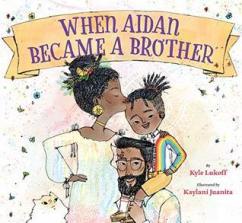 Authors typically have very little, if any, collaboration with their illustrators! When it came to Aidan, Kaylani had free rein to interpret my words in a way that matched her creative vision for the story–the outfits, the setting, the emotional tenor of each scene. She’s Black and Filipina, which is why she depicted Aidan’s family that way, and I love telling kids about how we both put parts of our story into this book.
I did ask for a few small changes–the only one I remember is something hinting at what Aidan’s old name was, but since I never imagined what his name used to be, I asked to replace that detail because I didn’t want to give people permission to speculate. But I largely trusted her, not just because I’m not a visually-minded person, and now I can’t imagine the book any other way.
Also, Aidan is not especially close to me personally. It is close to me politically, in that I have a lot of opinions about transmasculinity and misogyny, parental responsibility, gender reveal parties, etc. etc., but my life story isn’t at all close to Aidan’s–I came out when I was in college, I don’t have a little sibling, etc. etc. I might feel more protective if someone were to make a picture book biography of me! (no one do that ever please and thank you).
You have so much professional experience with children, and prior to COVID, school visits were also a big part of being an author for you. What do you think adult authors of queer literature for kids misunderstand the most about their audiences, and what should they keep in mind when writing for them?
Kids are entire human beings with inner lives and moral compasses all their own, and you cannot mold a person’s sense of self by just telling them what to think. I read a lot of scenes in books (not just queer-themed) where there are moments that are so clearly didactic, imparting important lessons about intersectionality or assimilation or privilege or what-have-you, and I’m not sure if those land as clearly as the authors are hoping they will. When I read middle grade novels aloud to my students, I would often stop to discuss important scenes, and what kids took away from them was often nothing like what the author had intended (in some cases I knew the author and could ask about their intent, in other cases it was just clear to me as an adult). So I wish authors focused more on telling a story and allowing for varied answers to complex questions, instead of trying to tell kids what they should believe. I’m definitely guilty of that too, so I’m also telling this to myself.
Of all the age groups you’ve written for, is there one that’s closest to your heart and/or one you feel is most specifically in need of trans literature written by an actual trans person? Is there one you simply prefer most from a craft perspective?
Fifth grade is very close to my heart, because that’s the year my students graduate from the school I worked at–so, they were generally the kids I knew the longest (the 5th grade class of 2021 includes students I met when they were two!), and it was incredible to watch them develop into sophisticated, mature thinkers. When I write middle grade I think, more than anything, of my fifth grade students, because in one class a kid might be re-reading Wimpy Kid and another might be tackling The Immortal Life of Henrietta Lacks or The Martian (true story!). I love trying to reach all those kids at once.
I do think that all ages would benefit from trans-themed books by trans writers, because…well, why not? I feel really grateful I’ve been able to build a career in so many different genres (more to come! including a board book! keep an eye out for announcements) and want that for my peers.
From a craft perspective, I will always love the challenge of writing as much as possible in as few words as possible. I’ve been branching out into more creative structures; I have one book coming out that is the simplest story imaginable, told in a complex rhyme scheme that I think I invented, and that is the most fun I’ve putting a book together (well, “fun” in that I pulled out my notebook during an evening of existential despair, and putting words together like jigsaw pieces helped). I have another forthcoming project that’s an epistolary picture book, and I loved the restrictions that puts on the story. Basically the more restrictions on a project the more fun I have with it–someday I might attempt a novel written in blank verse or just (“just”) iambic pentameter, but that might be too ambitious.
I imagine launching your debut novel in a pandemic sucks, even if it’s not your first published work. What do you feel like you missed out on the most as a result, and were there any pleasant surprises that came with it? How did you celebrate?
It does suck! One piece of gratitude I’ve been holding onto, though, is that Aidan came out in 2019, and I took that fall off from my day job (which I’ve since quit) to travel all over the country. If I had had to cancel all that, I don’t know what kind of emotional state I’d be in (not a good one, I think!) so I have so much sympathy for my author friends debuting into this.
So, I know a lot of what I missed out on–baths in hotel rooms that someone else paid for, kid-made signs welcoming me to their school, a significant percentage of my projected income. But on the other hand, I don’t think I would have made my deadline for novel #2 if I hadn’t been just home writing. I also sold a bunch of other projects, for a bunch of different age groups. Too Bright To See still got six starred reviews. I still got to launch with Maulik, which was dreamy. I’m not good at celebrating in the best of times, but right after the virtual launch a neighborhood friend took me out for a beer and some microwaved crinkle fries. It was really nice weather, and I think it’ll be a good memory, everything aside.
Of course there’s already a lot of work under your belt in such a short time, but are there any other categories or genres you’d really like to publish that you haven’t attempted yet?
I love writing short stories (for adults) and have a lot of them that I keep trying to get published and they keep getting rejected! I am also not trying very hard, I suppose, because that whole process is really unpleasant. But in general I would love to branch out into adult fiction, not least of which because I’m worried that all the fun and cool adult trans writers think that I’m the FTM Mr. Rogers and I want them to think that I’m a fun and cool grown-up too.
Are there any queer and/or trans books you’d particularly like to recommend, especially if you don’t think they’ve gotten sufficient airtime?
So, my favorite thing is intra-community conflict and dialogue. As I said earlier, about why I don’t really write about transphobia, I simply don’t think that anything cis/straight people have to say about trans/queer people is interesting, but I am endlessly fascinated with how we treat each other, and how conflict within LGBTQIA+ communities play out, in both deadly serious ways and more frivolous ones. There are quite a few authors doing this, but I especially love Lev Rosen’s YA novels Jack of Hearts (and Other Parts) and Camp.
What’s up next for you?
I’m really excited for my first nonfiction picture book, a biography that I wrote with Gavin Grimm. He’s the trans activist who, as a teenager, worked with the ACLU (and Chase Strangio) to fight his school’s bathroom policy. It’s called If You’re A Kid Like Gavin, and will be out in summer of ’22 from Katherine Tegen Books, illustrated by J Yang. I also have…um…5? or 6? new books that haven’t been announced yet, so keep an eye out for those as well!
***

Cat: Jasmine
Kyle Lukoff writes books for kids and other people. Right now you can read his debut middle grade novel TOO BRIGHT TO SEE, A STORYTELLING OF RAVENS, WHEN AIDAN BECAME A BROTHER (which won the 2020 Stonewall Award!), the MAX AND FRIENDS series, and EXPLOSION AT THE POEM FACTORY. You will be able to read more books by him in the next years, including a non-fiction picture book about teenage trans activist Gavin Grimm, and a book for babies.
Kyle spent eight years as an elementary school librarian, but now he writes full time and presents on children’s and youth literature all across the country. He got hired at a bookstore when he was sixteen, which means he’s been working at the intersection of books and people for well over half his life.
Kyle is represented by Saba Sulaiman at Talcott Notch. Find him on Twitter at @KyleLukoff and Facebook at fb.me/kylelukoffwrites. All purchasing links are through his affiliate page at Bookshop.org.

 When Zora Novak is framed for a crime she didn’t commit, she must track down the true culprit and clear her name before it’s too late. But in a small town obsessed with ghosts, getting people to believe the truth might prove to be impossible. Fans of Riverdale and Maureen Johnson’s Truly Devious will devour this eerie murder mystery. Features spot art and a map by the author.
 The Larkin family isn’t just lucky—they persevere. At least that’s what Violet and her younger brother, Sam, were always told. When the Lyric sank off the coast of Maine, their great-great-great-grandmother didn’t drown like the rest of the passengers. No, Fidelia swam to shore, fell in love, and founded Lyric, Maine, the town Violet and Sam returned to every summer.
 After the War of Kinds ravaged the kingdom of Rabu, the Automae, designed to be the playthings of royals, usurped their owners’ estates and bent the human race to their will.
 Kate and Tam meet, and both of their worlds tip sideways. At first, Tam figures Kate is your stereotypical cheerleader; Kate sees Tam as another tall jock. And the more they keep running into each other, the more they surprise each other. Beneath Kate’s sleek ponytail and perfect façade, Tam sees a goofy, sensitive, lonely girl. And Tam’s so much more than a volleyball player, Kate realizes: She’s everything Kate wishes she could be. It’s complicated. Except it’s not. When Kate and Tam meet, they fall in like. It’s as simple as that. But not everybody sees it that way. This novel in verse about two girls discovering their feelings for each other is a universal story of finding a way to be comfortable in your own skin.
 Many years ago, Claire was named Head Librarian of the Unwritten Wing—a neutral space in Hell where all the stories unfinished by their authors reside. Her job consists mainly of repairing and organizing books, but also of keeping an eye on restless stories that risk materializing as characters and escaping the library. When a Hero escapes from his book and goes in search of his author, Claire must track and capture him with the help of former muse and current assistant Brevity and nervous demon courier Leto.
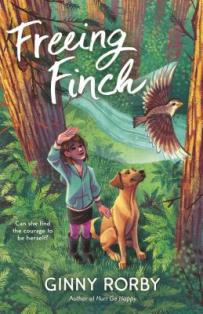 When her father leaves and her mother passes away soon afterward, Finch can’t help feeling abandoned. Now she’s stuck living with her stepfather and his new wife. They’re mostly nice, but they don’t believe the one true thing Finch knows about herself: that she’s a girl, even though she was born in a boy’s body.
 It’s the fall of 2016. Cate, a set designer in her early forties, lives and works in Chicago’s theater community. She has stayed too long at the fair and knows it’s time to get past her prolonged adolescence and stop taking handouts from her parents. She has a firm plan to get solvent and settled in a serious relationship. She has tentatively started something new even as she’s haunted by an old, going-nowhere affair. Her ex-husband, recently booted from his most recent marriage, is currently camped out in Cate’s spare bedroom, in thrall to online conspiracy theories, and she’s not sure how to help him. Her best friend Neale, a yoga instructor, lives nearby with her son and is Cate’s model for what serious adulthood looks like.
 Lethe Press is excited to be releasing the debut short story collection by Bogi Takács. Takács may be known more for their recent editorial efforts, winning a Lambda Literary Award for Transcendent 2: The Year’s Best Transgender Themed Speculative Fiction. But Takács is a talented storyteller and poet. An uplifted octopus finds a strange capsule in the water and wonders if one of the long-vanished humans might be found inside; a team of scientists perform some reverse-engineering on a space station and shapeshifting becomes political; and other tales of AI, hybrids, and the far future.
 Freshly graduated Master Physician Narsi Lif-Tahm has left his home in Anacleto and journeyed to the imposing royal capitol of Cieloalta intent upon keeping the youthful oath he made to a troubled writer. But in the decade since Narsi gave his pledge, Atreau Vediya, has grown from an anonymous delinquent to a man renowned for penning bawdy operas and engaging in scandalous affairs.</p>
 Lake Geneva, 1816. Nineteen-year-old Mary Shelley is inspired to write a story about a scientist who creates a new life-form. In Brexit Britain, a young transgender doctor called Ry is falling in love with Victor Stein, a celebrated professor leading the public debate around AI and carrying out some experiments of his own in a vast underground network of tunnels. Meanwhile, Ron Lord, just divorced and living with his mom again, is set to make his fortune launching a new generation of sex dolls for lonely men everywhere. Across the Atlantic, in Phoenix, Arizona, a cryogenics facility houses dozens of bodies of men and women who are medically and legally dead… but waiting to return to life.
 Hazel knows a lot about the world. That’s because when she’s not hanging with her best friend, taking care of her dog, or helping care for the goats on her family’s farm, she loves reading through dusty encyclopedias.
 A lively, intimate memoir from an icon of the gay rights movement, describing gay life in 1950s and 60s New York City and her longtime activism which opened the door for marriage equality.
 From award-winning poet Saeed Jones, How We Fight for Our Lives is a stunning coming-of-age memoir written at the crossroads of sex, race, and power.

 Jessie Archer is a member of the Athena Protocol, an elite organization of female spies who enact vigilante justice around the world.
 The Lunar Chronicles meets Rook in this queer #OwnVoices science-fantasy novel, perfect for fans of Marissa Meyer and Sharon Cameron.
 Frozen meets Mad Max in this epic teen fantasy duology bursting with star-crossed romance, immortal heroines, and elemental magic, perfect for fans of Furyborn.
 Nova Huang knows more about magic than your average teen witch. She works at her grandmothers’ bookshop, where she helps them loan out spell books and investigate any supernatural occurrences in their New England town.
 Dark, irreverent, and truly innovative, the speculative stories in Homesick meditate on the theme of home and our estrangement from it, and what happens when the familiar suddenly shifts into the uncanny. In stories that foreground queer relationships and transgender or nonbinary characters, Cipri delivers the origin story for a superhero team comprised of murdered girls; a housecleaner discovering an impossible ocean in her least-favorite clients’ house; a man haunted by keys that appear suddenly in his throat; and a team of scientists and activists discovering the remains of a long-extinct species of intelligent weasels.
 When Max starts school, the teacher hesitates to call out the name on the attendance sheet. Something doesn’t seem to fit. Max lets her know the name he wants to be called by–a boy’s name. This begins Max’s journey as he makes new friends and reveals his feelings about his identity to his parents.
 Veronica Welch has made it. She’s about to be named a partner at one of the most prestigious law firms in New York C ity. She’s on top of the world, except for one tiny ridiculous thing: she promised herself she’d be married by thirty-five. After a drink too many, she accidentally lets her “life plan” slip to Bea, her steadfast, ever meddling assistant, and now Bea won’t let the idea go.