New Releases: October 21st-31st

Amazon and IndieBound links are affiliate links. Please consider using them, especially the latter if you are able, to help support the site.

Most Ardently by Susan Mesler-Evans (21st)

Elisa Benitez is proud of who she is, from her bitingly sarcastic remarks, to her love of both pretty boys and pretty girls. If someone doesn’t like her, that’s their problem, and Elisa couldn’t care less. Particularly if that person is Darcy Fitzgerald, a snobby, socially awkward heiress with an attitude problem and more money than she knows what to do with.

From the moment they meet, Elisa and Darcy are at each other’s throats — which is a bit unfortunate, since Darcy’s best friend is dating Elisa’s sister. It quickly becomes clear that fate intends to throw the two of them together, whether they like it or not. As hers and Darcy’s lives become more and more entwined, Elisa’s once-dull world quickly spirals into chaos in this story of pride, prejudice, and finding love with the people you least expect.

Buy it: Amazon

I Hope You Get This Message by Farah Naz Rishi (22nd)

oct16Seven days. Seven days. The Earth might end in seven days.

When news stations start reporting that Earth has been contacted by a planet named Alma, the world is abuzz with rumors that the alien entity is giving mankind only few days to live before they hit the kill switch on civilization.

For high school truant Jesse Hewitt, though, nothing has ever felt permanent. Not the guys he hooks up with. Not the jobs his underpaid mom works so hard to hold down. Life has dealt him one bad blow after another — so what does it matter if it all ends now? Cate Collins, on the other hand, is desperate to use this time to find the father she’s never met, the man she grew up hearing wild stories about, most of which she didn’t believe. And then there’s Adeem Khan. While coding and computer programming have always come easily to him, forgiveness doesn’t. He can’t seem to forgive his sister for leaving, even though it’s his last chance.

With only seven days to face their truths and right their wrongs, Jesse, Cate, and Adeem’s paths collide even as their worlds are pulled apart.

Buy it: Amazon | B&N | Indiebound

Carved in Bone by Michael Nava (22nd)

This is the 8th book in the Henry Rios series

November, 1984. Criminal defense lawyer Henry Rios, fresh out of rehab and picking up the pieces of his life, reluctantly accepts work as an insurance claims investigator and is immediately is assigned to investigate the apparently accidental death of Bill Ryan. Ryan, part of the great gay migration into San Francisco in the 1970s, has died in his flat of carbon monoxide poisoning from a faulty gas line, his young lover barely surviving. Rios’s investigation into Ryan’s death – which Rios becomes convinced was no accident – tracks Ryan’s life from his arrival in San Francisco as a terrified 18-year-old to his transformation into a successful businessman. What begins for Rios as the search for the truth about Bill Ryan’s death becomes the search for the meaning of Ryan’s life as the tsunami of AIDS bears down on the gay community.

Buy it: B&N | Amazon | IndieBound

Find Me by André Aciman (29th)

This is the sequel to Call Me By Your Name

In this spellbinding exploration of the varieties of love, the author of the worldwide bestseller Call Me by Your Namerevisits its complex and beguiling characters decades after their first meeting.

No novel in recent memory has spoken more movingly to contemporary readers about the nature of love than André Aciman’s haunting Call Me by Your Name. First published in 2007, it was hailed as “a love letter, an invocation . . . an exceptionally beautiful book” (Stacey D’Erasmo, The New York Times Book Review). Nearly three quarters of a million copies have been sold, and the book became a much-loved, Academy Award–winning film starring Timothée Chalamet as the young Elio and Armie Hammer as Oliver, the graduate student with whom he falls in love.

In Find Me, Aciman shows us Elio’s father, Samuel, on a trip from Florence to Rome to visit Elio, who has become a gifted classical pianist. A chance encounter on the train with a beautiful young woman upends Sami’s plans and changes his life forever.

Elio soon moves to Paris, where he, too, has a consequential affair, while Oliver, now a New England college professor with a family, suddenly finds himself contemplating a return trip across the Atlantic.

Aciman is a master of sensibility, of the intimate details and the emotional nuances that are the substance of passion. Find Me brings us back inside the magic circle of one of our greatest contemporary romances to ask if, in fact, true love ever dies.

Buy it: B&N | Amazon | Indiebound

Full Disclosure by Camryn Garrett (29th)

Simone Garcia-Hampton is starting over at a new school, and this time things will be different. She’s making real friends, making a name for herself as student director of Rent, and making a play for Miles, the guy who makes her melt every time he walks into a room. The last thing she wants is for word to get out that she’s HIV-positive, because last time . . . well, last time things got ugly.

Keeping her viral load under control is easy, but keeping her diagnosis under wraps is not so simple. As Simone and Miles start going out for real–shy kisses escalating into much more–she feels an uneasiness that goes beyond butterflies. She knows she has to tell him that she’s positive, especially if sex is a possibility, but she’s terrified of how he’ll react! And then she finds an anonymous note in her locker: I know you have HIV. You have until Thanksgiving to stop hanging out with Miles. Or everyone else will know too.

Simone’s first instinct is to protect her secret at all costs, but as she gains a deeper understanding of the prejudice and fear in her community, she begins to wonder if the only way to rise above is to face the haters head-on…

Buy it: B&N | Amazon | Indiebound

All the Things We Do in the Dark by Saundra Mitchell (29th)
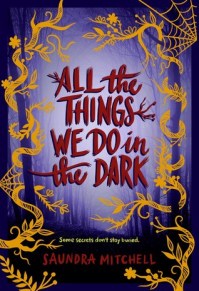
37236008There’s no such thing as a secret.

SOMETHING happened to Ava. The curving scar on her face is proof. But Ava would rather keep that something hidden—buried deep in her heart and her soul.

She has her best friend Syd, and she has her tattoos—a colorful quilt, like a security blanket, over her whole body—and now, suddenly, she has Hailey. Beautiful, sweet Hailey, who seems to like Ava as much as she likes her. And Ava isn’t letting anything get in the way of finally, finally seeking peace. But in the woods on the outskirts of town, the traces of someone else’s secrets lie frozen, awaiting Ava’s discovery—and what Ava finds threatens to topple the carefully-constructed wall of normalcy that she’s spent years building. Secrets leave scars. But when the secret in question is not your own—do you ignore the truth and walk away? Or do you uncover it from its shallow grave, and let it reopen old wounds—wounds that have finally begun to heal?

Buy it: B&N | Amazon | Indiebound

Beyond the Black Door by A.M. Strickland (29th)

stricklandbookKamai was warned never to open the black door, but she didn’t listen …

Everyone has a soul. Some are beautiful gardens, others are frightening dungeons. Soulwalkers―like Kamai and her mother―can journey into other people’s souls while they sleep.

But no matter where Kamai visits, she sees the black door. It follows her into every soul, and her mother has told her to never, ever open it.

When Kamai touches the door, it is warm and beating, like it has a pulse. When she puts her ear to it, she hears her own name whispered from the other side. And when tragedy strikes, Kamai does the unthinkable: she opens the door.

A.M. Strickland’s imaginative dark fantasy features court intrigue and romance, a main character coming to terms with her asexuality, and twists and turns as a seductive mystery unfolds that endangers not just Kamai’s own soul, but the entire kingdom …

Buy it: Amazon | B&N | Indiebound

I’m A Gay Wizard by V. S. Santoni (29th)

santonibookCarry On meets Rick Riordan in I’m a Gay Wizard, where a brave new nonbinary voice in YA fantasy has created a vivid, engaging world with love at its core

You do magic once, and it sticks to you like glitter glue…

When Johnny and his best friend, Alison, pass their summer holidays dabbling in magic, they never expect it to have consequences. Sure, it’d be great if they could banish bullies or change their lives for the better, and what harm could come from lighting a few candles and chanting a few spells? They get their answer in the form of an earthquake unleashed at their behest, which draws the attention of the Marduk Institute, an age-old organization dedicated to fostering the talents of young wizards.

Whisked away to the institute and told they can never return to their old lives, Johnny and Alison must quickly adapt to a new world shimmering with monsters, fraternities, and cute boys like Hunter and Blake. But when they’re pulled into a dark, supernatural fight that could cost them their lives, they’ll have to find strength they never knew they had as they battle for love, acceptance, and their own happy endings—all with the help of a little bit of magic

Buy it: Amazon | B&N | Indiebound

Fave Five: New and Upcoming Witches in YA

For even more YA witches, click here. And yes, this post has seven 2019-20s, not just five. What can I say? We’ve been blessed.

The Lost Coast by A.R. Capetta

These Witches Don’t Burn by Isabel Sterling (sequel coming in 2020)

Mooncakes by Suzanne Walker and Wendy Xu

Witches of Ash and Ruin by E. Latimer (Upcoming in 2020)

When We Were Magic by Sarah Gailey (Upcoming in 2020)

The Mermaid, The Witch, and the Sea by Maggie Tokuda-Hall (Upcoming in 2020)

The Scapegracers by H.A. Clarke (Upcoming in 2020)

Bonus: It doesn’t yet have a title, and it isn’t out until 2021, but it’s never too early to get Adrienne Tooley’s debut on your TBR! And though they’re yet not on Goodreads to add, The Contemporary Witches of Salem by Sol Santana and The Witches of Silverlake by Simon Curtis will be arriving then as well!

Double Bonus: You can also catch a sorceress in Reverie by Ryan La Sala, a wizard in I’m a Gay Wizard by V.S. Santoni, and a strega in The Storm of Life by Amy Rose Capetta, sequel to The Brilliant Death!

Excerpt Reveal: Homesick by Nino Cipri

Today on the site I’m excited to welcome Nino Cipri, author of the brand-new Homesick, which just released from Dzanc Books on Tuesday! It’s a short story collection that spans speculative, sci-fi, fantasy, and horror, with all sorts of queer/trans rep, including queer, bisexual, lesbian, gay, transfeminine, transmasculine, nonbinary, and bigender. Here’s the official blurb:

Dark, irreverent, and truly innovative, the nine speculative stories in Homesick meditate on the theme of home and our estrangement from it, and what happens when the familiar suddenly shifts into the uncanny. In stories that foreground queer relationships and transgender or nonbinary characters, Cipri delivers the origin story for a superhero team comprised of murdered girls; a housecleaner discovering an impossible ocean in her least-favorite clients’ house; a man haunted by keys that appear suddenly in his throat; and a team of scientists and activists discovering the remains of a long-extinct species of intelligent weasels. Nino Cipri’s debut collection announces the arrival of a brilliant and wonderfully unpredictable writer with a gift for turning the short story on its ear.

Buy it: Amazon | B&N | IndieBound

We’re celebrating the release with an excerpt from the novella “Before We Disperse Like Star Stuff,” which you can learn more about here:

Three years ago, Damian Flores, Min-Ji Hong, and Ray Walker made the discovery of a lifetime: the fossilized remains of a long-dead species of intelligent weasels, who had a developed language and writing system. Their find helped redefine ideas of sentience and saved parts of Pine Ridge from natural gas extraction. Three years later, however, Damian can’t shake the suspicion that he’s a sellout, Min can’t find a post-doc fellowship despite co-discovering a non-human language, and Ray is languishing in boredom in a small Kansas college town. When an opportunity to film a documentary about their discovery arises, the three former friends must reckon with secrets, drunken apologies, baby otters, and the bullshit colonial underpinnings of archeology.

(Rep notes for anyone curious: Damian is Latinx, transmasculine, and queer. Min is a transwoman and Korean-American. Ray Walker is Lakota and bisexual. )

And here’s the excerpt!

Ray’s flat Midwest accent always made Damian think of hollow logs rolling down a hill. It was unmistakable and weirdly attractive.

“I was hoping to talk to you,” Damian answered. Ray had grown his hair out and wore it tied back in a messy bun, wavy tendrils escaping in the wind. Damian instinctively wanted to tuck them back behind Ray’s ears.

“Hell of a drive from New York City, just for a conversation,” Ray said. “Why didn’t you call?”

“You changed your number.”

Ray rolled his eyes. “Min still has my number. You could have gotten it from her.”

He hadn’t even thought of that. Why were Min and Ray still talking to each other and not to him? He was the connection between them, the common denominator. He’d assumed that they’d all lost touch at the same time, after he’d announced his book deal and they looked at him with betrayal instead of excitement. “I’ve got a proposition for you,” he said to Ray. “I figured you’d be less likely to turn me down in person.”

Ray huffed—not quite a scoff, but too annoyed to be a laugh. “Good to know you’re still a manipulative shit.”

“I guess I deserve that,” Damian said quietly. He absolutely deserved that. Even now, he was calculating how much hurt to allow into his voice and vigorously hating himself for it. He wanted to be a good person, but he wanted to do good work more. This documentary was good—ergo: all was fair.

“Come on,” Ray said. “Step into my office.”

His office was, of course, his truck, and if the sight of it had been a punch to the gut, stepping into it was like getting reverse-suplexed into the past. Same threadbare fabric on the seats. Same clatter of coffee cups rolling around the footwell. Same dusty dashboard, with the word BUTTS etched into the leather near the passenger window—a gift from one of Ray’s nephews. Ray had attempted to turn it into the word BURTS, supposedly in honor of Reynolds and Kwouk, but with meager success.

It was horrible. Damian only liked the past when it was a minimum of six hundred years old.

“The good old Buttsmobile,” he said.

“It’s the Burtsmobile, damn it,” Ray muttered. “What’s your proposition?”

“The Smithsonian wants to make a documentary about ossicarminis.”

“Adapt your book, you mean?”

“Not just the book,” Damian said. “They optioned it as an actual documentary about ossicarminis, finding and identifying them, the whole thing with NEOCO.” He wasn’t going to go into the Space Weasels. He could only have one crisis of conscience at a time.

“And what happened after? Our falling out? Or only the part of the story that makes you look good?” Ray asked. He’d always been blunt. Damian used to like that about him.

“Is that what you call it?” Damian asked, honestly interested. “A falling out?”

Ray shrugged. “That’s what other people call it when they’re trying to ask me what happened.”

“Falling out,” Damian said again, testing the words. Like it was natural law, rather than two stubborn assholes roleplaying an unstoppable force meeting an immovable object.

“I told them I wouldn’t do it without you and Min,” Damian said. It wasn’t quite a lie; assuring Annika that Ray and Min would definitely sign onto the project was basically the same thing. “The two of you are the story. More than me. I just got lucky by falling in a cave.”

Ossicarminis is the story,” Ray said. “I—I don’t—”

Damian waited him out, toying with the iron pendant his mother had made him in a smithing class.

“I don’t want to rehash the whole thing, man,” Ray said eventually. A nice blush was spreading across his cheek. “Not what happened between us. That stays off camera and in the past.”

“I am one hundred percent okay with that,” Damian said, and knew it was a lie as soon as he said it. He had fallen into a fast, consumptive love with this nerdy asshole and his terrible khakis, his probably lethal caffeine habit, and his utter disinterest in being tactful. Their so-called falling out hadn’t changed that. He had planned on avoiding Ray forever, but he’d come around to the idea that this could be his second chance. That’s why he’d actually driven to this godforsaken prairie infested with Elvis-themed restaurants. They’d wanted the same thing, after all: to spread the word about ossicarminis, to make people understand the gravity of this discovery. They had disagreed loudly and angrily on how to do that, and Ray had dumped him.

And then he’d grown out his hair, which just seemed unfair.

“You grew out your hair,” Damian said, like the lovesick dumbass he was.

Ray ran a self-conscious hand over it. “I told myself I would when I got tenure. When they couldn’t fire me for looking ‘unprofessional.’” The word dripped with sarcasm. “Not sure if that meant too gay or too Indian. The chair never specified. Both, probably.”

The familiarity was a physical ache; Damian thought of the feeling of taking off his binder after a day of wear, stretching his shoulders back after hunching them for hours. It was unfair, it was exquisite, and it felt like pressing hard on a bruise that he’d successfully ignored for the past year and a half.

“So?” he asked. “Documentary?”

***

Nino Cipri is a queer and trans/nonbinary writer, editor, and educator. They are a graduate of the 2014 Clarion Writers’ Workshop, and earned their MFA in fiction from the University of Kansas in 2019. Their fiction collection Homesick won the Dzanc Short Story Collection award, and their novella Finna–about queer heartbreak, low-wage work, and wormholes–will be published by Tor.com in 2020. A multidisciplinary artist, Nino has also written plays, screenplays, and radio features; performed as a dancer, actor, and puppeteer; and worked as a stagehand, bookseller, bike mechanic, and labor organizer.

One time, an angry person on the internet called Nino a verbal terrorist, which was pretty funny.

Writing Bisexual Characters—By Accident: a Guest Post by Author Nem Rowan

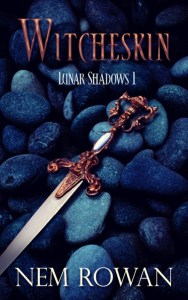
Today we’re welcoming to the site author Nem Rowan, author of Witcheskin and Rough Sleepers, genre mashups of horror, urban fantasy, and romance with trans and queer representation set in the UK that make for perfect reads for this time of year! The books are being rereleased following the closing of Less Than Three Press, so the author is here to give them a boost and talk about how bisexuality unexpectedly found its way into his stories!

***

My two books, Witcheskin and Rough Sleepers, recently received a re-release through JMS Books after the closing down of Less Than Three Press, and both have transgender representation in them. What I didn’t plan for when I wrote these books was the representation of bisexuality! Rough Sleepers was one of the finalists in the Bi Writers Association’s 2018 Annual Book Awards for the Romance genre, and this made me consider how and why I seem to write in bisexual characters, sometimes without even meaning to.

I am a transgender man, and this makes a large impact on the kind of characters I write and the way I write about them. Being trans means I sometimes approach certain fictional situations in a different way to how a cis-gendered writer might, taking into consideration the character’s self-esteem, physical presentation and anatomy. When you write trans characters as a trans author, a little part of yourself always makes it into the story, whether it’s in something the character says or does—such as coping strategies for living in a world that can be quite hostile at times—to the reasons for the clothes they wear. But, whether a writer is trans or not, a part of yourself is always there in the writing, and I suppose I didn’t consider that my sexuality would have such a far-reaching, yet subtle, influence on what I wrote as well.

Just a little warning that there are spoilers ahead for those who haven’t read my books!

In Witcheskin, the character Wenda and her husband Evan were in a poly relationship with the main villain of the story, Geraint. At the time of writing, I never considered that this would actually mean—as they were in an equal triad—that both Evan and Geraint were bisexual. It’s never explicitly written in the book, but I had always considered Maredudd, the love interest and secondary main character, to be bisexual, in that his character is heavily inspired by water, and the fluidity of water. It was not a far stretch for me to imagine Maredudd dating a man, a woman, or anyone really, and perhaps that is why he is so ready and willing to accept Owen. Maredudd has no boundaries and lives a free, sometimes wandering, life. Why wouldn’t his sexuality be like that too?

Moving on to Rough Sleepers, the categorisation of the main character’s sexuality became complicated when it came to defining its place in publishing. Leon is bigender, and (s)he switches between male and female frequently throughout the book. Leon’s sexuality is hard for him/her to define, and even harder for me to define, even though it’s clear that Leon is chronically attracted to masculinity. Ceri, on the other hand, had his sexuality pre-planned for me, since he appears as Geraint in the first book, and after dating Wenda for a time, then goes on to be in a relationship with Leon. Even Mecky, one of the other main characters, leans heavily into bisexuality, as she is attracted to both masculinity and femininity, and seems to take particular interest in gender transformation. I never planned any of these things when I wrote the book; I just wrote it.

My third, currently unreleased, novel The Things We Hide At Home, which hopefully will be getting the release it deserves through JMS Books, is the first book I’ve ever written with a strictly gay male/male romance, and I’m not entirely sure why it ended up that way. The main character, Tenny, is a trans male who is also gay, and is quite different to Owen in how he navigates the world. Perhaps when I wrote this novel, I was going through a particularly gay phase myself. Bisexuality, at least for me and the bisexual people I know, seems to fluctuate in waves, and is never a static block of 50% masculine, 50% feminine.

I think when authors allow their characters to evolve completely organically, by simply guiding them along the vague path chosen by the plot line, they sometimes end up choosing their own sexualities. When I create characters, their sexuality is the last thing I think about. At times, their default sexuality just happens to be bisexual, even if I don’t realise it, and it opens them up to choosing their loves in sometimes totally unexpected ways. Only later, when they have established a solid personality and romance do I then decide what to do about their sexuality, and even then it may just be a small note jotted on a pad somewhere.

Likewise, I’m not saying it’s wrong to pre-plan your character’s sexuality. That’s an impossible thing to refrain from if the story is deeply entwined with that aspect of the character, for example, in a coming out story, or a book based on someone’s life experiences. But, that’s just not my writing style! I think it’s wonderful that writers will actively choose to make their characters LGBTQ+ because it’s important to get that work out there, to the people whose lives we are representing, to the people who need it the most. It could be that my books, and other authors’ books, are found by accident while searching, by someone who needed to see themselves in a main character, being brave and finding their place in the world, because that makes all the difference when you feel isolated and alone.

I feel that bisexuality is sometimes under-represented, and I’d love to see it written about more and more in the LGBTQ+ fiction world. It doesn’t necessarily mean having a gay couple at the forefront—it could have a male and a female in what appears to be a heterosexual relationship, but if one or both of them is bisexual, it’s still queer. We can’t, as a community, do bisexual people a disservice by dictating who they fall in love with, whether it’s gay or straight or anything else, because then we risk becoming the oppressors we’ve fought against all these years.

Bisexuality isn’t greed or indecision; it’s just another sexuality colour in the rainbow.

***

Nem Rowan lives in Sweden with his wife and their girlfriend. He loves reading non-fiction and is fascinated by True Crime and unsolved mysteries, especially missing persons cases and serial killers. Nem is also well-read in mythology and folk tales, particularly British and European folklore. He is a huge fan of Horror movies and Retrowave music.

Nem started writing when he was 11 years old and since then, he’s never looked back. Romance has always been his favourite genre after inheriting a box of Mills & Boon novels from his grandma, but being a Horror fan, there is always some way for him to work in a bit of that to make sure things don’t get too mushy.

https://nemrowan.com
https://instagram.com/nemrowan
https://twitter.com/MrNemRowan

Backlist Book of the Month: Casting Lacey by Elle Spencer

Is banter the #1 thing you crave in romance novels? Was Kalinda Sharma being bi one of the highlights of your TV-watching experience? Is slow-burn with fiery chemistry one of your favorite things on the planet? Do you appreciate Romance novels where a character still has to deal with coming out for the first time as an adult? Are Hollywood Romances your jam? Honestly, the answer is a resounding “Yes” for me for every one of these questions, but if it’s a “Yes” for even one of them for you, Casting Lacey is an A+ choice for your next f/f Romance read! I’m often asked for my favorite adult f/f Romance, and, well, here’s the answer, so I hope you love it as much as I do!

Coming out is easier when you’ve got someone by your side. At least that’s how the hyper-private Quinn Kincaid sees it. When her publicist suggests a good old-fashioned sham of a Hollywood relationship, Quinn reluctantly agrees. And that’s how the star of Jordan’s Appeal, TV’s highest rated legal drama, ends up with a fake girlfriend—the very real, very sexy, and very gay soap star, Lacey Matthews.

The two clash immediately, and often hilariously, as they figure out how to fake a budding romance. And of course, things are never as simple as they seem. A freak accident, some reluctant caregiving, and a chance to work together on Jordan’s Appeal force Quinn and Lacey closer together—for better or worse.

In Casting Lacey, Elle Spencer gives us a funny new take on a classic storyline, complete with nosy mothers, fawning assistants, and two beautiful actresses who might learn about true love. If they don’t kill each other first.

Buy it: Amazon | Kobo | Audible


Fave Five: Canadian YA

Girl Mans Up by M-E Girard

Past Tense by Star Spider

The Scorpion Rules by Erin Bow

Way to Go by Tom Ryan

That Inevitable Victorian Thing by E.K. Johnston

Bonus: Coming in 2020, check out When You Get a Chance by Tom Ryan and Robin Stevenson, set at Toronto Pride!

Exclusive Cover & Excerpt Reveal: In the Role of Brie Hutchens… by Nicole Melleby

Happy National Coming Out Day! What better way to celebrate than with a cover reveal for a coming out story that must be on your radar for 2020??

Nicole Melleby is no stranger to the site, and should certainly be no stranger to any fans of queer MG, with Hurricane Season now behind her and several more coming up, including the beauty whose cover we’re revealing today: In the Role of Brie Hutchens…, which releases from Algonquin on April 21! Here’s the official copy for the book:

Introducing Brie Hutchens: soap opera super fan, aspiring actor, and so-so student at her small Catholic school. Brie has big plans for eighth grade. She’s going to be the star of the school play and convince her parents to let her go to the performing arts high school. But when Brie’s mom walks in on her accidentally looking at some possibly inappropriate photos of her favorite actress, Brie panics and blurts out that she’s been chosen to crown the Mary statue during her school’s May Crowning ceremony. Brie’s mom is distracted with pride—but Brie’s in big trouble: she has not been chosen. No one has, yet. Worse, Brie has almost no chance to get the job, which always goes to a top student.

Desperate to make her lie become truth, Brie turns to Kennedy, the girl everyone expects to crown Mary. But sometimes just looking at Kennedy gives Brie butterflies. Juggling her confusing feelings with the rapidly approaching May Crowning, not to mention her hilarious non-star turn in the school play, Brie navigates truth and lies, expectations and identity, and how to—finally—make her mother really see her as she is.

And here’s the rainbowtastic cover, with art by Stephanie Singleton, design by Carla Weise, and hand lettering by Maeve Norton!

Buy it: Amazon | B&N | IndieBound

Can’t wait to dive in? Good news: you don’t have to! We’ve got the first chapter right here:

Brie was almost positive her mom didn’t like her.

That wasn’t to say her mom didn’t love her. But Brie had a hard time believing that she liked her. For example, Brie didn’t think she was the type of girl her mom would point at and go “Now that is a good girl” if they met elsewhere. Someone like Kennedy Bishop, on the other hand, was the quintessential good girl. Everyone’s mom liked Kennedy Bishop.

Kennedy was destined to be the eighth grader chosen to crown Mary at Our Lady of Perpetual Help’s annual celebratory mass in the spring. Brie wouldn’t have cared which of her classmates was chosen—really, she wouldn’t have—if it hadn’t been for Kelly Monaco’s boobs.

Look, first of all, Kelly Monaco was Brie’s favorite soap opera star, and she also had really great hair. Even Brie’s mom thought so. They’d had an entire conversation about it while watching General Hospital together. “Kelly Monaco has really great hair,” her mom had said.

“She has really great everything,” Brie had responded— immediately turning red. Her mom hadn’t noticed.

Later Brie Googled photos of Kelly Monaco’s really great hair. How was she supposed to know Kelly had done Playboy photos and that they would be the first thing to pop up? Really it was her mom’s fault, since she had brought up Kelly Monaco’s hair to begin with, and honestly Brie kept looking at the photos only because she was curious.

Well, curious . . . and maybe a little flustered.

Of course that flustered moment was when her mom decided to waltz into her room, carrying Brie’s laundry and lecturing her about the need to unfold socks before throwing them in the hamper. Brie’s backpack was strewn on the floor, and—miracle of miracles—her mom tripped over it, stum- bling just enough to shift her eyes away from Brie’s computer screen. Brie—flushed and about to burst into flame—caught sight of her religion book as it slipped out of her bag. A statue of Mary with her arms outstretched beckoned from the cover. That was the moment Brie practically shouted, “I’m going to crown Mary!”

At the time it seemed like divine intervention.

Her mom was delighted. Brie closed her browser. Crisis averted.

Well, at least that crisis. The bigger problem was she hadn’t been chosen to crown Mary. No one had. The selec- tion wouldn’t happen for weeks, because, needless to say, the May Crowning was in May. The students of Our Lady of Perpetual Help still had fourteen weeks of regular masses to prepare for the eighth-grade event.

It was a big deal in Catholic school, or at least at Brie’s. May was the month they honored and celebrated the Mother of God by holding a special church mass during school and inviting the rest of the parishioners to attend. The eighth- grade students got all dressed up—out of their uniforms and into their Sunday best—and the rest of the school gathered in the church to watch as the chosen one went up on the altar and put a crown made of flowers on the Mary statue’s head. Since Brie had gone to OLPH since kindergarten, she’d sat through eight May Crowning masses. Now she would need to do more than sit through the ninth.

***

Nicole Melleby is a born-and-bred Jersey girl with a passion for storytelling. She studied creative writing at Fairleigh Dickinson University and currently teaches creative writing and literature courses with a handful of local universities. When she’s not writing, she can be found browsing the shelves at her local comic shop or watching soap operas with a cup of tea.

Authors in Conversation: Maulik Pancholy and Phil Stamper Talk Mental Health

Today is World Mental Health Day, and I’m thrilled to be celebrating it by having two wonderful gay kidlit authors discuss the representation in their book!

Maulik Pancholy (r.) is the author of the newly released The Best At It, a Middle Grade contemporary starring a gay Indian boy with OCD who’s starting seventh grade and getting used to lots of new changes, and Phil Stamper (l.) is the author of the upcoming The Gravity of Us, a contemporary YA love story between two boys who happen to be the sons of astronauts who are on the same mission to Mars. They’re here to talk about the roles mental health plays in their books, especially as it relates to queerness, pressure, and competition. Please welcome them!

Maulik: Hi Phil! I’m excited to get to do this with you. I loved The Gravity Of Us. I wanted Cal’s FlashFlame show to be real so I could actually tune in, and I was rooting for him and Leon from the first moment they met. I also lived in Houston for a year, so I related to all the characters having to deal with all that humidity! For folks who haven’t read it yet, want to give us a quick recap?

Phil: Thank you so much! A bit about my book: The Gravity of Us is a queer teen love story set against the backdrop of a present-day NASA mission to Mars. The story follows teen social media journalist Cal, whose carefully planned life is uprooted when his father is picked as an astronaut for the Orpheus missions to Mars. Amidst the chaos, and the move from Brooklyn to Houston, Cal meets the son of another astronaut on the program and finds himself falling for him—fast. But when Cal uncovers secrets about the program, he must find a way to reveal the truth without hurting the people who have become most important to him.

Do you want to give a brief rundown of The Best at It as well? It’s such a fantastic story. I love Rahul (and Chelsea! And Bhai! And the whole gang, really) and I remember having a similar need to be “the best” at something when I was his age… even if I could never quite figure out what that “something” was.

Maulik: Thanks! I’m glad it resonated with you. The Best at It is about Rahul Kapoor, a 12-year-old, Indian American boy who is just beginning to realize that he might be gay. He’s dealing with anxiety around that, and he’s also being bullied for multiple layers of his identity at school. One night, his favorite person in the whole world, his grandfather, Bhai, tells him a story that makes Rahul believe that if he’s just the best at something, all of his other problems will disappear. So with his best friend Chelsea by his side, he sets off on a mission to prove his self-worth. He’s only got two problems: What is he going to be the best at? And what if he falls short?

Phil, one of the things that I was struck by, is that in both of our books we have characters dealing with different forms or manifestations of anxiety. In your book, Becca, Cal’s mother, struggles with anxiety in a way that really hit home for me. I was drawn in by the way you described her facial expressions, and how it affected Cal to see that. Want to talk about that a bit?

Phil: Ah, that’s so great to hear. Becca’s anxiety was based off of my own experience, but it was really interesting writing Gravity from the perspective of someone who does not share those experiences. At that time, I think I was trying to be more cognizant of what happens to me and how that might affect or appear to people, and that really helped when describing the smaller physical manifestations of her anxiety.

Cal’s mom was such an interesting character, because I wanted to play against the “perfect astronaut wife” trope of the 60s. While she still knows there’s an expectation of her to be polished, steady, and camera-ready when it comes to the media circus of the launch, she gets to break down some of those expectations with Cal and her family, because she’s so open and clear about her experience with anxiety.

While we’re on the topic of mental health, one thing about The Best at It that stuck with me was how naturally Rahul’s experience with probable OCD was “revealed” on the page. Oftentimes with mental health in media, especially with OCD rep, we get something that’s a little less nuanced, but the way it was shown in your story made his experience seem so authentic and relatable. How did you choose to show this throughout the story?

Maulik: Rahul’s behaviors in the book are similar to some of the “checking” behaviors that I dealt with as a kid, and honestly still do as an adult. In my experience, those behaviors presented in different ways. Sometimes it was just checking something, like a lock, in a seemingly absent-minded manner, not really aware of the impulse why. Sometimes it was having an overwhelming feeling that something bad would happen if I didn’t check something, repeatedly. That dread of, “Is the stove really off? Am I SURE?” And, for me, these patterns were certainly triggered–and intensified–by stress, including emotional stress.

I’m hearing from middle school teachers that they see more and more kids dealing with anxiety. So, I didn’t want to shy away from this in the book. I also wrote the scene between Rahul and his father to model the kinds of conversations that I think adults and kids can be having around this.

For Rahul, his checking escalates as the level of competition in the book grows. In your book, Leon is dealing with depression related to the competitive world of Olympic athletics. Would you say that Leon is affected by competition in a similar way to Rahul?

Phil: That’s an interesting comparison, because I do think Leon and Rahul have a similar experience in that competition is a trigger for them. Gymnastics is a really intense sport that is full of pressure, and Leon’s response to that pressure was to pull back, to withdraw from the world and sort of shame himself for feeling this way, even if he couldn’t control it. That said, Leon’s a few years older than Rahul, and he is more-or-less removed from his Olympic trajectory by the time we get to meet him, even if the media conveniently forgets that on occasion.

Not a big spoiler here, but in the end, Leon finds a way to rekindle his passion for gymnastics, without subjecting himself to the pressure of competition. Similarly, and hopefully not a spoiler, but Rahul realizes that finding something you love and doing it until you get better is a better fit for him than competing. Does it mean that Leon and Rahul no longer experience depression or probable OCD, respectively? No, of course not.

But I do think it’s really important that both of these characters are learning more about themselves so they can hopefully better communicate that to their loved ones. Pivoting back to Cal for a moment—while I think Leon actually has a grasp on how to best avoid triggers like pressure and the spotlight, Cal’s kind of torn. He’s used to being in the spotlight, and he wants to be the one to break any and every news story, but he really gets himself into a mess in Houston, and you can really see the pressure and people’s expectations getting to him.

The more I think about it, Cal’s and Rahul’s stories both deal heavily with competition and perfection. With Rahul though, he’s experiencing this need for perfection all while trying to understand more about his queer identity. How do you think this affects his competitive nature?

Maulik: Rahul’s perfectionism and his need to win are 100% about proving his self-worth in a world where being different makes him feel less than. And his queer identity is one layer of that for sure. I just want to say, though, that it was important to me not to pathologize being gay. His mental health struggles are not because he’s gay. It’s the feeling less than, the wanting to fit in, that is stressful for him. And I think there’s something universal about that. What kid–or even adult–hasn’t felt like an outsider at some point?

Speaking of which, I think empathy for other people’s experiences really comes through in both our books, even if the characters themselves aren’t always perfect at expressing it. Rahul’s Dad doesn’t have all the language to talk about OCD, and in your book, you write about Leon’s parents choosing not to push the conversation around depression. In fact, it’s Leon’s sister, Kat, who’s a real ally to her brother. And Cal, of course, has Deb much in the same way Rahul has Chelsea. Was there a reason you wrote such great allies in the form of siblings and friends?

Phil: I guess I’ve written some really great allies and supporting characters, because the amount of comments I get about wanting to see more of Kat or Deb are astounding! Deb is loosely based around one of my best friends from high school, and she was so much fun to write. In the book, she’s the steadfast ally any queer kid would want, but I wanted to make sure she had her own story, her own arc, and didn’t exist solely for the benefit of Cal. So, I got to play with the boundaries of allyship and best friendship a bit. I also got to reflect on my own selfish tendencies, especially while I was in high school, and show how an ally can both offer unfaltering support about you and your identity while also being there to tell you to shut up when you’re out of line!

From our personal experiences with mental health, identity, and even the friendships we’ve had, it looks like we’ve both put a lot of ourselves into our debut novels. Would you like to talk briefly about why you chose to do this?

Maulik: Sure. The characters in my book go on a journey: they change, and they learn things about themselves. And maybe that allows readers to see themselves more clearly as well. What I really wanted was to tell a great story–grounded in reality, with both humor and pathos–and to hold up a mirror for kids who deserve to see themselves in the books they read. I guess that’s why I was willing to be so personal: I wanted to write a book that I could have used as a kid. But I have to say, it’s been gratifying to hear how many people–with experiences far different than mine–have made their own connections to Rahul’s story.

Phil: That’s fantastic. I set out to showcase a queer love story in a unique setting, so the feedback from the romance between Cal and Leon has been amazing. Less intentionally, though, I leaned on my own experiences with mental health while creating characters like Leon and Cal’s mother, and it’s been great to see readers connecting to that too.

I’m so glad we got to chat about this, Maulik! It’s been great getting to know a little bit more about your experience developing and writing The Best at It, and I can’t wait for readers everywhere to get their hands on a copy. And super special thanks to Dahlia and LGBTQ Reads for hosting us!

***

Buy The Best At It: B&N | Amazon | IndieBound

Preorder The Gravity of UsB&N | Amazon | IndieBound

New Release Spotlight: Mooncakes by Suzanne Walker and Wendy Xu

One of my favorite things about blogging is pushing myself into reading new things, and I could not have made a better choice for my first graphic novel than Mooncakes, written by Suzanne Walker and drawn by Wendy Xu. This book is a freaking delight, targeted to a YA audience and featuring a queer hard-of-hearing witch who lives with her grandmas and is delighted at the return of her old friend, a non-binary werewolf. Together, they fight a demon and celebrate Jewish and Chinese heritage and honestly it is all just glorious! 

A story of love and demons, family and witchcraft.

Nova Huang knows more about magic than your average teen witch. She works at her grandmothers’ bookshop, where she helps them loan out spell books and investigate any supernatural occurrences in their New England town.

One fateful night, she follows reports of a white wolf into the woods, and she comes across the unexpected: her childhood crush, Tam Lang, battling a horse demon in the woods. As a werewolf, Tam has been wandering from place to place for years, unable to call any town home.

Pursued by dark forces eager to claim the magic of wolves and out of options, Tam turns to Nova for help. Their latent feelings are rekindled against the backdrop of witchcraft, untested magic, occult rituals, and family ties both new and old in this enchanting tale of self-discovery.

Buy it: Amazon | B&N | IndieBound

Your Weapon of Choice: a Guest Post by Master of Restless Shadows Author Ginn Hale

Today on the site we’re welcome back Ginn Hale, whose fantasy Master of Restless Shadows, part of the Cadeleonian world (but kicking off its own new series) releases today! It’s full of espionage and other courtly intrigue, not to mention magic, witches, and romance. Here are the details:

Freshly graduated Master Physician Narsi Lif-Tahm has left his home in Anacleto and journeyed to the imposing royal capitol of Cieloalta intent upon keeping the youthful oath he made to a troubled writer. But in the decade since Narsi gave his pledge, Atreau Vediya, has grown from an anonymous delinquent to a man renowned for penning bawdy operas and engaging in scandalous affairs.

What Narsi―and most of the larger world―cannot know is the secret role Atreau plays as spymaster for the Duke of Rauma.

After the Cadeleonian royal bishop launches an unprovoked attack against the witches in neighboring Labara, Atreau will require every resource he can lay his hands upon to avert a war. A physician is exactly what he needs. But with a relentless assassin hunting the city and ancient magic waking, Atreau fears that his actions could cost more than his own honor. The price of peace could be his friends’ lives.

Buy it: Blind Eye Books | Amazon | Smashwords

And here’s the guest post on making choices in the world of weaponry in Epic Fantasy, complete with fabulous exclusive art from cover designer Zaya Feli!

***

Epic fantasy is full of weapons. Swords are particularly common. Some are imbued with specific and significant cultural meaning, such as Excalibur or Kusanagi-no-tsurugi. Others, like J.R.R. Tolkien’s Gurthang or Sikanda from The Never Ending Story are magical to the point of sentience, while others are simply notable for their history, quality or the use they are put to, such as Mr. Smee’s Johnny Corkscrew in Peter Pan—so named because of the way the sailor twists the blade in the wound after stabbing his opponent.

But it’s not just magical, mythical, or infamous weapons that convey information about the their world and the person wielding them. After all swords, spears, bows, guns, etc. are real tools with real histories. Everything about them—from how they’re made, how they’re adorned and who can carry them—has been shaped by particular places and times in human history.

To me as an author, this means that who I arm and how I choose to arm them can serve the story.  Even when the choice of weapon might seem little more than costume to a reader, often much more thought has gone into the matter.

When I began writing my Cadeleonians series—Lord of the White Hell, Champion of the Scarlet Wolf and Master of Restless Shadows—I called on personal experience, and a passing familiarity with the history of weapon to arm my protagonists and also to personalize how and why they fight.

Since the series begins inside a military academy, it only made sense to employ weapon preference and fighting styles to characterize the students and to add depth to their duels. (Not to mention the ambushes and battles they would later be involved in.)

Slim and smart, Kiram Kir-Zaki is far more interested in his mechanical studies than swordplay, so he relies on tactics more than strength. He also hails from a different culture than his sword-swinging Cadeleonian classmates, so his weapon of choice is a bow, which offers him the advantage of distance. Archery allows him to hunt birds, while his classmates gripe about winter rations of cabbage stew. His inventiveness also means that he eventually crafts his own unique weapons to defend himself and his family of choice.

His roommate Javier on the other hand is an excellent swordsman, but because his instructors believed he’s cursed he’s forced to undergo a regime of religious penance that leaves him physically weak. This leads to his decision to forgo both shields and longer, heavier swords, as just carrying them would exhaust him. Instead he relies on a light rapier—not unlike an early épée. Of course stepping into a dueling ring armed with such a fragile-looking sword broadcasts his vulnerability. Javier’s solution is to play up his weakness—expending the minimum of his strength to elude his opponents and hold them at bay all while lulling them into overconfidence. Then, having conserved his strength and lured his opponent into the range of his shorter, lighter weapon he strikes his winning blow.

At the opposite end of the spectrum is their friend Elezar, who possesses exceptional strength and reach. He comfortably wields a longer, much heavier sword; one that readily tears through the armored enemies he faces on the battlefield. Since the majority of his fighting is done while mounted I imagine him armed with something between an estoc and a broadsword. On foot, his weapon of choice is probably something like a bastard sword, (likely a hand-me-down and quite out of fashion, but comfortable to him and a reminder of the people he’s left behind when he journeys to other lands.) That said, Elezar has also won his way through couple predicaments by employing a woodcutter’s maul—ouch!—and his coin purse.

Master of Restless Shadows introduces a new character: Sabella, who is a professional fighter. But unlike the nobles who schooled at the Sagrada Academy, Sabella’s battles are fought in dueling rings of sword houses and serve as entertainment for gamblers and the general public. Her weapon is a civilian sword, a rapier. It’s easily sheathed and unsheathed in close quarters and meant for combat on city streets against unarmored opponents. Like Sabella herself, a rapier is agile and deadly. It’s also something a rarity for any woman to possess, as sumptuary laws would normally bar a Cadeleonian woman from wearing a sword. (Though my books are fantastical, sumptuary laws aren’t. They were and are still used to suppress gender and class freedom. Fascinating historical figures like as Mary Frith (aka Molly Cutpurse) and the extraordinary duelist, La Chevalier d’Eon number among the many people who struggled to live authentically under such laws.)  But since I took my initial inspiration from the real life figure of duelist and opera singer Julie D’Aubigny in creating Sabella, I allowed her to win a special dispensation to dress in men’s clothes—which includes her beloved rapier.

Master of Restless Shadows also introduces Delfia who, like Sabella, has been expertly trained in combat since childhood. But since she and her brother are assassins, it would hardly do for her to flout sumptuary laws or strut through the capitol with a rapier at her hip. Instead she carries a fighting knife, which her decorative sheath and full skirt help to disguise as a mere belt knife. And, of course, she also employs poison. Being smaller and less menacing in demeanor doesn’t make her less deadly. It does however mean that her greatest weapon is the element of surprise. (As in, ‘Surprise! That tiny jab from a lace needle was loaded with poison!’)

Ariz

And last but not (I hope) least is Delfia’s brother, Ariz. He puts me in mind of a quote attributed to Confucius: Never give a sword to a man who can’t dance. In his guise as an instructor of fencing and dance, Ariz often plays down his facility for swordplay. But his grace, balance and speed as a dancer really ought to betray him, particularly when it comes to sword dancing. (Most sword dances actually began as forms of military exercise and training, so that ought to be a give away right there.) However Ariz presents himself and his personal weapons in the most lackluster manner possible. Instead of using the eye-catching effect of bluing to bring out the splendor of his heavy rapier and dagger, Ariz’s weapons are russeted or browned. This chemical process renders the flats of the blades a dull black-brown. At a glance his drawn dagger can appear to still be sheathed.

This detail, is a small one but to me it is central to Ariz’s characterization. Not only does it display just how he fights and survives but it serves as a metaphor for the man himself. That’s not too shabby of a feat for a homely sword with a deadly point to pull off.

***

Ginn Hale lives with her lovely wife in the Pacific Northwest. She spends the many cloudy days observing plants and fungi. She whiles away the rainy evenings writing fantasy and science-fiction featuring LGBTQ protagonists. Her first novel, Wicked Gentlemen, won the Spectrum Award for best novel. She is also a Lambda Literary Award finalist and Rainbow Award winner.

Her most recent publications include the Lord of the White Hell, Champion of the Scarlet Wolf and The Rifter Trilogy: The Shattered Gates, The Holy Road, His Sacred Bones.

She can be reached through her website: www.ginnhale.com as well as on Facebook and Twitter. Her Instagram account, however, is largely a collection of botanical photos…so, be warned.