
It’s one thing to debut with a great addition to queer kidlit canon, particularly one that fills a huge gap, and with something beautifully written, no less. It’s another to do it in both Middle Grade and Young Adult in the same damn year. But that’s exactly what this month’s featured author, Kacen Callender, is doing with their 2018, and trust me when I say you wanna be along for the ride.
You, Kacen Callender, have had A Year! I’m gonna be greedy and jump ahead to your next release, because lord knows I am dying for everyone else to read the incredibly cute glory of This Is Kind of an Epic Love Story. What can you share about it, and what’s your absolute favorite thing in it?
 Thank you so much, that really means a lot! In Epic Love Story, Nathan Bird is afraid of letting himself fall in love–to him, happy endings only belong in rom-coms, not in real life–but his resolve against romance is tested when a long-lost childhood best friend, Oliver James, returns to town. Lots of cuteness ensues. 🙂
My absolute favorite thing in the novel? I’m pretty proud of the intersectionality, and seeing brown queer people in love and unapologetically happy. It makes my heart soar whenever I re-read the book, and is a love letter to myself and my QPOC sibs in a lot of ways: we absolutely deserve epic love stories, too.
Labels are conspicuously absent in Epic Love Story, which I imagine was a conscious choice. Is shifting away from labels something you’d like to see more of, or was it more of a “right for your characters” situation?
Glad you caught that! It was definitely a purposeful choice to shift away from labels in the book.
Labels are a source of pride for me, personally, and a way to connect with others who are also queer, trans, and/or nonbinary, for example. But when I’m around my community of QPOC friends and self-made family, we never really talk about labels. It’s understood, and generally unsaid, that one person can be into another regardless of gender identity. If we talk about labels, it’s usually for the sake of non-queer folk around us.
This is Kind of an Epic Love Story is set in a perfect world, where there’s no anti-queer climate for the characters to worry about (or racism, for that matter)—where labels aren’t necessary, because the idea of queer sexuality isn’t groundbreaking. This is what I hope is a perfect escape for QPOC readers, since we already deal with so much homophobia and racism in our every day lives.
Of course, you also released a Middle Grade this year, the wonderful Hurricane Child, which is a standout for so many reasons—a queer girl of color, a Caribbean setting… What has response to the book been like, and who’s your dream reader for it?
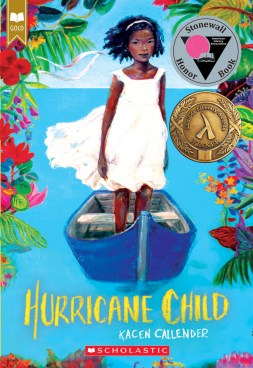 The response to Hurricane Child has been amazing. I really never dreamed that it would receive the level of love and support its gotten, which I’m so incredibly grateful for.
My dream reader is ultimately anyone who feels alone and isolated, and reads and feels empowered by Caroline Murphy and her journey to be herself—that she deserves to exist, and deserves to be happy, no matter what. Whenever I need a reminder of that myself, I just take a look at the cover, and that powerful expression on Caroline’s face.
You also somehow managed to be an editor at Little, Brown among all this, which is just wild to me. What drew you to the queer titles you worked on as an editor, and what would you like to see more of?
Well, the main queer title I worked on during my time at LBYR was Ashley Herring Blake’s Ivy Aberdeen’s Letter to the World, which to this day remains one of the most beautiful middle grade novels in existence. Ashley is such a talented author, and I know she’ll blow everyone away with her second MG novel, The Mighty Heart of Sunny St. James, which is out in March 2019 (I know, I know, such a long wait…)
As for what I’d like to see more of, I did want to see more queer MG books, and I do think that there’s still such a large gap to fill, but I’ve also been so uplifted by the number of recent queer MG books (such as Jen Petro-Roy’s P.S. I Miss You, Barbara Dee’s Star Crossed, One True Way by Shannon Hitchcock, and more)…
Right now, my focus is on seeing more intersectionality. I’d love to see more queer people of color as main characters, in all sorts of novels—and especially more rom-coms where the only tension is if the main character and love interest are going to make out or not, and where you know there’s going to be a happy ending. Unfortunately, historically, queer folks, and especially queer people of color, haven’t been guaranteed happy endings; it feels revolutionary to me to see stories where we are guaranteed that happily ever after.
As someone who straddled both author and editor positions, and particularly within the same category, what were the biggest challenges and the biggest perks?
The biggest challenge in the end unfortunately did become juggling a little too much, and spreading myself too thin. I wanted to help diversify the industry, so I tried very hard to continue working in publishing, as one of the few black editors in children’s books (and I believe the only black trans editor)… but the work became a little too overwhelming, sadly, and I started to become curious about other potential opportunities (my position at LBYR was my first out of grad school, and I’ve never explored any other fields!), so I decided to leave my position in the end, though I hope to now help other people of color and queer people of color find positions in publishing.
The most difficult part of leaving has been parting with incredible authors I’ve been honored to work with, but I know I had nothing to do with their talent, and that they’ll continue to flourish!
The biggest perk was definitely humility. Seeing the incredible talent of authors I worked with was very grounding in my own work, and a reminder that there are so many wonderful authors with so much extraordinary talent, and that no one author is more important than another, or that no one story is more important than another. I’m determined to keep this mindset as I move forward, in all of the work that I do.
I ordinarily ask people who the characters are in media who’ve resonated with them, but you already had a fantastic Twitter thread back in May about Adam from Degrassi. What was it about that character that really stuck with you and made a difference in your own life?
Adam not only changed my life, but I’m pretty sure he’s saved my life, too. Adam had a problematic ending on the show, but watching his story and journey allowed me to see similarities in him that I’d thought and experienced, but had never been able to put a name to before. Suddenly, everything shifted into place, and a few years later, I’m the happiest I’ve ever been. I’m not sure I was living life before–going through the motions, maybe—but now, as people around me say, I’m “glowing.” 🙂
Adam’s absolutely inspired me, and I hope to have a YA with a trans main character named Felix coming out soon!
Lightning round, based on things from This is Kind of an Epic Love Story:
And speaking of which, there are some great shoutouts in the book, including ones to authors Benjamin Alire Sáenz and Gabby Rivera. Who are your insta-read authors?
So many! Right now, definitely Sáenz, but also Nina LaCour and David Levithan.
Shifting back to editor life, we’ve spoken before about how you’d love to help more people of color, and specifically Black editors, get involved in publishing. What tips do you have for PoC trying to break into publishing on the business/editorial side?
My biggest piece of advice would be to follow groups like POC in Publishing and We Need Diverse Books on social media for regular tips and job opportunities, and to take advantage of programs like Representation Matters. Reach out to editors for informational interviews, ask questions, be curious and passionate!
What’s something on the topic of queer lit/publishing you wish was talked about more?
I wish intersectionality was discussed a little more. I want to see a lot more queer people of color as main characters, and I want more stories by and featuring queer authors with disabilities, queer authors with different religions, queer authors with different socio-economic statuses, and a mix of all of the above, and more. There’s still a lot of work to be done.
Kacen Callender is the author of Hurricane Child and This Is Kind of an Epic Love Story, and is committed to expanding diversity in children’s books. Kacen loves playing RPG video games and watching soul-sucking reality TV shows in their free time. They really wish they had a dog.
 ABOUT THIS EPISODE
 Haunted by the sacrifices he made in Constantinople, Radu is called back to the new capital. Mehmed is building an empire, becoming the sultan his people need. But Mehmed has a secret: as emperor, he is more powerful than ever . . . and desperately lonely. Does this mean Radu can finally have more with Mehmed . . . and would he even want it?
 Alexandra Graff, a Californian living in Paris, is a stained-glass artist whose synesthesia gives her the ability to see sounds in the form of colors. When she’s commissioned to create glass panels for the new Philharmonie, she forms a special bond with the intriguing Halina Piotrowski, a famous Polish pianist. As their relationship develops, Alexandra shows Halina the beautiful images her music inspires. But when it comes to a lasting future together, will Halina’s fear of roots and commitment stand in the way?
 Aisha Un-Haad would do anything for her family. When her brother contracts a plague, she knows her janitor’s salary isn’t enough to fund his treatment. So she volunteers to become a Scela, a mechanically enhanced soldier sworn to protect and serve the governing body of the Fleet, the collective of starships they call home. If Aisha can survive the harrowing modifications and earn an elite place in the Scela ranks, she may be able to save her brother.
 A ring of braided grass. A promise. Ten years of separation.


 In this extraordinary debut novel by the author of the Lambda Literary Award-winning story collection A Safe Girl to Love, Wendy Reimer is a thirty-year-old trans woman who comes across evidence that her late grandfather–a devout Mennonite farmer–might have been transgender himself. At first she dismisses this revelation, having other problems at hand, but as she and her friends struggle to cope with the challenges of their increasingly volatile lives–from alcoholism, to sex work, to suicide–Wendy is drawn to the lost pieces of her grandfather’s life, becoming determined to unravel the mystery of his truth. Alternately warm-hearted and dark-spirited, desperate and mirthful, Little Fish explores the winter of discontent in the life of one transgender woman as her past and future become irrevocably entwined.
 In this modern fairy tale, a noble prince and a brave knight come together to defeat a terrible monster and in the process find true love in a most unexpected place.
 Claire is a sixteen-year-old fangirl obsessed with the show Demon Heart. Forest is an actor on Demon Heart who dreams of bigger roles. When the two meet at a local Comic-Con panel, it’s a dream come true for Claire. Until the Q&A, that is, when Forest laughs off Claire’s assertion that his character is gay. Claire is devastated. After all, every last word of her super-popular fanfic revolves around the romance between Forest’s character and his male frenemy. She can’t believe her hero turned out to be a closed-minded jerk. Forest is mostly confused that anyone would think his character is gay. Because he’s not. Definitely not.
 Every time Cinnamon Blade, crime fighter making up for a bad past, rescues the sweet and nerdy Soledad Castillo from bad guys, the two women’s chemistry grows stronger. Now that she’s finally asked Soledad out, sparks fly — but is a normal date even possible in a city threatened by aliens and vampires on a regular basis?
 Freshman year at Harvard was the most anticlimactic year of Danny’s life. She’s failing pre-med and drifting apart from her best friend. One by one, Danny is losing all the underpinnings of her identity. When she finds herself attracted to an older, edgy girl who she met in rehab for an eating disorder, she finally feels like she might be finding a new sense of self. But when tragedy strikes, her self-destructive tendencies come back to haunt her as she struggles to discover who that self really is.
 This modern-day retelling of Shakespeare’s Much Ado About Nothing takes place at the idyllic Camp Dogberry, where sisters Bee and Hana Leonato have grown up. Their parents own the place, and every summer they look forward to leading little campers in crafts, swimming in the lake, playing games of capture the flag and sproutball, and of course, the legendary counselor parties.
 Six years ago, Moss Jefferies’ father was murdered by an Oakland police officer. Along with losing a parent, the media’s vilification of his father and lack of accountability has left Moss with near crippling panic attacks.
 In this epistolary middle-grade debut novel, a girl who’s questioning her sexual orientation writes letters to her sister, who was sent away from their strict Catholic home after becoming pregnant.
 When a tornado rips through town, twelve-year-old Ivy Aberdeen’s house is destroyed and her family of five is displaced. Ivy feels invisible and ignored in the aftermath of the storm–and what’s worse, her notebook filled with secret drawings of girls holding hands has gone missing.
 Autumn always knew exactly who she was—a talented artist and a loyal friend. Shay was defined by two things: her bond with her twin sister, Sasha, and her love of music. And Logan always turned to writing love songs when his love life was a little less than perfect.
 Michael Sterling disappeared from his Maine town five years ago. Everyone assumed he was kidnapped. Everyone was wrong.
 The first collection of Kim Reaper comics, contains issues 1-4!
  Shane is still reeling from the suicide of his kid sister, Destiny. How could he have missed the fact that she was so sad? He tries to share his grief with his girlfriend, Tara, but she’s too concerned with her own needs to offer him much comfort. What he really wants is to be able to turn to the one person on the rez whom he loves—his friend, David.
 If Jane Austen and Sholem Aleichem (Fiddler on the Roof) schemed in an elevator, this just might be their pitch. Ari is Elizabeth and Itche is Jane–and this Jewish, queer, New York City retelling of Pride and Prejudice is for everyone.


 Jay na Thalang is a demanding, driven genius. He doesn’t know how to stop or even slow down. The instant he lays eyes on Maria Lopez, he knows that she is a sexy distraction he can’t afford. He’s done his best to keep her at arm’s length, and he’s succeeded beyond his wildest dreams.