
I am so thrilled to have Katherine Locke on the site today, not only as one of my best friends and not only as one of my favorite authors, but as one of the editors of It’s a Whole Spiel, an anthology in which I happen to be a contributor and which releases on the 17th from Knopf! Here’s where I’ll mention that you can see us both at Books of Wonder in NYC on September 17th and Children’s Book World in Haverford on September 19th! And now, on to get to better know Katherine Locke! (Which, by the way, you can also do as a Patron at the $10+ level, as they’ve also done an interview there!)
Happy It’s a Whole Spiel month!
Thank you!! I’m so excited it’s finally here 😀
Of course, I have a little more insight into this one than usual being that I’m a contributor to this all-#ownvoices Jewish anthology you coedited with Laura Silverman, but for those a little less in the know, can you share a little bit about the process of editing it, and about the queer stories in it?
 Yes! Spiel is Laura Silverman’s brain child. She called me in February 2017 and wanted me to co-edit this anthology with her. I was fresh off finishing my story for Unbroken (edited by Marieke Nijkamp) which had been a tough story for me to write (personally, but also from a craft perspective, I hadn’t written short stories since college and hadn’t read much either, to be honest.) But I said yes right away. We worked really collaboratively on putting together the author list, the proposal, and then the editing of the anthology.
It’s been a really interesting experience. There are four explicitly queer stories in it, all by out queer authors–Alex London wrote about a gay boy at summer camp who falls in love with a fellow camp counselor, while also trying to make sense of a crisis aboard the space station, one of his favorite nerdy topics. David Levithan wrote a really moving story about a Jewish boy’s coming of age, falling in love, and how that weaves through being Jewish too. It has lines that brought tears to my eyes and lines that made me sigh. It’s lovely. Hannah Moskowitz’s short story is about a Jewish girl who is dating a more observant Jewish girl, and grappling with her eating disorder on Yom Kippur. Hannah writes with this beautiful sparse language that really guts you, and this story really showcases that. I love that it’s the story of two girls dating and religious observance all tangled up together (with a good serving of self-acceptance and taking the first steps toward recovery mindset as well.) And my story is also queer!
Your own story has some A+ queer content, including a non-binary sibling who undergoes a religious coming-of-age ceremony. It’s a great example of how queerness and religion intersect, and I’d love for you to talk a little about that!
Yes! Davey, the younger sibling to my narrator Gabe, is nonbinary and uses they/them pronouns. I used B’nai Mitzvah for the name of their coming of age ceremony (for non-Jewish readers, Bar and Bat Mitzvah are gendered (as is Hebrew) after consulting with a rabbi and parents of nonbinary kids. I really loved writing Davey and writing Gabe’s interactions with Davey. Gabe’s fiercely protective of his sibling (a theme that comes up a LOT in my work). Gabe identifies as cishet, but there’s another character, Yael, who is the moderator of the fandom website Gabe haunts, who is also nonbinary and uses they/them but online only. That’s all I can say without spoilers!
Of course, this isn’t your first queer work (or even your first Jewish queer work); your most recently published novel, The Spy With the Red Balloon, is a dual-POV set during WWII and told from the perspectives of two Jewish siblings, one of whom is a bi girl and one of whom is a demi boy in a relationship with another boy. How do you go about writing historical with identities that didn’t have the terminology we have now, and in what ways does their queerness impact the story you’ve told?
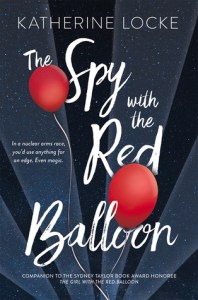 I struggle a lot with terminology in historical fiction. A lot of it, including phrases which marginalized people used to self-identify, would be considered slurs and harmful now. And sometimes, people just didn’t have the language we have now. I try to describe how they feel instead, being as precise as possible. I was more vague with Wolf (my demisexual MC in Spy) at first and my editor asked me to be MORE explicit. I balked at first, mostly because I think it’s hard to describe demisexuality on the page (I am demisexual and I wrote Wolf’s ID largely from my experience). But I’m glad I did because that’s been something readers really connected with. But Wolf uses the word ‘queer’ because that’s the word that came up frequently in my research that I could be comfortable with, versus other words I wasn’t comfortable putting on the page. Ilse doesn’t have the word “bisexual” but says she likes some girls the way she likes some boys.
Spy was the first time I’d written queer main characters. I really loved writing those queer relationships that felt bold and brave and hopeful in that book because a lot of that book is grim and dark. When I think about the book, I think about those quiet, gentle moments between those characters–Ilse and Polly’s first kiss, Wolf asking Max if he volunteered to be a pilot because Wolf was on the mission, Ilse teasing Wolf and Max, the last scene that I can’t talk about because spoilers. Those relationships got me through the dark parts of writing the book. And they were often the first scenes to come to me. Writing SPY was a really hard process and I wrote it in a pretty chaotic fashion. But Ilse and Polly’s first kiss has been there from the first draft, written exactly as it is now. Those are the lights in the dark. (Tl;dr: writing the queer relationships in SPY gave me the same joy writing fanfic does.)
Like our most recently featured author, you’ve got a short story in the upcoming Out Now, edited by Saundra Mitchell. What can you tell us about it?
Ahhh! I can tell you…that technically it lives in the same universe as my short story in It’s A Whole Spiel! There’s an overlapping coffee shop, because queer coffee shop AUs are the best? The Out Now story is called ‘Seditious Teapots’ because the main character, Rory, collects teapots. They don’t drink tea. They just like teapots. (Their mom does not get it.)
I’m not sure everyone realizes this, but back when YA Pride had a book club, you were its spectacular moderator! Any advice for someone seeking to do a queer book club, and any recommendations that sparked particularly interesting conversation?
Yes! I did that for many years, actually. I would use this lovely website, LGBTQReads as a great resource, if I was running a book club now. And I would talk and communicate with the group members! Some people really don’t want to read any stories in which queer characters come up against tragedy or hate, and that’s totally fair! Some people aren’t into coming out stories. That’s also okay. It’s good to know what your group’s hard limits are. Book recommendations: all of Ashley Herring Blake‘s books sparked great conversation, as did A Line In The Dark by Malinda Lo. I think that one makes a particularly good book club book because it gets that true crime x lgbtqreads crossover. Plus that cover literally sends shivers down my spine.
Your books require a lot of research, and your writing schedule requires a lot of discipline. What are your favorite resources for looking up historical details, and your favorite resources and tricks for staying on track?
I wish I had all the discipline my writing schedule requires! I do a lot of reading for my books. I think the book I’m researching now is going to end up being about 22 books in total. And then there’s the movies, tv shows, articles online, and interviews. I borrow books from the library when I think I can read it, get the general gist and won’t need to touch it again. I buy them when I think I’ll need to reference them again and again. I have a pretty good memory so for the most part, I highlight and bookmark. I only write down the timeline of the events because I do not have the brain for dates/years/times/etc (a problem for my previous two YA novels which were time travel books…)
I have a rule that I read 3 sources before I begin, and the rest I read as I go along. Otherwise, I’ll drown in the research and never surface to write the book. So I usually try to read an overview of the time or event, a personal memoir or biography, and then something broader about that time period in the world OR the time period right before the time period I’m writing about (history builds on what came before it. You can’t write historical fiction and only read about that ONE time period.)
I flag things in manuscripts as I first-draft so that I don’t slow myself down. Part of my problem is my brain gets distracted very easily (ADHD, and also, our brains are being rewired by our technology to have shortened attention spans). So if I open up a tab to look up a street name, I’ll end up with ten tabs open, buying a rug, researching swimsuits, and in a twitter argument. It’s best if I just put [STREET NAME] in my document, and fill it in later in revisions. Everything can be fixed in revisions. EVERYTHING.
What’s the first LGBTQIAP+ representation you recall in media, for better or for worse?
I think Jack? From Will & Grace. I can’t think of one earlier. I certainly didn’t read one in books until college, I think. Or one that I recognized. I suppose in retrospect there’s a lot of queer coding that I did not catch.
Naturally, you’re one of my favorite people to talk upcoming books with, so I have to ask: what are you really excited about this fall and in 2020?
OKAY. I’m excited for everyone to read The Starless Sea by Erin Morgenstern (which has a gay protagonist!) because it is simply stupendous. I’m also excited to read Gideon The Ninth which I’ve heard great things about. I have not read, but am absolutely dying to read, King and the Dragonflies by Kacen Callender. Kace is one of my favorite kidlit writers (they also have an adult novel called Queen of the Conquered coming out this fall I think that I want to dive into!) and King looks lush and magical and heartfelt. I am also DYING-ACTUALLY DYING to get my hands on Julian Winters’ next book How To Be Remy Cameron! I loved his debut, Running With Lions, so much and I just want to shove his books into everyone’s hands. And I’m excited to read By Any Means Necessary because bees! (BEES!) Also: Crier’s War. That’s on my list. (I’m just scrolling through pre-orders right now.) Jackpot by Nic Stone because the voice in Dear Martin blew me away and I just want to get sucked in like that again. OH and The Bone Houses by Emily Lloyd Jones because I try to read one creepy book each year even though I don’t do creepy well, and this is my pick this year. But I’m in it to win it because I’ve been promised an undead goat. [Blogger’s Note for readers: Those last three are not queer books, AFAIK, though both authors do have other queer work! I forgot to specify the queer part in my question.]
Also I hear there’s a really amazing Edgar Allen Poe anthology that’s coming out? His Hideous Heart! That’s the one. So I guess I’m going to get creeped out TWICE this fall. *shivers* *buys more blankets and hot chocolate to make up for it*
What’s up next for you?
*nervous laugh* UHHHHH. It’s A Whole Spiel is out on September 17th, and Out Now is out in May 2020. I am breaking out in my picture book debut in spring 2021 (!!!). And right now, I’m hard at work on another novel! It’s adult, historical fantasy (similar vein as the Balloonmakers books but with a weirder magic system), and I love it very, very much. It’s so weird. It’s so historical. That’s my favorite.
***
Katherine Locke lives and writes in Philadelphia, Pennsylvania with their feline overlords and their addiction to chai lattes. They are the author of The Girl with the Red Balloon, a 2018 Sydney Taylor Honor Book and 2018 Carolyn W. Field Honor Book, as well as The Spy with the Red Balloon. They are the co-editor and contributor to It’s A Whole Spiel: Love, Latkes and Other Jewish Stories, and a contributor to Unbroken: 13 Stories Starring Disabled Teens. They not-so-secretly believe most stories are fairytales in disguise. They can be found online at KatherineLockeBooks.com and @bibliogato on Twitter and Instagram.
 Keep faith, in the broad sense of the word. It doesn’t have to be a religion, unless you want it to be. It doesn’t have to speak about the universe, unless you want it to. It doesn’t have to be about anyone but yourself. Keep faith, in other planets and other houses; be it in the face of danger, grief, or while you spread your arms and laugh. Keep faith the same way you keep hope, bright and shiny, ever present. Keep faith in all your queer, beautiful self. Because you deserve it.
 For Teodora DiSangro, a mafia don’s daughter, family is fate.
 Mokoya and Akeha, the twin children of the Protector, were sold to the Grand Monastery as children. While Mokoya developed her strange prophetic gift, Akeha was always the one who could see the strings that moved adults to action. While his sister received visions of what would be, Akeha realized what could be. What’s more, he saw the sickness at the heart of his mother’s Protectorate.
 Destiny sees what others don’t.
 Fifteen-year-old Kivali has never fit in. As a girl in boys’ clothes, she is accepted by neither tribe, bullied by both. What are you? they ask. Abandoned as a baby wrapped in a T-shirt with an image of a lizard on the front, Kivali found a home with nonconformist artist Sheila. Is it true what Sheila says, that Kivali was left by a mysterious race of saurians and that she’ll one day save the world? Kivali doesn’t think so. But if it is true, why has Sheila sent her off to CropCamp, with its schedules and regs and what feels like indoctrination into a gov-controlled society Kivali isn’t sure has good intentions?
 If you look for yourself in the past and see nothing, how do you know who you are? How do you know that you’re supposed to be here?
 A teen rockstar has to navigate family, love, coming out, and life in the spotlight after being labeled the latest celebrity trainwreck in Jen Wilde’s quirky and utterly relatable novel.
 Behrouz Gets Lucky is a romantic, literary, kinky, and political novel about two older San Francisco queers – a butch dyke gardener named Lucky and a genderqueer librarian named Behrouz. A coffee date at Café Flore in the Castro, sparks a fiery trans masculine relationship that ends with the couple eating falafel in bed at 3 am half way around the world in a hotel room in Tehran. Forced gentrification in modern San Francisco goads Behrouz and Lucky to find their own uniquely sexual way of reclaiming the city’s lost queer spaces. Behrouz Gets Lucky is also tenderly sensual – an immersive novel, full of fragrances, delicious food, delirious sexual touch, dandy fashion, and beauty.
 Non-binary poet Cyrus Parker returns with an all-new collection of poetry and prose dedicated to those struggling to find their own identity in a world that often forces one into the confines of what’s considered “socially acceptable.”
 A gender-confused farmer desperate to reclaim her farm and escape her stepparents’ abuse. A closeted prince more interested in helping his people than finding a bride. A fairy godfather with a ton of secrets and no powers. In this diverse fairy tale, everyone is searching for a happy ending.
 Odd-mannered, obsessive, withdrawn, Aster has little to offer folks in the way of rebuttal when they call her ogre and freak. She’s used to the names; she only wishes there was more truth to them. If she were truly a monster, as they accuse, she’d be powerful enough to tear down the walls around her until nothing remained of her world, save for stories told around the cookfire.
 Join us on the adventures of young demon hunters, star-crossed Viking lovers, and cyberpunk street artists as we invite you into new worlds where brave heroes with diverse queer identities demonstrate the strength of their hearts and the power of their dreams!


 When Ben De Backer comes out to their parents as nonbinary, they’re thrown out of their house and forced to move in with their estranged older sister, Hannah, and her husband, Thomas, whom Ben has never even met. Struggling with an anxiety disorder compounded by their parents’ rejection, they come out only to Hannah, Thomas, and their therapist and try to keep a low profile in a new school.


 In 1890, Rose Cleveland, sister of President Grover Cleveland, began writing to Evangeline Simpson, a wealthy widow who would become the second wife of Henry Whipple, Minnesota’s Episcopal bishop. The women corresponded across states and continents, discussing their advocacy and humanitarian work—and demonstrating their sexual attraction, romance, and partnership. In 1910, after Evangeline Whipple was again widowed, the two women sailed to Italy and began a life together.
 Twisted Wishes bass player Mish Sullivan is a rock goddess—gorgeous, sexy and comfortable in the spotlight. With fame comes unwanted attention, though: a stalker is desperate to get close. Mish can fend for herself, just as she always has. But after an attack lands her in the hospital, the band reacts, sticking her with a bodyguard she doesn’t need or want.
 Much to her father’s dismay Lady Louisa Adele Kathryn Present is quite solidly on the shelf. She shows no interest in finding a husband after three long seasons of, well, not particularly trying.
 Me, Myself, They: Life Beyond the Binary chronicles Joshua M. Ferguson’s extraordinary story of transformation to become the celebrated non-binary filmmaker, writer, and advocate for trans rights they are today. Beginning with their birth and early childhood years of gender creativity, Ferguson recounts the complex and often challenging evolution of their identity, including traumatizing experiences with gender conversion therapy, bullying, depression, sexual assault, and violent physical assault. But Ferguson’s story is above all about survival, empathy, and self-acceptance. By combining their personal reflections on what it feels like to never truly fit into the prescribed roles of girl or boy, woman or man, with an informed analysis of the ongoing shifts in contemporary attitudes towards sex and gender, Ferguson calls for recognition and respect for all trans, non-binary, and gender non-conforming people, and an inclusive understanding of the rich diversity of human identity. Through their honest and impassioned storytelling, we learn what it means to reclaim one’s identity and to live beyond the binary.
 Fig, a sixth grader, wants more than anything to see the world as her father does. The once-renowned pianist, who hasn’t composed a song in years and has unpredictable good and bad days, is something of a mystery to Fig. Though she’s a science and math nerd, she tries taking an art class just to be closer to him, to experience life the way an artist does. But then Fig’s dad shows up at school, disoriented and desperately searching for Fig. Not only has the class not brought Fig closer to understanding him, it has brought social services to their door.
 Regal romance abounds in this flirty, laugh-out-loud companion novel Royals, by New York Times bestselling author Rachel Hawkins.
 Laura Dean, the most popular girl in high school, was Frederica Riley’s dream girl: charming, confident, and SO cute. There’s just one problem: Laura Dean is maybe not the greatest girlfriend.
 For sixteen years, Nate was the perfect son—the product of a no-nonsense upbringing and deep spiritual faith. Then he met Cam, who pushed him to break rules, dream, and accept himself. Conflicted, Nate began to push back. With each push, the boys became more entangled in each others’ worlds…but they also spiraled closer to their breaking points. And now all of it has fallen apart after a fistfight-turned-near-fatal-incident—one that’s left Nate with a stab wound and Cam in jail.
 Perpetually awkward Nima Kumara-Clark is bored with her insular community of Bridgeton, in love with her straight girlfriend, and trying to move past her mother’s unexpected departure. After a bewildering encounter at a local festival, Nima finds herself suddenly immersed in the drag scene on the other side of town.
 An adaptation of Shaftesbury’s award-winning, groundbreaking queer vampire web series of the same name, Carmilla mixes the camp of Buffy the Vampire Slayer, the snark of Veronica Mars, and the mysterious atmosphere of Welcome to Nightvale.
  Thelia isn’t in line to inherit the crown, but she’s been raised to take power however she can. She’s been friends with Princess Corene her whole life, and she’s scheming to marry Bayled, the heir to the throne. But her plans must change when an army of elves invades the kingdom.
 A young woman and her wife’s attempts to have a child unfold in this poetic tale that ebbs and flows like the sea.
 In her powerful debut collection of poetry, Arielle Twist unravels the complexities of human relationships after death and metamorphosis. In these spare yet powerful poems, she explores, with both rage and tenderness, the parameters of grief, trauma, displacement, and identity. Weaving together a past made murky by uncertainty and a present which exists in multitudes, Arielle Twist poetically navigates through what it means to be an Indigenous trans woman, discovering the possibilities of a hopeful future and a transcendent, beautiful path to regaining softness.
 Seventeen-year-old internet video star Fit is on a mission to become famous at all costs. She shares her life with her fans through countless videos (always sporting some elaborate tinfoil accessory), and they love her for it. If she goes viral, maybe she can get out of her small casino town and the cramped apartment she shares with her brother and grandpa. But there’s one thing Fit’s fans don’t know about her: when Fit was three-years-old, her mother, suffering from postpartum psychosis, tried to kill her.


 “A Play in Many Parts” is…sort of a Faustus retelling. Or a number of retellings all tangled together and on the page at onceIt’s a love letter to (Marlowe’s version of) the play, and to theatre itself…a tale of bargaining for one more curtain call, whoever you are.
 Honestly, while I’m intensely proud of those books in and of themselves, the world – and publishing – has shifted since I wrote those stories. Everything I’m working on at the moment is much closer to home, and I’d rather concede the floor to own-voices representation, for now.
 Uhhh. I think I discovered Boys don’t Cry and Priscilla in the same week O_o.
 Fox Benwell is a perpetual student of the world, a writer, adventurer, and wannabe-knight, who holds degrees in international education and writing for young people, and believes in the power of both to change the world. His in-progress PhD research examines disability in current YA fiction.